
India's highway network is growing at a pace unmatched anywhere in the world. With over 1,46,000 kilometres of national highways forming the backbone of trade, connectivity, and economic growth, and the government adding thousands of kilometres every year, the challenge is no longer simply building roads — it is building them to specification, maintaining them through their full lifecycle, and ensuring that both government authorities and private concessionaires can demonstrate quality and compliance at every stage.
The Hybrid Annuity Model (HAM) is a Public-Private Partnership framework introduced by India's National Highways Authority of India (NHAI) in January 2016. It combines elements of the Engineering, Procurement, and Construction (EPC) and Build-Operate-Transfer (BOT) models to balance risk and investment between the government and private developers.
In HAM, the project cost is shared between the government and the private developer in a 40:60 ratio. The government pays 40% of the project cost during construction and the remaining 60% as annuity payments over the concession period. Toll collection responsibilities lie with the government, insulating the private developer from traffic and revenue risks, while the developer handles construction and maintenance risks.
This structure spanning a concession period of construction plus 15 years of operations creates a monitoring challenge of extraordinary scope and duration. Unlike EPC contracts where the government's quality obligation effectively ends at handover, HAM concessionaires remain responsible for the condition and performance of the road they build for the entire concession period. Annuity payments are linked to performance. Poor maintenance standards can trigger payment deductions. And NHAI's oversight obligation does not diminish after the ribbon is cut it intensifies.
Traditional quality monitoring periodic site visits, laboratory testing records, manual inspection reports was designed for a world of shorter contracts and simpler oversight relationships. For HAM, it is structurally insufficient. What this model demands is continuous, evidence-backed, standards-aligned monitoring across both the construction and the operational phases of a concession that may span two decades.
This is precisely what RoadVision AI's suite of AI agents is built to deliver.
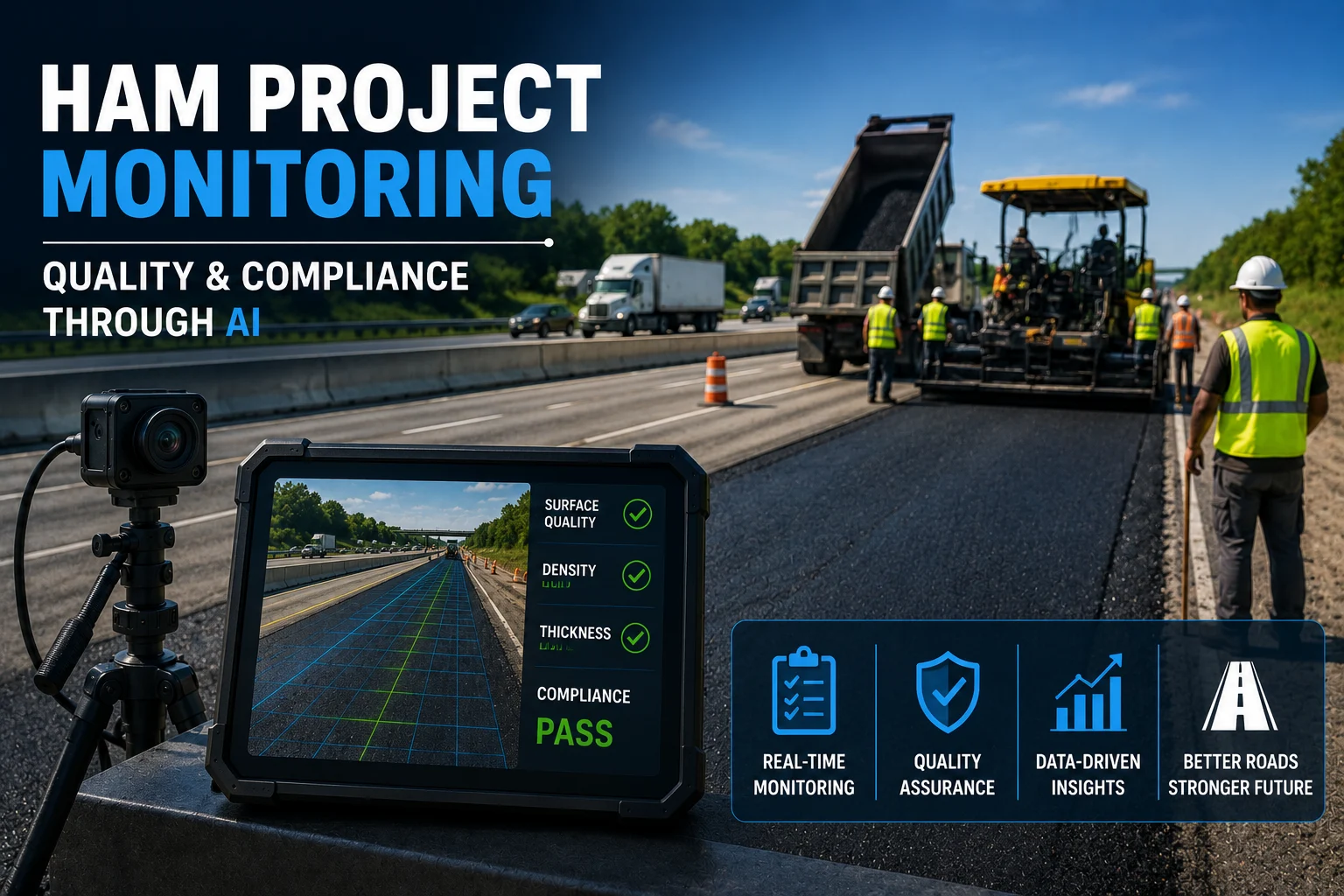
Before examining how AI transforms HAM monitoring, it is essential to understand the quality and compliance obligations that govern these projects — because RoadVision AI's platform is built to address them specifically, not generically.
The MoRTH Quality Assurance Manual and IRC codes require contractors to implement systematic testing of aggregates, bitumen, soil compaction, and pavement layers during highway construction. Independent engineers also carry out random inspections to validate results.
Quality compliance on NHAI projects means strictly following all the promises made in the contract, all the rules from MoRTH, the detailed NHAI specifications, and NHAI's own guidelines. Non-compliance has serious consequences: mandatory rectification of faulty work at the contractor's expense, withholding of payments, financial penalties (liquidated damages), contract termination in severe cases, and even blacklisting of contractors or consultants from future NHAI projects.
For HAM projects specifically, the payment milestone structure intensifies the compliance stakes. The release of construction support payment is divided into ten equal instalments, each dependent upon the successful accomplishment of specific project milestones. A milestone certification that fails quality inspection means a delayed payment directly impacting the concessionaire's cash flow and debt service capacity.
HAM's operational phase compliance obligations are equally demanding. Performance obligations by developers can result in deduction of annuity payments where maintenance standards fall below contractual thresholds. Road roughness (IRI), pothole density, signage condition, drainage integrity, and pavement marking retroreflectivity are all subject to periodic assessment by Independent Engineers appointed by NHAI and findings of non-compliance translate directly into revenue consequences for the concessionaire.
O&M cost increases for stretches dominated by heavy vehicles and highways falling under higher economic resilience areas. In zones of high precipitation, possibilities of moisture percolating to the bituminous layer result in higher O&M and major maintenance expenses. Concessionaires who built to a marginally acceptable standard rather than to full specification during construction frequently discover that their O&M costs in the operational phase substantially exceed their bids a risk that data-driven construction quality monitoring directly reduces.
Every HAM project involves an Independent Engineer (IE) appointed by NHAI to monitor construction quality and certify milestone completions. The IE is the formal quality assurance gatekeeper but the IE's capacity for continuous, network-level oversight is inherently limited. IEs conduct periodic site inspections, review test records, and certify milestones, but they cannot be physically present at every pour of concrete, every asphalt layer, every compaction pass. The documentary evidence they review is largely self-reported by the contractor.
This creates a systematic information gap between what the contract requires and what the IE can actually verify through periodic visits a gap that AI-powered continuous monitoring is purpose-built to close.
The quality monitoring challenges HAM projects face are not a consequence of bad intentions or inadequate standards. They are a direct consequence of applying monitoring systems designed for simpler, shorter contracts to a project model with fundamentally different requirements.
Coverage gaps between inspection visits. A construction site may be visited by an Independent Engineer once a week or once a fortnight. In the intervals between visits, multiple critical construction activities occur sub-base laying, WMM spreading, bituminous layer application, compaction passes that directly determine the long-term quality and durability of the finished road, but are never directly observed by any third-party assessor.
Self-reported test data is difficult to verify. The MoRTH quality framework requires contractors to maintain detailed test logs for every material and every construction layer. In practice, these records are maintained by the contractor's own quality team and submitted to the IE for review. The IE cannot independently verify every test record and the incentive structure is not always well aligned with complete, accurate reporting. AI-based construction monitoring provides an independent, continuous data stream that cross-checks reported activity against observed physical progress.
Layer-by-layer compliance is invisible after completion. Once a pavement layer is covered by the next layer, its quality becomes effectively unverifiable by any non-destructive method. The only opportunity to confirm that the base course was laid to the correct thickness, at the correct temperature, with the correct compaction passes, is during the narrow window when that layer is being placed. Manual inspection misses most of that window. Continuous AI monitoring does not.
Operational monitoring is episodic and reactive. Periodic NHAI condition surveys which form the basis for annuity deduction assessments — are typically conducted on annual or semi-annual cycles. Road condition can deteriorate significantly between survey cycles, and a concessionaire who is not monitoring their own network continuously may discover compliance shortfalls only when the IE's periodic survey produces an annuity deduction notice. By then, the condition has already deteriorated beyond the threshold, and emergency intervention is required at far higher cost than preventive maintenance would have been.
Documentation is fragmented across the project lifecycle. A HAM concession generates an enormous volume of quality documentation — test certificates, inspection reports, milestone completion records, maintenance logs, incident reports. Managing this documentation consistently across a concession period of 15–20 years, in a form that remains accessible and auditable, is a significant operational challenge that most concessionaires manage through a combination of manual filing systems and disconnected digital tools.
RoadVision AI's Construction Monitoring Agent and the broader platform ecosystem address each of these gaps through a structured, AI-driven monitoring pipeline that covers both the construction and operational phases of a HAM concession.
RoadVision AI's Construction Monitoring Agent uses satellite imagery, dashcam footage from site vehicles, and drone data to autonomously monitor project progress, quality, and compliance across construction stages providing continuous visibility into construction activity without requiring dedicated inspection visits.
Satellite imagery provides a broad, daily overview of earthwork progress, material stockpile locations, and construction front advancement across the project corridor giving project owners and NHAI an independent, objective record of physical progress that is not dependent on contractor reporting. Drone imagery provides detailed, high-resolution coverage of specific active work fronts, capturing the visual evidence of layer placement, compaction activity, and quality-critical construction events at a level of detail satellite imagery alone cannot deliver.
By combining advanced imaging, data analytics, and connected devices, highway construction AI technology is enabling project owners, contractors, and governments to deliver smart roads in India with assured quality, improved safety, and optimized costs.
For the most quality-critical construction events subgrade preparation, granular sub-base laying, wet mix macadam spreading, bituminous layer application, and final wearing course. R oadVision AI's platform creates a continuous visual and sensor evidence record. This record serves multiple functions simultaneously: it provides the contractor with real-time quality feedback, gives the Independent Engineer a verifiable evidence base for milestone certification beyond contractor-supplied records, and creates a long-term audit trail that can be referenced throughout the concession period if questions arise about construction quality.
<cite index="20-1">Cameras, IoT sensors, and cloud-based dashboards continuously record material usage, layer thickness, temperature control, and compaction quality, creating an evidence-based audit trail that supports road authorities in verifying quality in real time.</cite>
All monitoring data flows into RoadVision AI's centralized compliance dashboard, giving project stakeholders the concessionaire, the Independent Engineer, NHAI, lenders, and equity investors a role-appropriate, real-time view of project status against the quality and schedule milestones defined in the concession agreement.
Advanced quality monitoring techniques including Independent Quality Auditors, laboratory testing, and modern technologies like drones and sensor-based systems provide comprehensive oversight.RoadVision AI's platform provides the continuous data infrastructure that makes these traditional quality assurance tools more effective surfacing issues in real time rather than at the next scheduled inspection.
The dashboard presents construction progress against scheduled milestones, quality indicator trends, flagged deviations from specification, pending rectification actions, and upcoming milestone certification events giving every stakeholder the information they need without requiring manual report compilation.
Once a HAM project enters its operational phase, the monitoring focus shifts from construction quality to ongoing pavement and asset condition. RoadVision AI's Pavement Condition Intelligence Agent takes over the primary monitoring role, processing dashcam footage from maintenance vehicles already operating on the concession to generate continuous pavement condition data.
This continuous monitoring serves the concessionaire directly: rather than discovering IRI or pothole density non-compliance when an NHAI periodic survey triggers an annuity deduction, the platform gives the operations team the same information the IE's survey would produce updated continuously, available weeks or months before any formal survey, enabling preventive maintenance intervention before compliance thresholds are breached.
The agent evaluates pavement condition against MoRTH, IRC, and AASHTO standards, producing condition scores, deterioration trend charts, and maintenance priority rankings that directly inform the concessionaire's O&M programme. Historical condition records are maintained automatically, providing an audit-ready record of the concessionaire's monitoring and maintenance activity throughout the concession period.
HAM concession obligations extend beyond pavement surface to the full portfolio of roadside assets signs, barriers, delineators, drainage structures, embankments, and pavement markings. RoadVision AI's Roadside Assets Inventory Agent maintains a continuously updated digital inventory of all assets within the concession corridor, tracking condition changes and flagging items that have deteriorated below contractual maintenance standards.
<cite index="19-1">Vision-based surveillance and adaptive analytics assist in detecting unsafe conditions, supporting investigations and monitoring compliance</cite> across the full asset portfolio not only the pavement surface that periodic surveys typically focus on.
RoadVision AI's Enterprise DMS & Workflow Agent provides the document management backbone for the full HAM lifecycle, maintaining a structured, version-controlled repository of all project documentation with Design–As-Built–As-Maintained traceability. This traceability is critical for HAM projects, where the quality decisions made during design and construction have direct long-term consequences for maintenance cost and annuity payment security.
When a maintenance issue arises in the operational phase a recurring pavement failure at a specific chainage, for instance the system enables engineers to trace back through the design specifications and construction records for that location, identifying whether the issue reflects a maintenance shortfall or an underlying construction quality problem. This traceability is essential for managing disputes between the concessionaire and NHAI, and for directing warranty claims against construction contractors where applicable.
The National Highways Authority of India has already deployed AI in its Project Management Information System (PMIS), automating construction audits and enabling proactive intervention in cases of quality deviation.RoadVision AI's platform is built to produce outputs compatible with NHAI's reporting requirements, enabling concessionaires and Independent Engineers to fulfill their PMIS reporting obligations directly from the platform reducing the administrative overhead of maintaining a separate reporting layer alongside operational monitoring.
For Concessionaires-Continuous construction monitoring software reduces rework risk and the financial exposure of milestone payment delays caused by quality non-compliance. Continuous operational monitoring enables early intervention before annuity deduction thresholds are breached. And end-to-end documentation traceability provides the audit defense capability essential for managing the disputes that arise in any long-duration concession relationship.
For Independent Engineers-AI-generated, continuously updated condition data and construction progress evidence gives IEs a far richer information base for milestone certification and periodic compliance assessments than periodic site visits alone can provide enabling more confident, defensible certification decisions.
For NHAI and MoRTH-Network-wide quality intelligence derived from continuous AI monitoring supports MoRTH's goal of evidence-based infrastructure governance. Initiatives such as the Ministry of Road Transport and Highways' AI-MC platform use GPS-enabled compactors and drone-based pavement surveys to optimize road construction demonstrating the alignment between AI-driven quality monitoring and the direction of national highway governance in India.
For Lenders and Equity Investors-HAM projects attract lender scrutiny around construction quality risk and operational cash flow reliability. Continuous, independent monitoring data provides lenders and rating agencies with objective evidence of project performance that reduces monitoring risk and supports more accurate, timely assessment of construction completion and operational performance milestones.
Providing partial funding mitigates financial risks and establishes a sustainable investment structure. Deep expertise in operation and maintenance ensures consistent, proactive upkeep of assets throughout the concession period, maximizing their performance and longevity.- AI-powered road monitoring is the operational tool that makes this commitment tangible and verifiable.
Pre-Construction Baseline Documentation-Before construction begins, drone and satellite surveys establish a detailed baseline record of existing road conditions, land acquisition status, utility locations, and encroachment situations providing an objective reference point for construction commencement and an evidence base for land-related claims during execution.
Active Construction Phase Monitoring-Daily satellite passes track overall construction front progress across the project corridor. Weekly drone flights cover active work fronts in high detail. Site vehicle dashcam footage provides continuous visual evidence of material handling, layer placement, and compaction activity. All data flows into the compliance dashboard in near-real time.
Milestone Certification Support-As construction milestones approach, RoadVision AI generates milestone-specific condition and progress reports aligned with NHAI's certification requirements giving the IE a structured, evidence-backed package for milestone review rather than relying solely on contractor-compiled documentation.
Operational Condition Monitoring-Throughout the 15-year operational phase, monthly or more frequent pavement condition surveys conducted by maintenance fleet vehicles equipped with dashcams feed continuous IRI and distress data into the platform supporting both proactive O&M planning and NHAI periodic survey preparation.
Annuity Payment DefenseWhen NHAI periodic surveys produce condition assessments that the concessionaire disputes, the platform's continuous historical condition record provides the evidence base for a structured, data-backed response demonstrating the road's condition trajectory and the maintenance interventions applied.
The Hybrid Annuity Model represents India's most sophisticated framework for highway development aligning government support with private sector execution capability and distributing risk in a way that has successfully revived private investment in national highway infrastructure. But sophistication in contracting demands sophistication in monitoring. A framework that makes annuity payments conditional on quality performance, and that holds concessionaires accountable for road condition across a 15-year operational period, requires monitoring systems that are continuous, standards-aligned, evidence-based, and built for the long haul.
Traditional monitoring approaches periodic site visits, self-reported test records, annual condition surveys were designed for contracts with simpler, shorter accountability horizons. For HAM, they leave too many gaps, catch problems too late, and create too little audit trail to support the dispute resolution and regulatory accountability that long-duration concessions inevitably require.
RoadVision AI's autonomous AI agent platform closes those gaps providing continuous construction quality monitoring, real-time compliance dashboards, continuous operational condition surveillance, and end-to-end document traceability across the full HAM lifecycle. Whether you are a concessionaire protecting annuity revenue, an Independent Engineer discharging certification obligations, a lender monitoring construction risk, or an NHAI official ensuring that India's highways are built and maintained to the standard the public deserves, RoadVision AI delivers the quality intelligence that makes HAM projects perform as the model intends.
Ready to bring AI-powered monitoring to your HAM project? Contact RoadVision AI today to discuss your concession requirements or arrange a platform demonstration.
HAM is a Public-Private Partnership framework where the project cost is shared between the government and private developer in a 40:60 ratio. The government pays 40% during construction as milestone-linked instalments and the remaining 60% as annuity payments over a 15-year operational concession. This structure means the concessionaire remains financially accountable for road quality for the entire concession period — making continuous, standards-aligned quality monitoring an operational necessity, not just a contractual formality.
The platform ingests data from satellite imagery, drone flights, and dashcam footage from vehicles already operating on site, processing it through RoadGPT against MoRTH, IRC, and NHAI quality standards. This produces a continuous, evidence-backed construction progress and quality record accessible to all project stakeholders concessionaire, Independent Engineer, and NHAI through a role-appropriate dashboard interface.
Yes. RoadVision AI generates milestone-specific condition and progress reports aligned with NHAI certification requirements, providing Independent Engineers and NHAI with structured, AI-generated evidence packages that supplement traditional inspection and testing records making milestone certification faster, more defensible, and less dependent on contractor self-reporting alone.
The Pavement Condition Intelligence Agent processes dashcam footage from maintenance fleet vehicles to generate continuous IRI and pavement distress data. This gives concessionaires the same condition intelligence that NHAI's periodic surveys would produce updated continuously, enabling proactive maintenance before thresholds that trigger annuity deductions are breached.

The Autonomous Road Engineer
AI-powered road condition monitoring, asset management, & infrastructure intelligence helping agencies move from reactive maintenance to predictive road management.


.webp)
.webp)
.webp)