
Not all cracks in a road surface mean the same thing. A spiderweb of interconnected cracking near the center of a traffic lane tells a very different engineering story than a straight line of cracking running perpendicular to the direction of travel, or a network of rectangular blocks spread evenly across an entire lane. Each crack pattern has a distinct underlying cause structural fatigue, thermal contraction, poor edge support, material aging and correctly identifying which type you're looking at is essential for selecting the right repair treatment and understanding what it signals about the pavement's overall health.
This is also one of the areas where AI-powered computer vision has made genuine, measurable progress: modern models can now distinguish between crack types with a level of consistency that's difficult to achieve through manual visual inspection alone, especially at scale. In this blog, we'll walk through the four major crack types fatigue, block, edge, and transverse covering what causes each one, how to recognize it, what it means for pavement condition, and how AI models are trained to detect and classify them.
Before diving into individual crack types, it's worth understanding why classification not just detection is so important in pavement management:
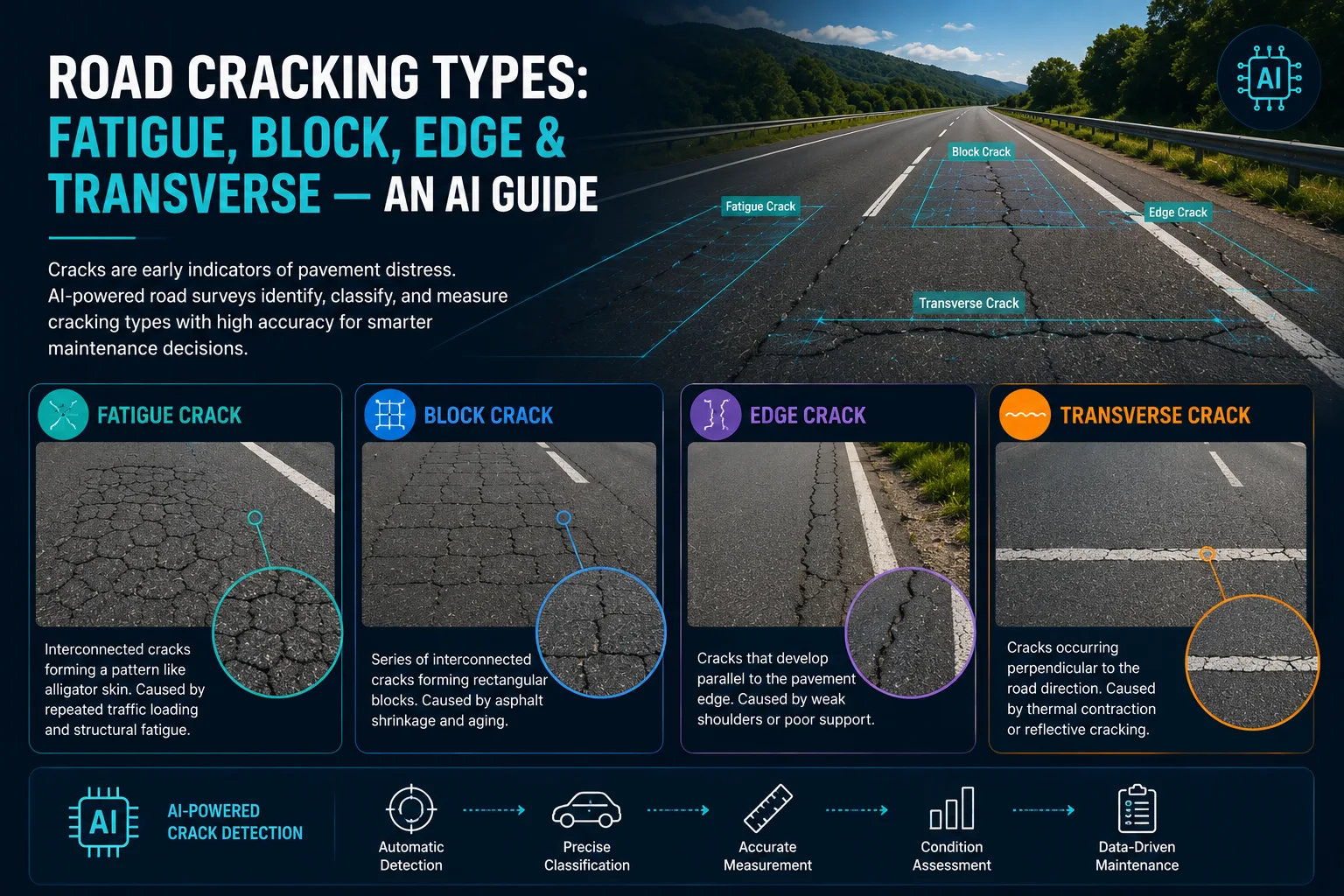
Fatigue cracking, often called alligator cracking due to its resemblance to reptile skin, appears as a series of interconnected cracks forming a pattern of small, roughly rectangular or polygonal pieces. It typically begins as a series of parallel longitudinal cracks that eventually connect with transverse cracks, forming the characteristic interlocking pattern.
Fatigue cracking is fundamentally a structural distress, caused by repeated traffic loading that exceeds the pavement's structural capacity over time. It typically originates at the bottom of the asphalt layer and propagates upward, meaning that by the time it's visible on the surface, structural damage has often already progressed significantly. Common contributing factors include:
Fatigue cracking most commonly appears in wheel paths, where repeated loading is concentrated, rather than uniformly across the full lane width.
Fatigue cracking is generally considered one of the more serious crack types because it directly reflects structural distress rather than purely surface-level or environmental factors. As it progresses, it typically leads to pothole formation, since the interconnected crack network allows water infiltration and further weakens the surrounding pavement, eventually causing pieces to break loose under traffic loading.
Early-stage fatigue cracking may be addressed with surface treatments or overlays, but more advanced fatigue cracking often requires full-depth repair or reconstruction, since the underlying structural capacity issue isn't resolved by surface-level treatment alone.
Block cracking appears as a series of interconnected cracks that divide the pavement surface into approximately rectangular blocks, typically ranging from roughly 0.3 to 3 meters on each side. Unlike fatigue cracking, block cracking tends to appear relatively uniformly across the pavement, not concentrated specifically in wheel paths.
Block cracking is primarily caused by asphalt binder aging and shrinkage rather than traffic loading. As asphalt binder ages, it loses flexibility and becomes increasingly brittle, causing it to shrink and crack under normal daily and seasonal temperature cycling, independent of the structural loading that drives fatigue cracking. Common contributing factors include:
Because block cracking results from binder aging rather than traffic-related structural stress, it tends to appear across the entire pavement surface relatively uniformly, including areas outside typical wheel paths.
Block cracking is generally considered less severe from a structural standpoint than fatigue cracking, since it doesn't necessarily indicate underlying structural weakness. However, if left untreated, it allows water infiltration into the pavement structure, which can accelerate other forms of deterioration over time.
Block cracking often responds well to preventive treatments like crack sealing or surface treatments applied before the cracking becomes severe, helping to slow water infiltration and extend pavement life without requiring more extensive rehabilitation.
Edge cracking appears as crescent-shaped or straight-line cracks located within roughly 0.3 to 0.6 meters of the outer pavement edge, running roughly parallel to the edge of the roadway.
Edge cracking is typically caused by inadequate lateral support at the pavement edge, often related to insufficient shoulder support, poor drainage near the pavement edge, or vegetation growth that weakens the adjacent support structure. Common contributing factors include:
By definition, edge cracking is located specifically near the outer edges of the pavement, distinguishing it clearly from fatigue cracking's wheel-path concentration or block cracking's more uniform distribution.
Edge cracking severity depends significantly on how far it has progressed toward the traffic lane and whether it has begun to affect structural support beneath the wheel path itself. Left unaddressed, it can progress into more significant edge deterioration and eventually threaten adjacent pavement structural integrity.
Addressing edge cracking often involves improving shoulder support and drainage conditions in addition to direct pavement repair, since simply patching the crack without addressing the underlying edge support issue often leads to recurrence.
Transverse cracking appears as cracks running roughly perpendicular to the direction of traffic, extending across all or part of a traffic lane in a relatively straight line.
Transverse cracking is primarily caused by thermal contraction as pavement temperature drops, particularly during rapid or significant temperature swings, the asphalt contracts and, if it can't accommodate that contraction through flexibility, cracks form. It can also result from reflective cracking, where cracks in an underlying pavement layer (such as an older surface beneath an overlay) propagate upward through subsequent layers. Common contributing factors include:
Transverse cracks typically appear at relatively regular intervals along a pavement segment, spanning across the lane width, and are often more prevalent in regions with significant seasonal temperature variation.
Transverse cracking severity is generally assessed based on crack width and the degree of spalling (breaking away of material) at the crack edges. While often less directly tied to structural loading capacity than fatigue cracking, transverse cracks that are left unsealed allow water infiltration that can contribute to broader pavement deterioration over time, including contributing to base layer weakening beneath the crack.
Crack sealing is a common and effective preventive treatment for transverse cracking when applied while cracks are still relatively narrow, helping prevent water infiltration and associated secondary deterioration.
AI models learn to distinguish crack types by training on large datasets of labeled pavement imagery, where each crack has been manually classified by qualified pavement engineers according to established distress identification criteria. The quality and diversity of this training data directly determines how reliably a model can distinguish between crack types in real-world conditions.
Computer vision models, typically built on convolutional neural network architectures, learn to recognize the distinctive geometric patterns associated with each crack type—the interconnected polygonal structure of fatigue cracking, the larger rectangular blocks of block cracking, the edge-proximate linear pattern of edge cracking, and the perpendicular, regularly-spaced pattern of transverse cracking.
Because crack location within the lane is such a strong indicator of type (wheel path versus full-width versus edge-proximate), effective AI models incorporate positional information within the frame, not just crack shape alone, to improve classification accuracy.
Beyond simply classifying crack type, advanced models estimate severity based on crack width, density, and spalling characteristics, supporting more nuanced condition scoring rather than a simple binary presence/absence determination.
Rather than running separate models for each crack type, most modern systems use multi-class object detection or semantic segmentation models that simultaneously identify and classify multiple crack types within a single pass over the imagery, improving both processing efficiency and consistency.
Because crack appearance can vary meaningfully based on pavement material, regional climate, and imaging conditions, well-maintained AI systems incorporate ongoing model refinement based on real-world performance feedback and expanded training data over time.
Accurate, automated crack type classification directly supports better pavement management outcomes:
Understanding the distinct causes and characteristics of fatigue, block, edge, and transverse cracking isn't just an academic exercise it directly informs how agencies prioritize repairs, select appropriate treatments, and interpret the underlying health of their pavement network. AI-powered computer vision has made significant strides in reliably distinguishing between these crack types at scale, applying consistent classification criteria across entire networks in a way that manual inspection alone struggles to match. As training datasets continue to grow and models are refined further, AI-based crack classification is set to become an increasingly foundational capability within modern pavement management practice.
RoadVision AI's computer vision models are trained to distinguish between fatigue, block, edge, transverse, and other crack types automatically turning raw road imagery into accurate, structured condition data that supports smarter treatment selection and more reliable PCI scoring. Instead of relying on subjective manual classification, get consistent, network-wide crack detection built for real-world pavement conditions.
Want to see AI-powered crack classification applied to your network? Talk to the RoadVision AI team to learn more or request a demo.
1. What is the difference between fatigue cracking and block cracking?
Fatigue cracking (alligator cracking) is caused by repeated traffic loading and indicates structural distress, appearing as an interconnected polygonal pattern concentrated in wheel paths, while block cracking is caused by asphalt binder aging and shrinkage, appearing as larger rectangular blocks spread more uniformly across the pavement.
2. What causes transverse cracking in roads?
Transverse cracking is primarily caused by thermal contraction during temperature fluctuations, and can also result from reflective cracking, where cracks in an underlying pavement layer propagate upward through newer surface layers.
3. Is edge cracking a serious pavement problem?
Edge cracking severity depends on how far it has progressed; if left unaddressed, it can advance toward the traffic lane and threaten structural support, but early-stage edge cracking is often manageable with improved shoulder support and drainage.
4. How does AI distinguish between different types of pavement cracking?
AI models trained on large, labeled datasets learn to recognize the distinctive geometric patterns, locations, and characteristics of each crack type, using computer vision techniques such as convolutional neural networks and location-aware classification.

The Autonomous Road Engineer
AI-powered road condition monitoring, asset management, & infrastructure intelligence helping agencies move from reactive maintenance to predictive road management.


.webp)
.webp)