
Roads are the arteries of modern civilization yet most countries struggle to maintain them. In the United States alone, the American Society of Civil Engineers estimates that 43% of public roads are in poor or mediocre condition, costing motorists billions in vehicle repairs annually. Traditional road inspection methods crews walking with clipboards, slow-moving vans with mounted sensors, or manual photo documentation are expensive, time-consuming, and often inconsistent.
Enter drone road inspection: a rapidly maturing technology that combines unmanned aerial vehicles (UAVs), high-resolution imaging, LiDAR sensing, and artificial intelligence to survey road networks at a fraction of the cost and time. This technical overview breaks down exactly how the process works from flight planning to final report and why engineers, municipalities, and transport agencies are adopting it at scale.
.webp)
A UAV road survey uses unmanned aerial vehicles commonly called drones equipped with specialized sensor payloads to collect georeferenced data about a road's surface condition, geometry, and surrounding environment. Unlike satellite imagery (which lacks resolution) or ground-penetrating radar vans (which are slow and expensive), drones offer a flexible, scalable middle ground.
UAV road surveys typically combine several data types:
Modern UAV platforms like the DJI Matrice 350, senseFly eBee X, or WingtraOne can cover between 100 and 500 acres per flight, depending on altitude, sensor type, and desired resolution. A fixed-wing UAV flying at 120 meters altitude with a 42-megapixel camera can achieve ground sampling distances (GSD) of under 2 centimeters per pixel enough to detect hairline cracks in pavement.
Successful aerial pavement inspection begins long before a drone leaves the ground. The flight planning phase is arguably the most technically demanding part of the workflow.
Engineers define a "survey corridor" typically 20 to 50 meters wide centered on the road using GIS software. Tools like DJI Terra, Pix4Dmapper, or Mission Planner allow operators to import existing road network shapefiles and automatically generate flight paths that maximize coverage while minimizing battery changes.
For survey-grade accuracy, ground control points are placed along the road at regular intervals typically every 300 to 500 meters. These are physical markers (usually high-contrast printed targets) whose GPS coordinates are measured with centimeter-level RTK (Real-Time Kinematic) GPS equipment. GCPs anchor the photogrammetric model to real-world coordinates, ensuring the final maps are geometrically accurate to within 2–5 centimeters horizontally and vertically.
Alternatively, newer UAV systems use PPK (Post-Processed Kinematic) positioning, which logs GNSS data during the flight and corrects it in post-processing, eliminating the need for as many physical GCPs.
Before flying, operators must comply with local aviation authority regulations. In the United States this means FAA Part 107 certification; in the EU, EASA's drone regulations apply. For road surveys, particularly near active traffic, operations may require temporary road closures, coordination with traffic management authorities, and real-time communication with air traffic control if flying near airports.
Once airborne, the UAV executes the pre-planned flight path autonomously, capturing overlapping images at consistent intervals. Here's what's happening technically during this phase:
Cameras are triggered at precise intervals to ensure 70–80% forward overlap and 60–70% side overlap between consecutive frames. This redundancy is essential for photogrammetric reconstruction the process of creating 3D models from overlapping 2D photographs. Without sufficient overlap, the resulting point cloud or orthomosaic will contain gaps or alignment errors.
For a road survey at 2 cm GSD, a typical setup might capture one image every 3–4 seconds while flying at 8 m/s generating thousands of images per flight hour.
When surface geometry is the priority for rutting depth, cross-slope analysis, or International Roughness Index (IRI) estimation LiDAR sensors are mounted alongside or instead of cameras. LiDAR pulses laser beams at 100,000 to 1,000,000 points per second, measuring return times to calculate the exact distance from the drone to the ground surface.
The result is a dense point cloud: a 3D map of billions of individual measured points. From this, engineers can extract:
Thermal cameras detect temperature anomalies that indicate subsurface problems. A delaminating asphalt layer, for example, heats and cools at a different rate than intact pavement, creating a distinct thermal signature. Similarly, areas with subsurface water infiltration appear cooler in thermal imagery.
Multispectral cameras help identify vegetation overgrowth along road shoulders, drainage blockages in ditches, and differential settlement in embankments all of which affect long-term road integrity.
Collecting raw imagery and LiDAR data is only half the challenge. The real technical breakthrough in modern drone road inspection comes from road drone AI machine learning systems trained to automatically detect, classify, and quantify pavement distress from aerial data.
Raw images are first processed through photogrammetry software (Pix4Dmatic, Agisoft Metashape, or RealityCapture) using a process called Structure from Motion (SfM). The software identifies matching features across overlapping images, triangulates the camera positions in 3D space, and generates:
This processing is computationally intensive. A 1,000-image dataset might require 6–12 hours of processing on a GPU-accelerated workstation, or 1–2 hours on cloud infrastructure.
Once the orthomosaic is generated, deep learning models typically convolutional neural networks (CNNs) analyze the imagery pixel by pixel to detect pavement distresses. These models are trained on labeled datasets containing thousands of annotated road images, teaching the AI to distinguish between:
Leading platforms in this space include Roadbotics (acquired by Michelin), Pavemanager, and Verizon Connect's road assessment tools. These systems can process kilometers of road data in minutes, outputting severity ratings aligned with international standards like ASTM D6433 (Pavement Condition Index) or the UK's SCANNER survey methodology.
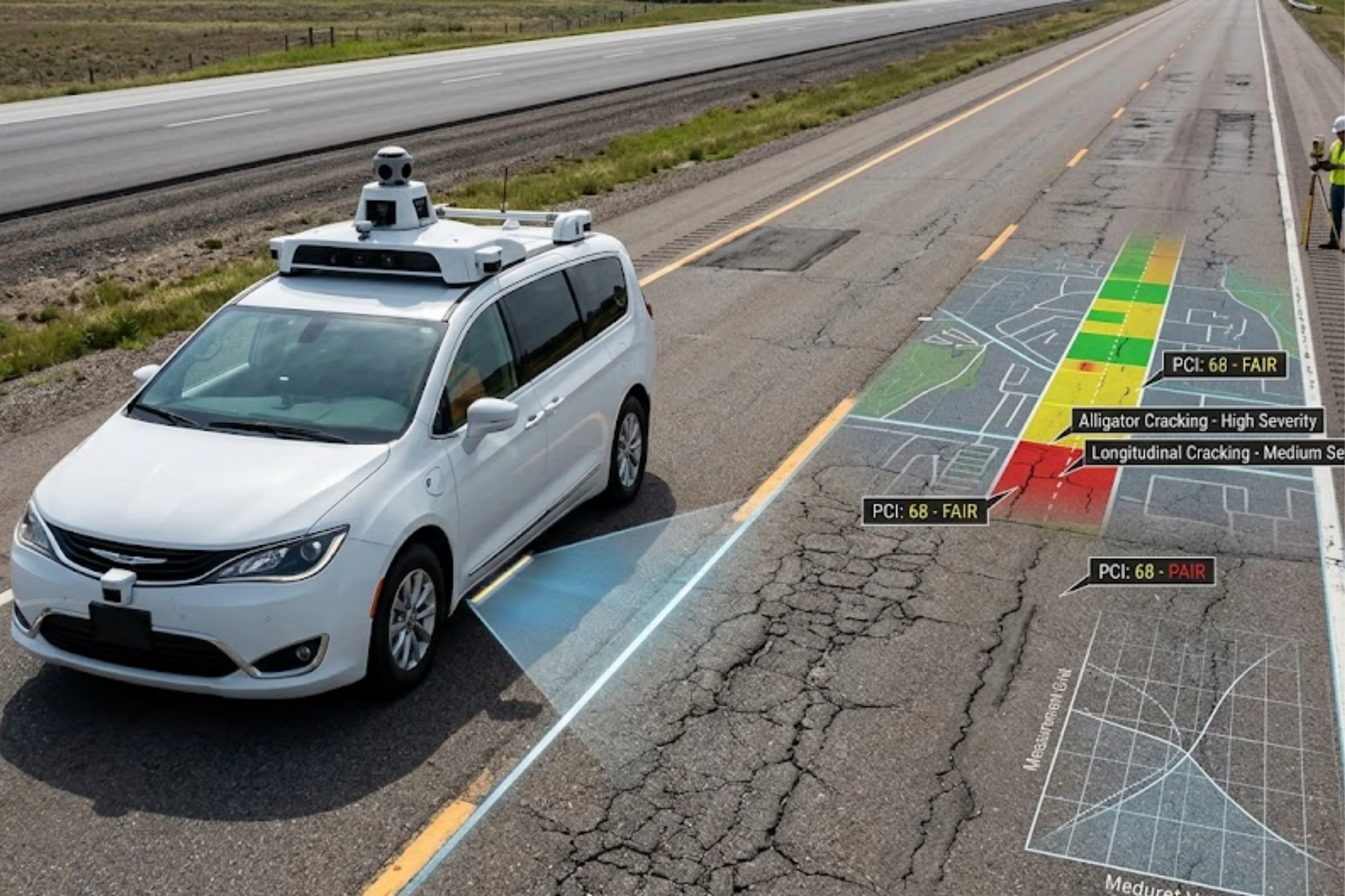
The Pavement Condition Index (PCI) is the most widely used metric in road asset management. Scores range from 0 (completely failed) to 100 (perfect condition), and are calculated based on the type, severity, and density of defects present.
Road drone AI systems can now generate PCI scores automatically for each road segment, color-coded on a GIS map for easy visualization by asset managers. A road segment scoring below 40 is flagged for immediate structural intervention; those scoring 40–70 are candidates for preventive maintenance; and those above 70 need only routine monitoring.
AI-generated road condition data is exported into infrastructure asset management platforms such as IBM Maximo, Cartegraph, or Cityworks, where it feeds directly into maintenance scheduling, budget forecasting, and long-term capital planning. Because UAV road surveys can be repeated annually or even seasonally, asset managers can track the rate of deterioration over time enabling predictive maintenance rather than reactive repair.
Despite its advantages, drone road inspection has real technical limitations that practitioners must account for.
Lighting and weather sensitivity: Camera-based photogrammetry requires consistent lighting. Cloud shadows, direct glare, or wet road surfaces can degrade image quality and confuse AI detection algorithms. Most surveys are conducted under overcast skies (diffuse lighting) to minimize these effects.
Minimum detectable crack width: Even at 2 cm GSD, detecting cracks narrower than 3–5 mm is unreliable. Hairline cracks that a trained inspector on foot might notice can be invisible from the air. This means aerial inspection is best suited for network-level assessment, with ground-level inspection reserved for detailed condition surveys on flagged segments.
Vertical accuracy of LiDAR: Consumer-grade UAV LiDAR systems achieve 3–5 cm vertical accuracy, which is sufficient for pothole detection but may be inadequate for precise rutting measurement in high-speed roads where 2 mm accuracy is sometimes required.
Regulatory constraints: Many countries still restrict BVLOS (Beyond Visual Line of Sight) UAV operations, limiting the efficiency of long corridor surveys and requiring either multiple operators or special waivers.
The economics of UAV road survey are compelling. Traditional road condition surveys using ground-based van-mounted systems typically cost $500 to $2,000 per lane-kilometer, depending on sensor configuration and labor costs. A UAV survey using photogrammetry alone can reduce this to $50–$200 per lane-kilometer a reduction of 60–90%.
Speed is equally dramatic. A two-person drone crew can survey 20–40 lane-kilometers per day in typical conditions. A comparable ground-based survey team might cover 5–10 lane-kilometers per day, and a walking crew even less.
For a medium-sized city managing 500 km of road network, switching from traditional to UAV-based survey methods can save hundreds of thousands of dollars annually while increasing survey frequency catching deterioration earlier, when preventive treatments like crack sealing cost a fraction of full-depth reconstruction.
Drone road inspection has moved well beyond experimental pilots. Today, municipalities from Singapore to Seville, and highway agencies from Australia to Alberta, are integrating UAV road surveys and road drone AI into their standard infrastructure management workflows.
Looking forward, the convergence of autonomous drone swarms (multiple UAVs operating collaboratively), 5G real-time data transmission, digital twin integration, and increasingly accurate AI models promises to push the technology further toward continuous, near-real-time road health monitoring at the network scale.
For engineers, transport planners, and infrastructure managers, the question is no longer whether to adopt aerial pavement inspection it's how quickly to deploy it and how deeply to integrate it into the asset management ecosystem. The roads of tomorrow will be monitored from above, analyzed by AI, and maintained proactively before potholes become crises.
Book a demo with RoadVision AI to explore how AI-powered road inspection can help your city improve road quality, optimize maintenance budgets, and build smarter urban infrastructure.
Drone road inspection is the process of using unmanned aerial vehicles (UAVs) equipped with cameras and sensors to capture detailed data about roads, highways, bridges, and related infrastructure. The collected data is analyzed to identify defects, assess asset conditions, and support maintenance planning.
A typical drone inspection follows these steps:
This workflow enables transportation agencies to monitor infrastructure efficiently and accurately.
Common equipment includes:
The choice of equipment depends on the inspection objectives and project requirements.
Drones fly along predefined routes while capturing high-resolution images, videos, or sensor data. GPS coordinates are attached to each image, allowing inspectors to accurately locate and map detected issues.
The Autonomous Road Engineer
AI-powered road condition monitoring, asset management, & infrastructure intelligence helping agencies move from reactive maintenance to predictive road management.


.webp)
.webp)