
This is a project-level account from RoadVision AI's road survey programme for the Ranchi Regional Office, covering NH-75 across two adjoining four-laned packages Kutchery Chowk–Piska More–Bijupara (Km 0.00–34.00) and Bijupara–Kuru (Km 34.00–55.00) as NHAI brings the combined stretch under a single Performance-Based Maintenance Contract. It sets out why that shift makes independent verification essential, and what the surveys of each package have found so far.
NH-75 between Kutchery Chowk in Ranchi and Kuru was built as two separate four-laning packages. The first runs from Kutchery Chowk through Piska More to Bijupara, Km 0.00 to Km 34.00. The second continues from Bijupara to Kuru, Km 34.00 to Km 55.00, delivered on an EPC basis at an awarded cost of ₹152.27 crore against a total capital cost of ₹235.47 crore, with the agreement signed on 13 April 2017 and work appointed to start that December.
NHAI has since drawn both packages into a single operation and maintenance scope, Km 3.560 to Km 55.000, together with the adjoining Piska More–Palma stretch of NH-23, and has been processing Operation & Maintenance tenders on a Performance-Based Maintenance Contract (PBMC) basis. Under PBMC, payment to the maintaining agency is tied to the corridor meeting defined condition standards over time which only works if someone other than the agency being paid is checking whether those standards are actually being met.
Every finding is placed on a live GIS map, each inspection point opening to its exact location, the defect flagged, and the frame behind it in original and AI-annotated form. Figure 1 shows the corridor's Piska More stretch as it runs from the rural approach roads near Chanho and Ratu into Ranchi city, with an inspection point near the city centre flagging faded pavement marking.
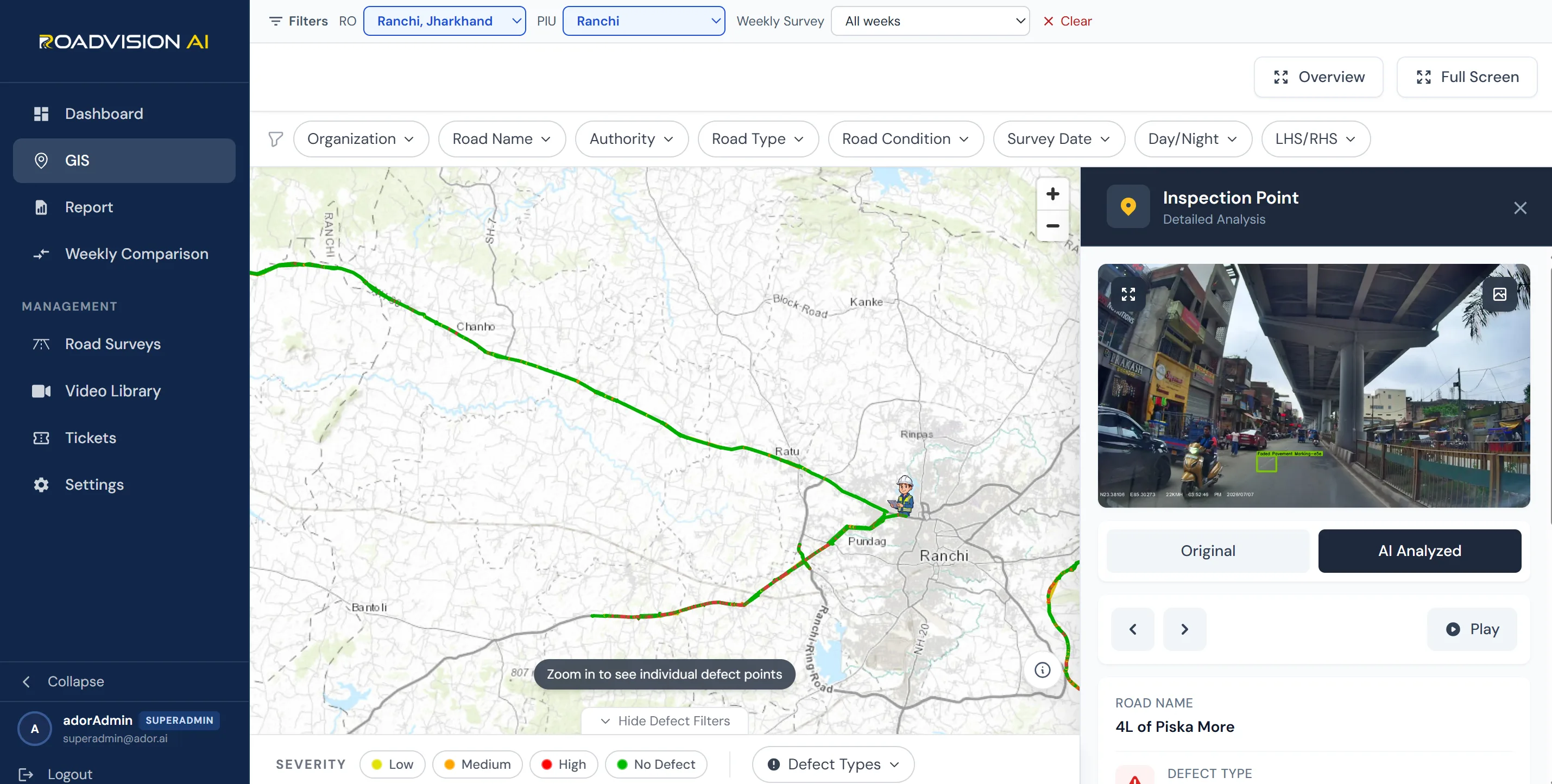
A standard maintenance contract pays for work done. A performance-based one pays for a standard held which means the paying authority needs an ongoing, independent record of whether that standard is actually being met, not a periodic inspection or the maintaining agency's own account. Across a combined 55 km corridor split between two original construction packages, that record also needs to be consistent: a defect on the Kutchery Chowk side and a defect on the Bijupara–Kuru side have to be measured the same way if the PBMC is to treat the whole corridor as one performance standard rather than two.
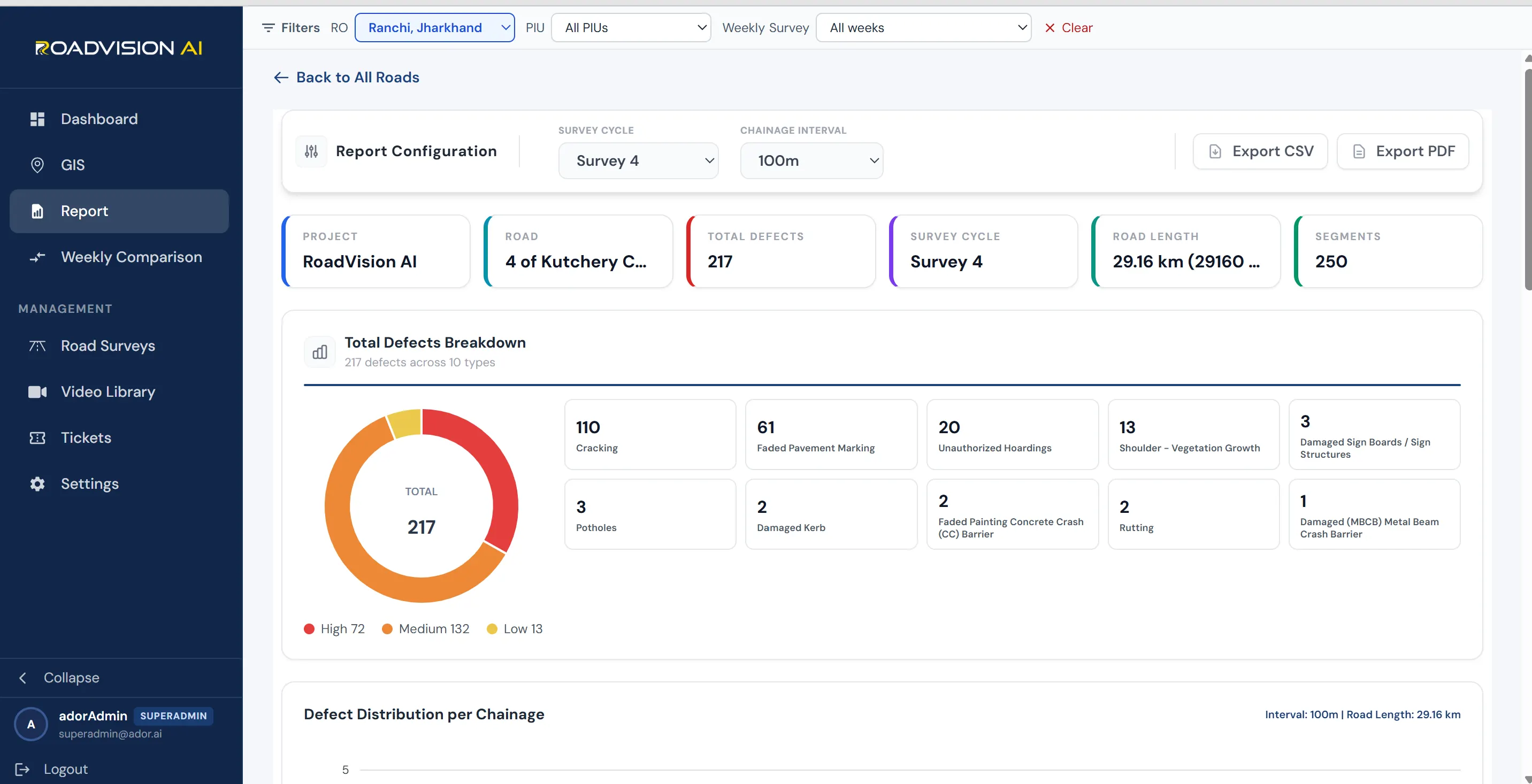
On the Kutchery Chowk–Piska More–Bijupara package, the fourth survey round logged 217 findings across 29.16 km and 250 segments. Of these, 72 (33.2%) were graded High severity, 132 (60.8%) Medium, and 13 (6.0%) Low. Cracking is the leading category at 110 findings (50.7%), ahead of faded pavement marking at 61 (28.1%) and unauthorised hoardings at 20 (9.2%).
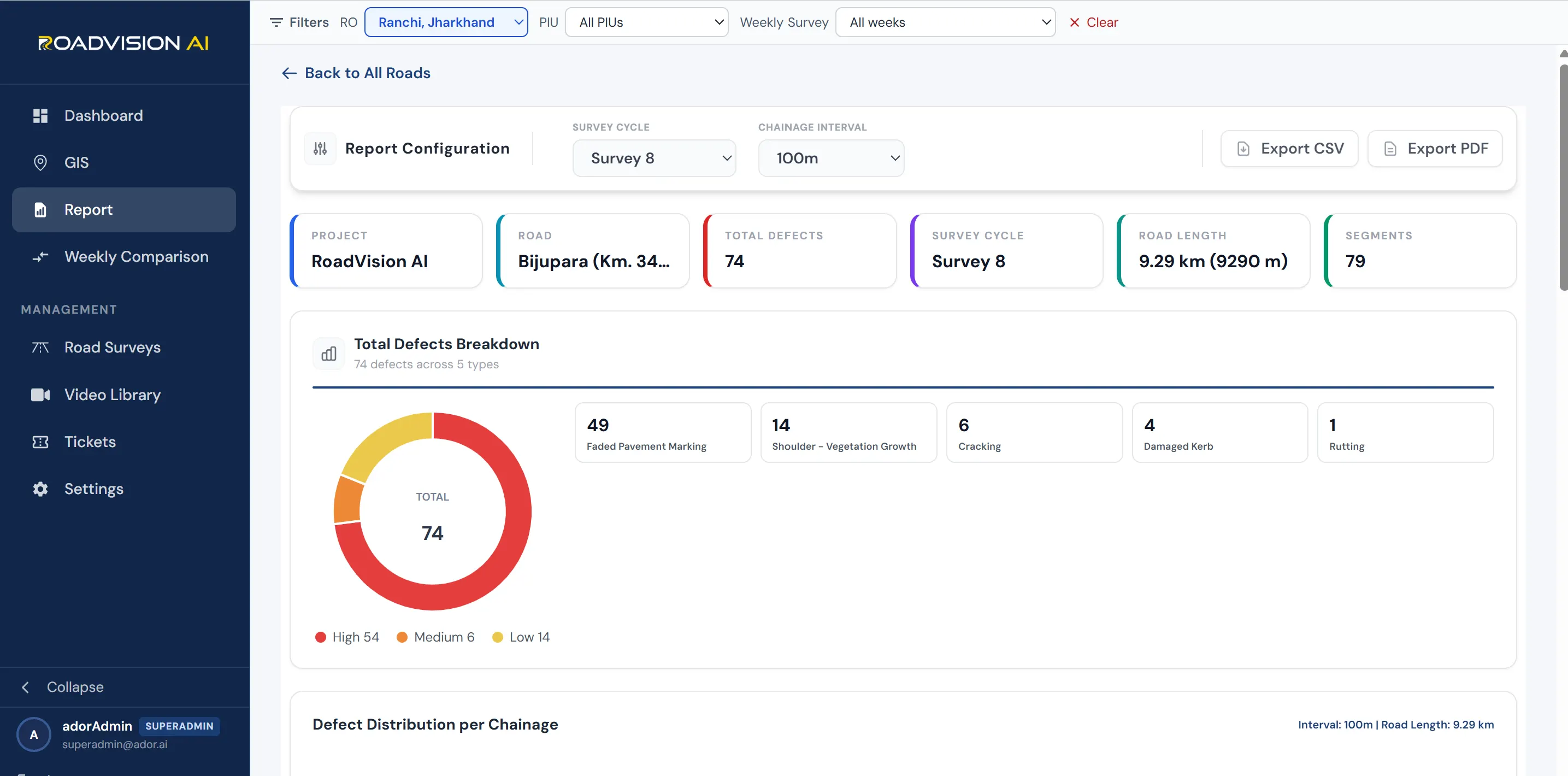
On the Bijupara–Kuru package, the eighth survey round covered a 9.29 km stretch across 79 segments and logged 74 findings a markedly more severe profile. 54 findings (73.0%) were graded High severity, 6 (8.1%) Medium, and 14 (18.9%) Low. Faded pavement marking dominates at 49 findings, 66.2% of the total, ahead of shoulder vegetation growth at 14 (18.9%).
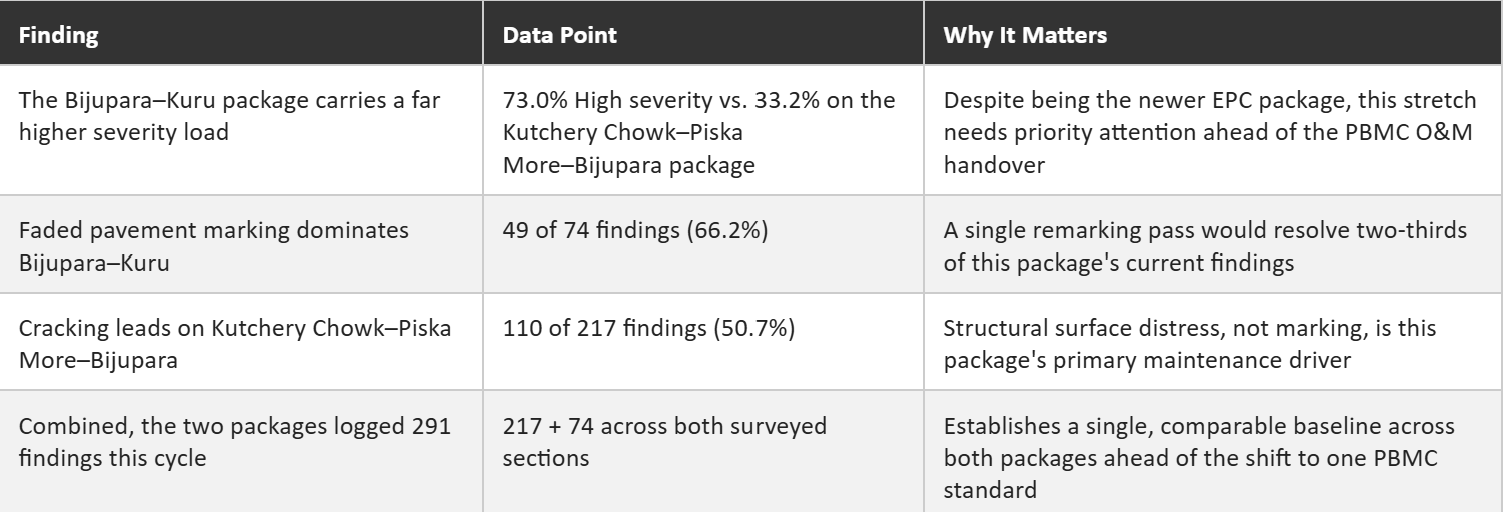
Once the PBMC O&M contract is in force, the maintaining agency's payment will depend on meeting the condition standards it sets out across the full Km 3.560–55.000 scope. Each survey round gives NHAI's Ranchi RO and PIU a defect ID, chainage and segment reference for every finding, independent of the agency being paid to maintain the corridor, so that performance can be assessed against the same evidence on both sides.
RoadVision AI is committed to continuous, independent monitoring of the Kutchery Chowk–Kuru corridor across both packages, giving NHAI a consistent basis for assessing performance as the stretch moves onto a Performance-Based Maintenance Contract. A payment structure built on meeting a standard is only as strong as the evidence behind it. Providing that evidence, survey after survey, is central to making the shift to performance-based maintenance work as intended.

The Autonomous Road Engineer
AI-powered road condition monitoring, asset management, & infrastructure intelligence helping agencies move from reactive maintenance to predictive road management.


.webp)
.webp)
.webp)