
This is a project-level account from RoadVision AI's road survey programme for the Patna region, covering the Bhojpur to Buxar section of NH-84, renumbered NH-922, in Bihar. It sets out why a structure-heavy EPC corridor like this one needs continuous monitoring, what the first full survey found, and what a focused follow-up check of one priority segment showed soon after.
The Bhojpur to Buxar section of NH-84, now NH-922, runs 47.9 km through Bihar, from Km 27.37 to Km 75.00, delivered on an EPC basis by the PNC-SPSCPL joint venture. The corridor is not a simple stretch of pavement: it carries 1 major bridge, 6 minor bridges, 6 vehicular underpasses, 9 pedestrian underpasses, 77 culverts (53 slab or box, 24 pipe), and 32 junctions, 10 of them major.
A corridor built around this many structures needs a survey that treats pavement, markings, medians and structure-adjacent defects as one connected picture, not a series of separate inspections. That is the brief RoadVision AI's weekly survey programme for the Patna Regional Office is built to meet.
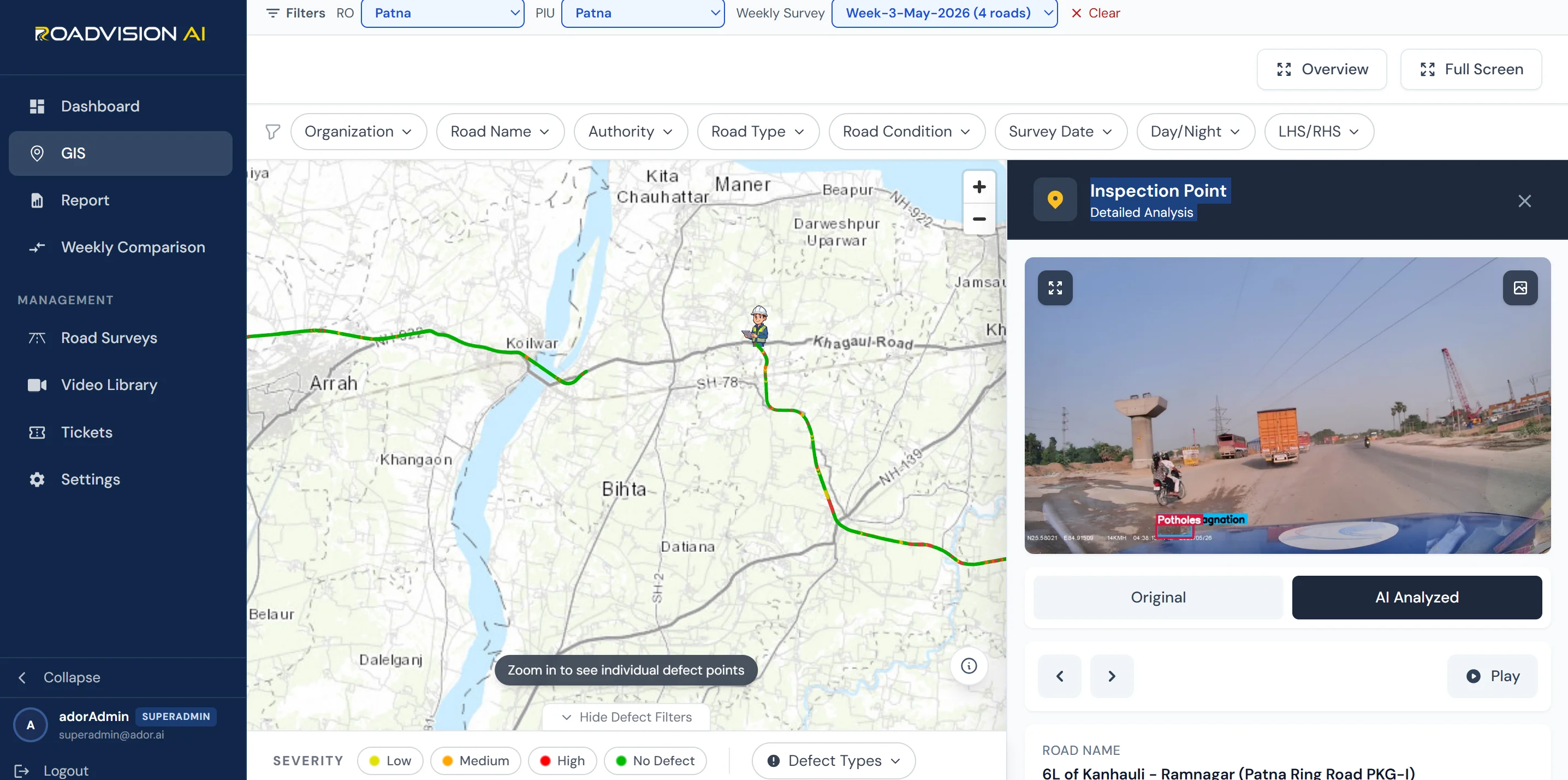
The Patna RO's GIS view covers NH-922 alongside the other roads surveyed under the same regional office, with the corridor's path visible through Koilwar and toward Arrah. Figure 1 shows this wider view; the inspection point illustrated here is drawn from the neighbouring Patna Ring Road Package-I project surveyed under the same account, shown to illustrate the chainage-level inspection format used consistently across the region, including on the Bhojpur–Buxar corridor itself.
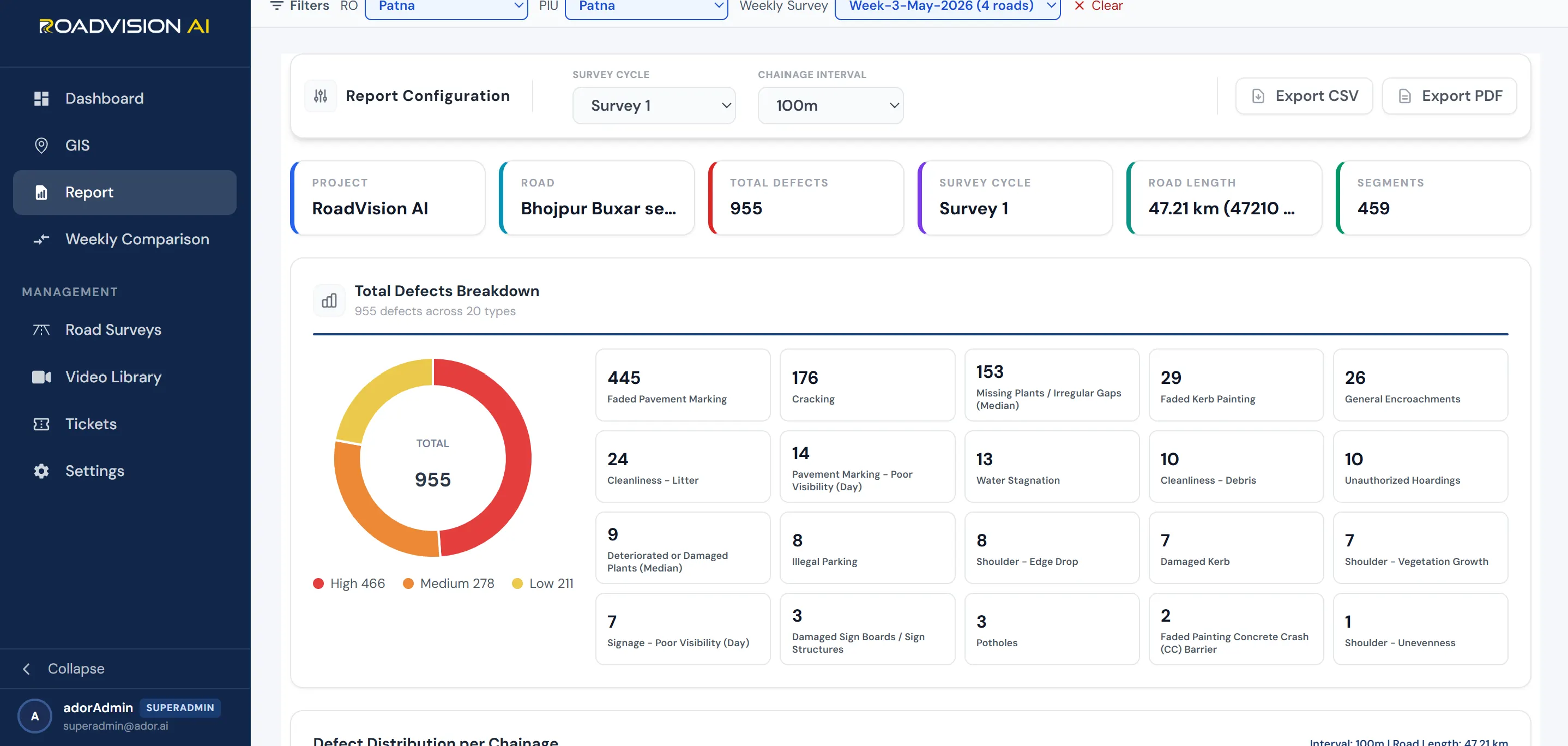
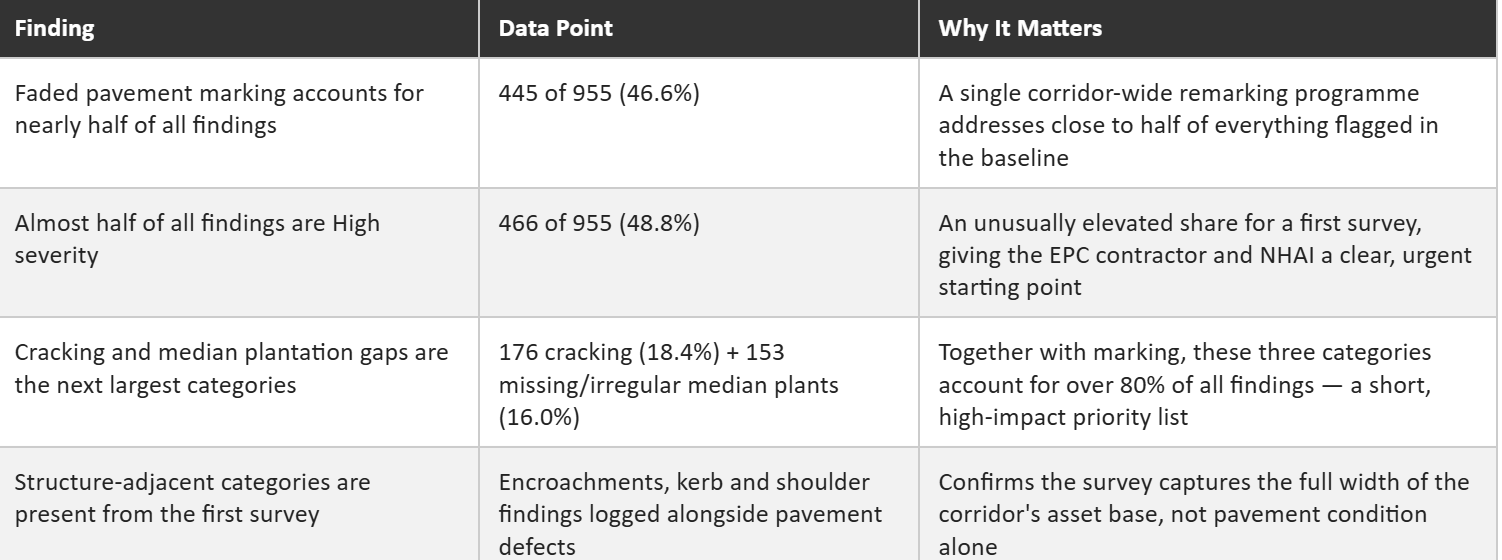
Survey 1, the corridor's baseline pass, covered the full 47.21 km in 459 segments at a 100 m chainage interval and logged 955 findings across 20 defect types. Of these, 466 (48.8%) were graded High severity, 278 (29.1%) Medium, and 211 (22.1%) Low a markedly elevated High-severity share for a first survey. Faded pavement marking alone accounts for 445 findings, 46.6% of the total, with cracking (176, 18.4%) and missing or irregularly spaced median plantation (153, 16.0%) the next largest categories.
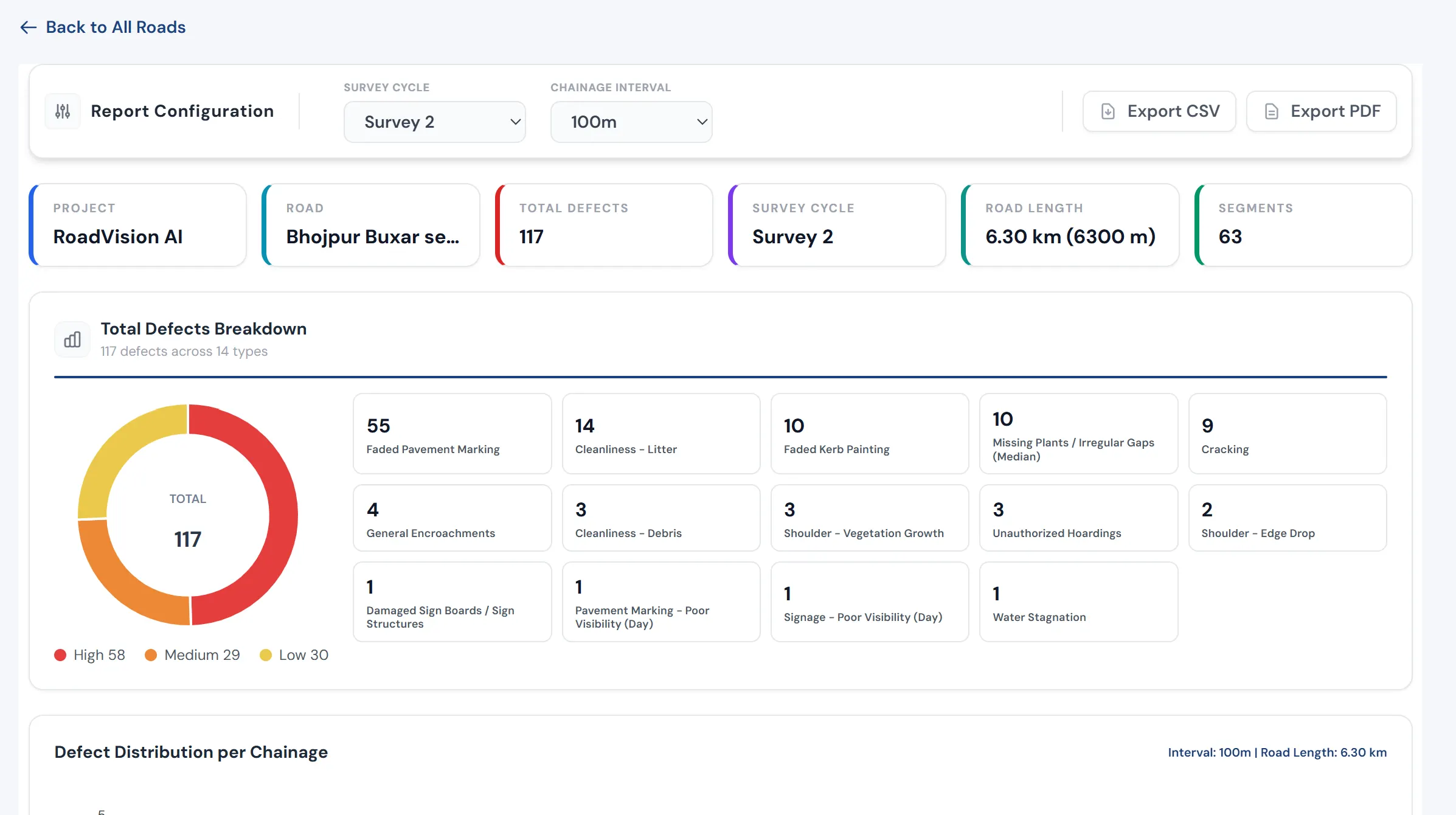
Shortly after the baseline, Survey 2 returned to a 6.30 km segment of the corridor for a focused re-check, covering 63 segments and logging 117 findings across 14 defect types. The pattern held: 58 findings (49.6%) were High severity, and faded pavement marking again led the count at 55 findings (47.0%) both figures closely tracking the baseline's corridor-wide averages, suggesting the segment chosen for closer attention is representative of the corridor as a whole rather than an outlier in either direction.
The contractor,, remains responsible for the corridor's upkeep under its EPC agreement. Each survey report gives the Patna RO and PIU a defect ID, chainage and segment reference sufficient to raise a corrective action request, and a subsequent survey of the same stretch confirms whether that action has actually closed the finding out.
RoadVision AI is committed to continuous AI-based monitoring of the Bhojpur–Buxar corridor, and to supporting the EPC contractor accountability that this monitoring enables. A highway built around this many bridges, underpasses and culverts carries a correspondingly high duty of care. Making sure its condition, especially the markings and structures that keep it safe, is verified survey after survey is central to that responsibility.

The Autonomous Road Engineer
AI-powered road condition monitoring, asset management, & infrastructure intelligence helping agencies move from reactive maintenance to predictive road management.


.webp)
.webp)
.webp)