
Roads are the backbone of any economy. They connect cities, enable trade, and keep everyday life moving. Yet, despite their importance, most road networks around the world are monitored and maintained using outdated, manual methods. Potholes go unnoticed for weeks, cracks widen into structural failures, and maintenance crews are often deployed reactively rather than proactively. The result is higher repair costs, increased accident risks, and frustrated commuters.
This is where a Road Condition Monitoring System (RCMS) steps in. By combining sensors, cameras, GPS data, and artificial intelligence, RCMS technology is transforming how road authorities detect, assess, and respond to road deterioration. In this blog, we'll explore what RCMS is, how it works, why AI is a game-changer for this industry, and what the future holds for smart road infrastructure.
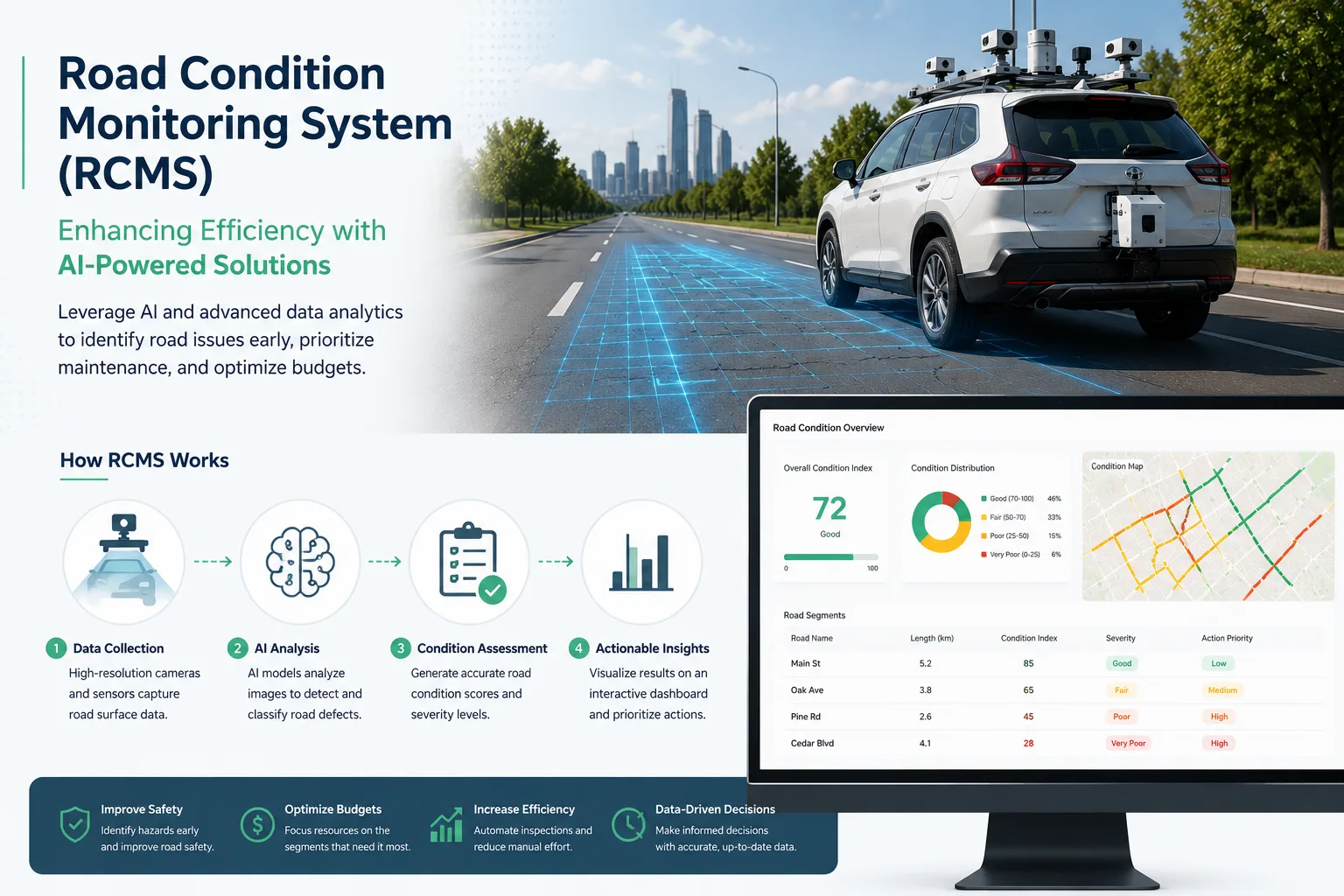
A Road Condition Monitoring System is a technology-driven solution designed to continuously assess the physical state of road surfaces. It uses a combination of hardware (sensors, cameras, accelerometers, GPS units) and software (AI algorithms, data analytics platforms) to detect issues such as:
Unlike traditional road inspection methods, which rely on manual surveys conducted by engineers walking or driving along roads with clipboards and cameras, RCMS automates this entire process. Vehicles equipped with sensors ranging from municipal vehicles to dedicated inspection cars, and even smartphones mounted on regular vehicles collect data as they drive. This data is then processed using AI models to identify defects, classify their severity, and pinpoint their exact GPS location.
Before diving deeper into how RCMS works, it's worth understanding why the traditional approach falls short:
These limitations create a maintenance backlog that compounds over the years, costing governments and taxpayers significantly more than proactive repairs would.
Artificial intelligence is the core engine that makes modern RCMS solutions so effective. Here's how AI enhances the entire monitoring and maintenance workflow:
AI-powered RCMS platforms use computer vision and deep learning models—often based on convolutional neural networks (CNNs)—to analyze images and video footage captured by dash-mounted or drone cameras. These models are trained on thousands of labeled images of potholes, cracks, and other road defects, enabling them to detect and classify issues with high accuracy, often exceeding 90% precision in optimized systems.
Beyond cameras, RCMS solutions integrate data from accelerometers, gyroscopes, and LiDAR sensors. When a vehicle passes over a rough patch or pothole, these sensors detect vibrations and irregularities. AI algorithms fuse this sensor data with visual data to cross-validate findings, reducing false positives and improving detection reliability.
Not all road defects are equally urgent. AI models can classify detected issues by severity—minor, moderate, or critical—based on factors like size, depth, and location (e.g., a pothole on a high-speed highway is more dangerous than one in a low-traffic residential area). This allows maintenance teams to prioritize repairs based on risk rather than treating every issue equally.
One of the most powerful applications of AI in RCMS is predictive analytics. By analyzing historical data, traffic patterns, weather conditions, and material aging, AI models can forecast which road segments are likely to deteriorate next. This shifts road maintenance from a reactive model to a predictive and preventive one, saving significant costs over time.
AI-driven RCMS platforms generate real-time dashboards and reports that visualize road conditions across an entire network. City planners and maintenance teams can view heat maps of problem areas, track repair progress, and allocate budgets more effectively—all without manual data entry.
A typical Road Condition Monitoring System consists of the following components:
The advantages of adopting an AI-powered Road Condition Monitoring System extend across multiple stakeholders:
Several cities and countries have already begun deploying AI-powered RCMS solutions:
While the benefits are substantial, deploying RCMS at scale does come with challenges:
Despite these challenges, the long-term return on investment and safety benefits make RCMS an increasingly attractive solution for road authorities worldwide.
As AI models become more sophisticated and sensor costs continue to decline, RCMS technology is expected to become more accessible, even for smaller municipalities and developing regions. Emerging trends include:
A Road Condition Monitoring System powered by artificial intelligence represents a significant leap forward from traditional, manual road inspection methods. By leveraging computer vision, sensor fusion, and predictive analytics, RCMS enables faster defect detection, smarter resource allocation, and safer roads for everyone. While implementation challenges exist, the long-term benefits—cost savings, improved safety, and more efficient infrastructure management—make RCMS a critical investment for modern road networks.
As cities continue to embrace smart infrastructure, AI-powered Road Condition Monitoring Systems will play an increasingly central role in building safer, more resilient, and more efficient transportation networks for the future.
An RCMS is a technology solution that uses sensors, cameras, and AI algorithms to automatically detect, classify, and report road surface defects such as potholes, cracks, and rutting in real time.
AI enables automated defect detection through computer vision, predicts future road deterioration through data analysis, classifies the severity of issues, and helps prioritize maintenance efforts more efficiently than manual inspection methods.
RCMS can detect potholes, longitudinal and transverse cracks, alligator cracking, rutting, surface roughness, debris, and faded or damaged road markings.
While RCMS was initially adopted by large cities and highway authorities, decreasing sensor and AI costs are making it increasingly accessible and cost-effective for smaller municipalities as well.
Modern AI-powered RCMS platforms can achieve detection accuracy rates exceeding 90%, though performance can vary based on training data quality, weather conditions, and sensor setup.
The Autonomous Road Engineer
AI-powered road condition monitoring, asset management, & infrastructure intelligence helping agencies move from reactive maintenance to predictive road management.


.webp)
.webp)
.webp)