
Qatar is rapidly advancing its infrastructure in alignment with Qatar National Vision 2030, with cities like Doha expanding faster than ever. As urban density and vehicle volumes increase, roads are under constant pressure—particularly within Doha's high-traffic corridors. Ensuring smooth, safe, and long-lasting pavements has become mission-critical for national mobility, economic resilience, and public safety.
In this evolving landscape, AI Road Asset Management in Qatar is emerging as a game-changing solution. By enabling early detection of pavement distress, precise pothole mapping, and Ashghal-compliant maintenance recommendations, modern platforms like RoadVision AI are redefining how Qatar preserves its world-class road network.
As the old saying goes, "A problem foreseen is a problem half solved." Preventive maintenance—powered by AI—is helping Qatar foresee problems before they disrupt mobility.
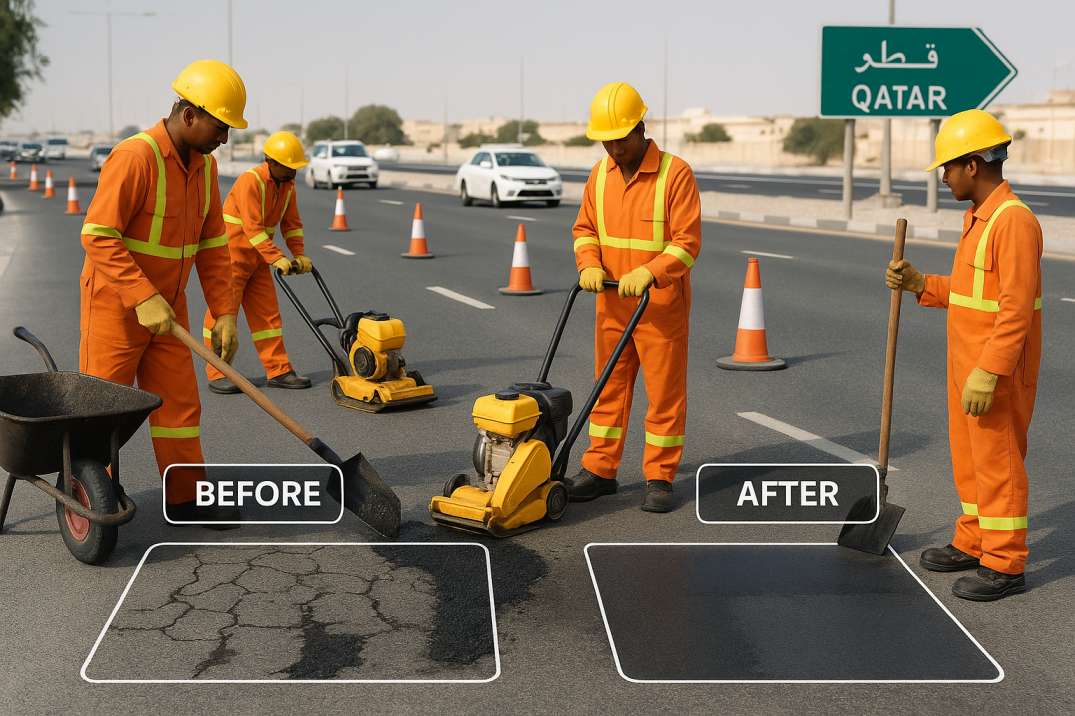
Qatar's urban roads, especially those in Doha, face unique stresses that accelerate pavement deterioration:
1.1 Harsh Desert Climate
Extreme temperatures reaching 50°C, sandstorms, and intense UV exposure weaken bituminous layers and accelerate oxidation, causing premature aging of pavement surfaces.
1.2 Heavy Urban Traffic & Construction Movement
High daily vehicle loads, combined with logistics and construction-related traffic from Qatar's ongoing development, place continuous structural pressure on pavements throughout the network.
1.3 Limitations of Manual Surveys
Conventional road inspections rely on periodic manual surveys—slow, inconsistent, and unable to detect early-stage defects before they escalate into costly failures.
Because of these factors, deterioration escalates quickly. Cracking begins small, then within weeks turns into potholes and surface failures. It is here that preventive maintenance becomes invaluable—fixing the small issues before they snowball. Or in local wisdom: "Fix the leak before it floods the house."
Preventive maintenance focuses on early intervention to preserve pavement health and extend service life. Qatar's approach aligns with best practices outlined in the Public Works Authority (Ashghal) frameworks, including:
Core preventive strategies include:
2.1 Crack Sealing
Prevents water and sand intrusion into base layers—critical in Qatar's environment where sand acts as an abrasive agent accelerating deterioration.
2.2 Fog Seal Treatments
Restores binder and enhances pavement flexibility, counteracting the brittleness caused by extreme heat exposure.
2.3 Slurry Seal & Microsurfacing
Improves skid resistance and rejuvenates the surface, extending pavement life by 5-7 years when applied at the right time.
2.4 Surface Rejuvenation
Extends pavement life by restoring oils lost due to oxidation from intense solar radiation.
These treatments work—but timing is everything. Knowing exactly when and where to apply them requires data, precision, and continuous monitoring. This is where AI becomes indispensable.
Platforms like RoadVision AI are transforming road maintenance by turning routine inspections into intelligent, automated workflows. Here's how they align with Qatar's technical standards and urban mobility needs:
3.1 Automated, High-Resolution Pavement Condition Surveys
Using mobile devices or dash-mounted cameras, the Pavement Condition Intelligence Agent captures road surface imagery and applies computer vision models to identify:
The platform generates Pavement Condition Index (PCI) maps tailored to Qatar's performance metrics, supporting Ashghal's asset management frameworks.
3.2 Qatar-Specific Pothole & Distress Detection
Qatar's pavements face unique distress signatures due to heat and sand abrasion. RoadVision AI's AI models are trained on local datasets, ensuring precise detection of:
Each defect is geotagged, severity-rated, and added to a priority repair list for immediate action.
3.3 Ashghal-Compliant Maintenance Recommendations
By combining historical roadway data, real-time imagery, and traffic patterns, the system suggests targeted maintenance interventions that align with Ashghal's standards—avoiding unnecessary resurfacing and saving millions in long-term rehabilitation costs.
3.4 AI-Enhanced Traffic Flow Management
Maintenance must be timed smartly, especially in busy corridors of Doha. The Traffic Analysis Agent integrates traffic survey data to:
This ensures roadwork is strategic—not disruptive—to Qatar's growing population.
3.5 Integrated Road Safety Audits
The Road Safety Audit Agent assesses:
This holistic approach ensures preventive maintenance enhances rather than compromises safety.
Despite strong infrastructure quality, Qatar faces recurring challenges:
4.1 Rapid Deterioration Due to Temperature Extremes
The transition from extreme summer heat to milder winters creates expansion-contraction cycles that accelerate cracking and fatigue.
4.2 High Congestion Levels in Doha
With one of the highest vehicle ownership rates globally, Doha's roads face continuous loading that limits maintenance windows.
4.3 Very Short Reaction Windows
The time between early cracking and major damage in Qatar's climate can be measured in weeks—not months—demanding rapid response.
4.4 High Costs of Late-Stage Rehabilitation
Emergency reconstruction costs 4-6 times more than timely preventive interventions, straining budgets.
4.5 Increased Pressure on Ashghal
Public expectations for world-class roads continue to rise, requiring proactive rather than reactive maintenance.
AI-based platforms bridge these gaps by bringing consistency, speed, and predictive intelligence across the entire maintenance lifecycle. As Qatar grows, "you cannot afford to play catch-up with the roads." AI ensures the country stays ahead.
Qatar's road agencies adopting AI-based systems report transformative outcomes:
These benefits reinforce Qatar's commitment to smart, sustainable infrastructure under Qatar National Vision 2030.
Qatar is at the forefront of smart infrastructure adaptation. As urban mobility accelerates, preventive maintenance—powered by artificial intelligence—will be the backbone of resilient, safe, and high-performing roads. AI ensures pavements are protected before problems escalate, helping Qatar maintain its world-class infrastructure with efficiency and precision.
RoadVision AI strengthens this journey by combining advanced computer vision, digital twin technology, and AI-driven insights—all tailored for Qatar's climate, traffic, and regulatory ecosystem. With proactive detection of potholes, cracks, and early-stage deterioration through the Pavement Condition Intelligence Agent, the platform empowers agencies to act faster, smarter, and more strategically.
As the proverb goes, "The best time to mend the road is before the cracks widen." With RoadVision AI, Qatar is not just reacting to road damage—it is predicting, preventing, and outperforming.
Ready to transform your approach to road maintenance? Book a demo with RoadVision AI today and discover how intelligent, predictive, and Ashghal-aligned road maintenance can support Qatar's transition to future-ready infrastructure.
It involves early-stage repair treatments to prevent road deterioration. In Qatar, it helps reduce costs and improve safety under harsh weather conditions.
Yes. RoadVision AI uses computer vision trained on regional datasets to identify and prioritize defects with over 90 percent accuracy.
Absolutely. The platform supports Ashghal-aligned data formats, defect categories, and decision logic for local compliance.

The Autonomous Road Engineer
AI-powered road condition monitoring, asset management, & infrastructure intelligence helping agencies move from reactive maintenance to predictive road management.


.webp)
.webp)
.webp)