
Road engineering has no shortage of software. Asset management systems, GIS platforms, project management tools, document repositories, survey applications most road authorities and engineering consultancies already run a stack of five, ten, sometimes fifteen different systems to manage a single road network. And yet, ask any chief engineer or asset manager whether they feel like they have a real-time, accurate picture of their network's condition, and the honest answer is almost always no.
This is not a failure of effort. It is a structural limitation of what conventional software was ever designed to do. Traditional road engineering software is, at its core, a record-keeping system. It stores the data that a human collected, classified, and entered. It displays that data on a map or in a report. It tracks workflow status. What it does not do what it was never built to do is look at a road, understand what it is seeing, apply engineering judgment to it, and tell you what matters.
That gap is precisely what AI agents are built to close, and it is the foundational reason RoadVision AI was built as what it calls an Agentic AI Company from day one not a software vendor that later added a machine learning feature. Founded in January 2024 around the premise that infrastructure demands intelligence at scale, RoadVision AI set out to build autonomous AI agents that think, analyze, and act like expert engineers, rather than another dashboard for engineers to populate manually.
This blog explains the meaningful difference between software and agents, why that difference matters specifically for road engineering, and what it looks like in practice when an AI agent rather than a static tool becomes part of a road engineering team.
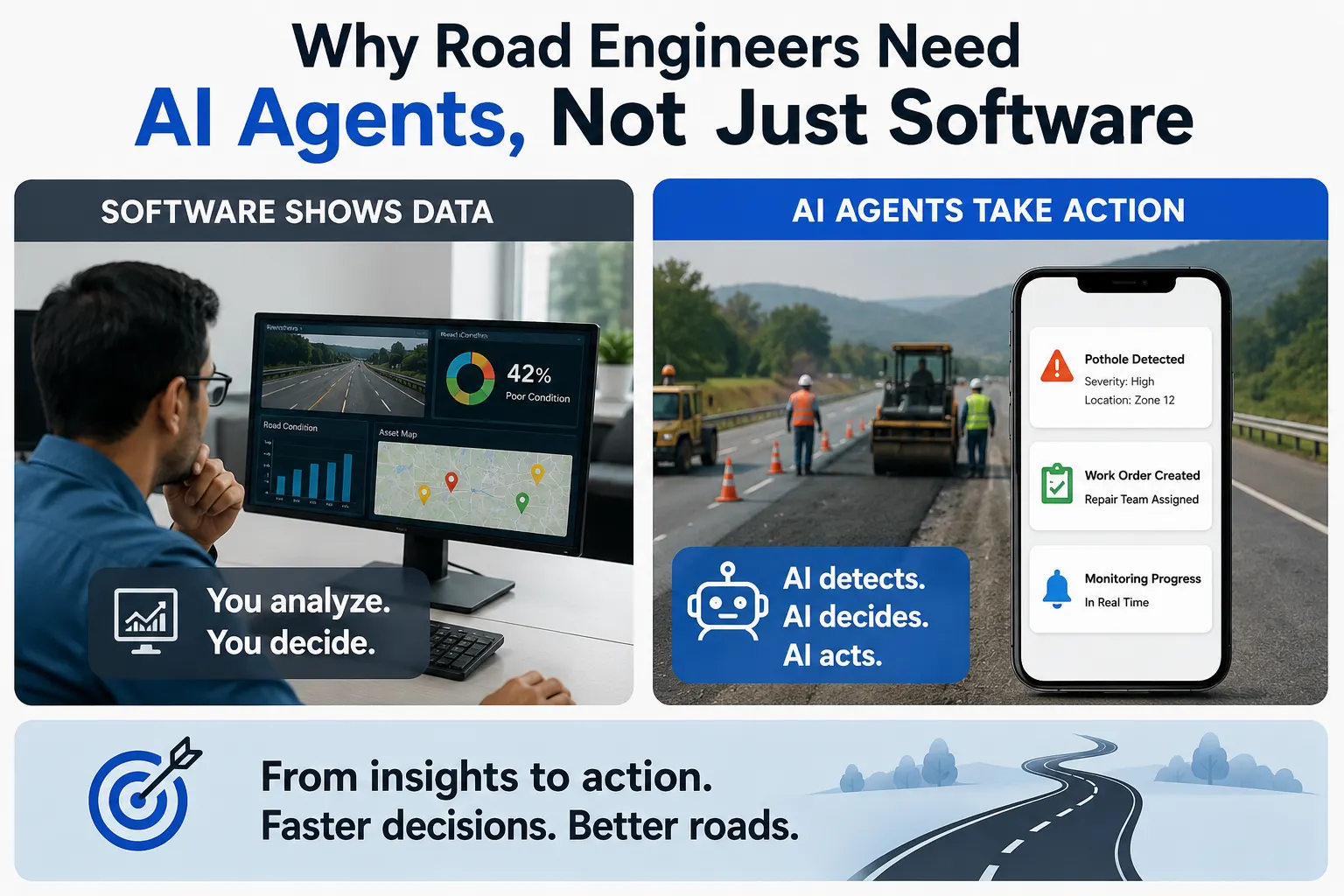
The word "AI" gets applied loosely across the infrastructure technology market, so it is worth being precise about what separates conventional software even software with some AI features bolted on from a true AI agent.
Traditional software is reactive and passive. It waits for a human to provide input a survey result, a defect classification, a status update and then stores, displays, or routes that input according to predefined rules. The intelligence in the system is entirely the intelligence the human brought to it before they opened the application. A road condition database does not know a road is deteriorating; it knows what a human told it about the road's condition on the date of the last manual entry.
An AI agent is active and reasoning. It observes raw data directly imagery, sensor readings, drawings, video and performs the analytical work that a human expert would otherwise have to do: detecting a defect, classifying its severity, comparing it against an engineering standard, correlating it with related conditions, and producing a judgment. Critically, it does this continuously and at a scale no individual engineer could sustain, while remaining traceable back to the specific evidence and standard that produced each finding.
The distinction is not philosophical it shows up directly in what each category of tool can and cannot do for a road authority managing a large network:
A traditional asset management system can tell you what condition score was recorded for a given road segment six months ago, because someone drove that segment, looked at it, and typed in a rating. An AI agent can tell you the condition of every segment in the network as of this week's data capture, because it assessed the imagery itself against the applicable standard without waiting for a human to physically visit and manually rate each one.
A traditional document management system can store a stack of design drawings and let you search them by file name. An AI agent can read those drawings, evaluate the road geometry against sight-distance and alignment standards, and flag a specific curve where the design does not meet code before construction ever begins.
A traditional reporting tool can generate a PDF summarizing data someone already entered. An AI agent can ingest video, accident records, and design files; classify findings by severity; correlate conditions with crash patterns; and produce a chainage-wise, standards-referenced report without a human first having to interpret the raw evidence.
Road networks present a particular combination of characteristics that make the software-versus-agent distinction matter more here than in almost any other infrastructure domain.
The asset base is enormous relative to the workforce available to assess it. A mid-sized state or provincial road authority may be responsible for tens of thousands of kilometres of road, supported by an engineering team numbering in the dozens or low hundreds. No realistic level of staffing allows that team to personally inspect, assess, and document the full network on any meaningful cycle using manual methods. Software that requires a human to generate every data point inherits this staffing constraint directly it can only be as comprehensive as the people feeding it. An agent that performs the assessment itself is not bound by that same constraint; it scales with the data captured, not the headcount available to interpret it.
Conditions change continuously, but most assessment processes are episodic. Pavement deteriorates daily under traffic loading and weather. Safety conditions shift as vegetation grows, signage fades, and barriers are damaged. Yet formal inspections, audits, and condition surveys are typically conducted on quarterly, annual, or multi-year cycles not because engineers believe that frequency is adequate, but because manual assessment at higher frequency is operationally and financially impractical. An agent that processes incoming data continuously removes that constraint, closing the gap between how often conditions change and how often they are actually assessed.
Engineering judgment must be standards-based and defensible. Road engineering decisions about safety interventions, maintenance prioritization, design compliance, contract claims are made within a framework of recognized codes: IRC, MoRTH, ASTM, AASHTO, PAS, and equivalent regional and client-specific standards. A generic AI tool that simply detects visual anomalies in an image is of limited use to an engineer who needs findings that map directly onto a specific, citable standard. This is why RoadVision AI built its platform around engineering-grade accuracy grounding every output in the codes road professionals are already accountable to, so an agent's findings are not just visually interesting, but objective, repeatable, and usable in the same compliance and audit processes engineers already operate within.
The cost of late discovery is severe and well documented. A pavement road defect or safety risk identified early is typically a low-cost preventive intervention. The same issue identified late after it has progressed because no one was monitoring it closely enough frequently becomes an emergency repair costing many times more, or in the worst cases, an incident with safety consequences. Software that depends on the next scheduled human inspection to surface a problem inherits the lag of that inspection cycle. An agent that continuously observes data can surface the same problem far closer to its point of origin.
RoadVision AI's approach to building AI agents rather than simply adding AI-flavoured features to conventional software rests on a set of guiding principles that shape how each agent is designed and deployed.
Autonomous intelligence. Each agent is built to observe, analyze, and reason at scale, the way an experienced road engineer would approach a problem not simply to flag visual anomalies and leave interpretation to a human. This is the core difference between a detection tool and an agent: an agent is expected to reach a judgment, not just surface a signal.
Engineering-grade accuracy. Every agent's outputs are grounded in recognized engineering standards, producing findings that are objective and repeatable meaning two assessments of the same condition under the same standard should arrive at the same conclusion, the same baseline expectation any human engineering review would be held to.
A lifecycle-first approach. Rather than building a single tool for a single moment in a road's life, agents are designed to support every phase — planning, design, construction, operations, and maintenance recognizing that the engineering questions a road authority needs answered change continuously across a project's lifetime, but the underlying need for continuous, standards-based intelligence does not.
Scalable by design. Agents are built for network-level deployment using standard, widely available equipment vehicle-mounted dashcams, drones, satellite imagery rather than requiring specialized survey fleets or proprietary hardware that limits how much of a network can realistically be covered.
Trust and transparency. Because agents are making judgments that inform real engineering and safety decisions, their outputs are built to be explainable, with traceable insights and clear data ownership so an engineer reviewing an agent's finding can see the evidence and the standard behind it, not just a score with no visible reasoning.
These principles are not abstract values they show up directly in how RoadVision AI's agents are structured and what they are expected to deliver, as outlined below.
The clearest way to understand the software-versus-agent distinction is to look at how a specific RoadVision AI agent is actually built to operate, rather than describing the concept abstractly.
Consider the Road Safety Audit Agent. A conventional approach to digitizing road safety auditing would produce a checklist application — a tool where a human inspector walks or drives a corridor, manually rates each safety element against a checklist, and the software stores and reports those ratings. That is software supporting a human process; it does not reduce the fundamental constraint that a human still has to personally assess every element.
RoadVision AI's agent instead ingests design drawings, video, and accident data directly, and performs the assessment itself: evaluating conditions against applicable safety standards, classifying findings by severity (high, medium, or low), analyzing correlations between conditions and accident patterns, generating a prioritized list of recommended interventions, and producing location-specific, chainage-wise reports all without requiring a human to manually walk the corridor and complete a checklist for every element under review. The output, importantly, explicitly maps to IRC, MoRTH, and equivalent international benchmarks, so the agent's reasoning is traceable back to the standard a human auditor would themselves be required to apply.
The same distinction holds across RoadVision AI's other agents. The Pavement Condition Intelligence Agent does not just display crack imagery for a human to rate it evaluates that imagery against IRC, MoRTH, ASTM, AASHTO, and PAS criteria and produces an engineering-grade condition assessment directly. The Blackspot Analysis Agent does not just plot accident locations on a map it correlates those locations with road geometry and condition data to identify why a stretch of road is accident-prone and what intervention would address the underlying cause. The Tender Intelligence & Bid Preparation Agent does not simply store tender documents in a searchable repository it extracts requirements, surfaces relevant templates, and actively assists in assembling a bid response.
In each case, the differentiating capability is the same: the agent performs analytical work that previously required a trained professional to do manually, rather than simply organizing the work product of that professional after the fact.
A natural question raised by agentic AI in any professional field is what it means for the people who currently do that work. The honest and accurate answer, reflected directly in how RoadVision AI positions its platform, is augmentation rather than replacement extending what a finite engineering team can cover, not eliminating the need for engineering judgment.
This shows up concretely in the language RoadVision AI uses for its safety audit capability specifically: the agent augments formal safety audits with continuous evidence between formal cycles, rather than replacing the audits themselves. A qualified safety auditor still reviews findings, still applies professional judgment to ambiguous cases, and still bears the professional responsibility for the audit conclusion but they do so with continuous, standards-aligned evidence in hand, rather than starting from a blank slate built entirely on what could be observed during a single site visit.
For road authorities and consultancies, this translates into a very practical shift in what engineering teams spend their time on. Instead of spending the majority of available hours on the labour-intensive work of manually surveying, classifying, and documenting baseline conditions across a network, engineers spend their time reviewing agent-generated findings, applying judgment to edge cases the agent flags as requiring human attention, and acting on prioritized recommendations work that more directly uses the expertise a trained road engineer actually brings to the job, rather than the data-collection labour that consumed so much of their time under manual processes.
The shift from software to agents changes what is possible for everyone with a stake in road infrastructure, not only the engineers operating the platform directly.
Road authorities and regulators gain continuous, network-wide visibility into conditions and compliance status that no manual inspection cycle could deliver, supporting more defensible planning and budgeting decisions backed by current, not stale, data.
Consultants and safety auditors gain evidence-backed findings that accelerate their own professional work and produce regulatory-ready documentation, allowing them to take on larger mandates without a proportional increase in field staff.
Concessionaires and operators gain continuous safety and condition monitoring that reduces liability exposure and strengthens the safety record they can demonstrate to regulators and the public.
Construction firms and project owners gain real-time quality and compliance monitoring during active delivery, catching design and specification deviations before they compound into expensive rework.
Investors gain independent, data-backed visibility into the physical condition of road assets for due diligence and portfolio tracking purposes — visibility that does not depend on the asset operator's own self-reported condition data.
The public, ultimately, gains roads where safety risks, pavement defects, and maintenance needs are identified and addressed earlier and more consistently than a workforce-constrained manual process could ever achieve on its own.
RoadVision AI describes itself plainly as an Agentic AI Company, founded in January 2024 around a singular premise: that infrastructure demands intelligence at scale, and that the only way to deliver that intelligence across road networks of meaningful size is through AI agents capable of observing, analyzing, and reasoning the way an expert engineer does not through better dashboards for storing what a human has already analyzed.
That premise is reflected in the platform's architecture, where RoadGPT processes incoming data against more than 50 engineering standards and a suite of specialist agents covering pavement, roadside assets, construction monitoring, safety auditing, traffic, tendering, and contract management each perform targeted analytical work within their domain, rather than relying on one generic model or, worse, no model at all and a database waiting for human input.
It is also reflected in who has shaped the platform's direction: a team guided by mentors with deep institutional road engineering experience, including a former CGM (Technology) at India's National Highways Authority of India and President of the ITS India Forum, a former CGM at NHAI and former World Bank consultant, and a transportation engineering professor specializing in road safety and pavement alongside a core team of more than 50 engineers, researchers, and strategists building the platform day to day. This grounding in institutional road engineering expertise, rather than purely a technology background, is part of why RoadVision AI's agents are built to reflect the standards and judgment of practicing road engineers, rather than the generic visual pattern recognition that defines many computer vision products adapted for roads as an afterthought.
The road engineering sector does not have a shortage of software. What it has lacked is intelligence that scales with the size of the networks engineers are responsible for analytical capability that can keep pace with how much road exists, how quickly its condition changes, and how few people are available to assess it manually. Conventional software, however well designed, cannot close that gap on its own, because it depends entirely on the human input fed into it.
AI agents close that gap differently by performing the engineering assessment itself, continuously, at network scale, grounded in the same standards a human engineer would apply, and delivered with the transparency needed to be trusted in real engineering and regulatory decisions. This is the premise RoadVision AI was built around from its founding as an Agentic AI Company: that infrastructure does not need another place to store data engineers have already analyzed it needs autonomous agents that think, analyze, and act like the expert engineers road networks have never had enough of.
Want to see the difference between software and an agent for yourself? Contact RoadVision AI to book a demonstration of the Autonomous Road Engineer in action.
AI-powered software typically uses machine learning to enhance a specific feature within an otherwise conventional, human-input-driven tool — for example, suggesting a category for a manually uploaded photo. An AI agent performs the core analytical work itself: observing raw data, applying engineering standards, and producing a judgment or finding without requiring a human to first interpret the evidence. The agent does the assessment; conventional software simply records the assessment a human already made.
No. RoadVision AI's agents are explicitly designed to augment, not replace, professional engineering judgment. Agents handle the continuous, large-scale analytical work that would be operationally impossible for a human team to sustain manually, while qualified engineers and auditors review findings, apply judgment to flagged edge cases, and retain professional responsibility for final decisions.
RoadVision AI's agents are built around engineering-grade accuracy, meaning outputs are grounded in recognized standards such as IRC, MoRTH, ASTM, AASHTO, and PAS, with explainable, traceable insights that map each finding back to the evidence and standard that produced it — rather than an unexplained AI-generated score.
RoadVision AI's deployed agents span pavement condition assessment, roadside asset inventory, construction monitoring, post-disaster damage assessment, vegetation analysis, road safety auditing, traffic analysis, automatic number plate recognition, blackspot analysis, document and workflow management, tender intelligence and bid preparation, and contract review and claims support — covering the road lifecycle from planning through operations.
oadVision AI's agents are built to work with standard, widely available data sources vehicle-mounted dashcam footage, drone imagery, and satellite imagery rather than requiring proprietary survey hardware or dedicated specialist fleets, allowing deployment to scale with the size of a network rather than being limited by access to specialized equipment.

The Autonomous Road Engineer
AI-powered road condition monitoring, asset management, & infrastructure intelligence helping agencies move from reactive maintenance to predictive road management.


.webp)
.webp)
.webp)