
Dubai has earned global recognition for its futuristic infrastructure, guided by the vision of the Roads and Transport Authority (RTA) and strategic frameworks such as the Dubai Urban Master Plan. As the city's highway network expands rapidly—connecting free zones, industrial hubs, and residential districts—the challenge is no longer limited to building world-class roads. The real task is maintaining them efficiently, sustainably, and proactively.
With rising traffic loads, desert climate conditions, and continuous development works, Dubai cannot afford reactive road maintenance. As the saying goes, "A stitch in time saves nine." AI-based pavement monitoring, drone road surveys, and digital road monitoring systems are now redefining how the city manages its road assets.
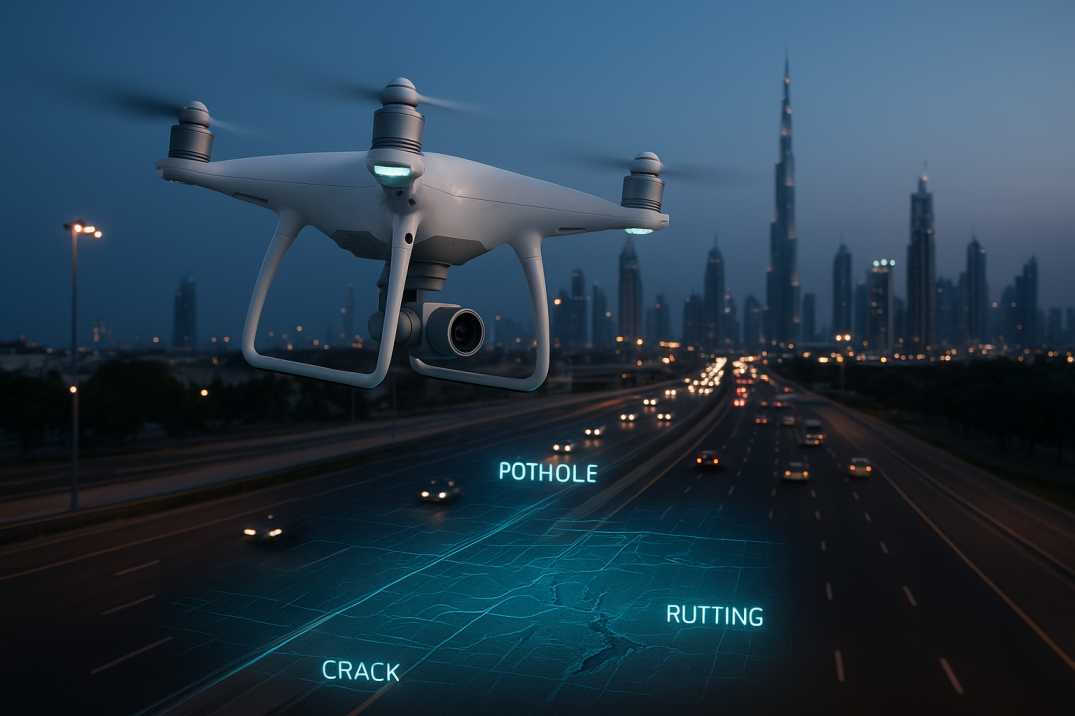
Dubai's road ecosystem is complex and high-density. Historically, inspections were conducted manually, requiring engineers to physically survey lanes, medians, and hard shoulders. While effective for smaller networks, this approach is no longer practical for a fast-growing metropolis.
Key limitations of traditional methods include:
Dubai needed a smarter, faster, and more predictive model—which AI now provides through platforms like RoadVision AI.
Although Dubai follows its own RTA standards, international best practices like India's IRC Codes offer valuable structural and maintenance guidelines that align well with AI-driven asset management. Key IRC-aligned principles relevant to Dubai include:
2.1 Preventive Maintenance as a Primary Strategy (IRC:82, IRC:SP-16)
Maintenance should begin before visible distress forms—reducing lifecycle costs and preventing failures through early intervention via the Pavement Condition Intelligence Agent.
2.2 Standardized Pavement Condition Indexing (PCI Frameworks)
Uniform collection and scoring of cracks, potholes, and deformations ensure objective decision-making across the network, eliminating subjective variability.
2.3 Adoption of Digital Survey Methods (IRC:SP-13, ITS Guidelines)
AI, drones, and digital loggers improve accuracy and reduce inspection time while providing comprehensive documentation.
2.4 Strengthening of Structural Health Assessments (IRC:37 & 115)
Assessment of subbase, asphalt layers, and surface integrity ensures long-term durability and prevents premature failure.
2.5 Lifecycle-Based Asset Management
Systematic tracking of asset condition from construction through maintenance to renewal ensures optimal resource allocation.
These principles help define how technology must be integrated into modern maintenance practices—and Dubai is already implementing similar expectations through RTA's smart mobility programs.
RoadVision AI operationalizes these global standards to support Dubai's shift toward predictive, AI-driven maintenance through its integrated suite of AI agents.
3.1 Drone Road Surveys for Rapid Data Collection
The Pavement Condition Intelligence Agent integrates with drone-based systems providing high-resolution imaging, LiDAR mapping, and thermal scans to detect:
Drone surveys drastically reduce inspection time, enabling the RTA to survey large corridors in hours—not days—while eliminating safety risks to inspection teams.
3.2 AI-Based Pavement Monitoring and Defect Detection
Deep-learning algorithms analyze images frame-by-frame to classify defects with high accuracy. This ensures:
3.3 Digital Road Monitoring Systems and Predictive Analytics
The Pavement Condition Intelligence Agent and Roadside Assets Inventory Agent generate digital twin technology with real-time dashboards showing:
This aligns with Dubai's vision of proactive mobility management and smart city readiness under the Dubai Urban Master Plan.
3.4 Compliance with IRC and Dubai RTA Standards
The platform's methodology integrates seamlessly with IRC maintenance frameworks while also adhering to UAE codes and RTA requirements, ensuring:
3.5 Integrated Traffic and Safety Analytics
The Traffic Analysis Agent provides:
The Road Safety Audit Agent identifies:
Even with advanced systems, maintaining Dubai's complex network presents several operational challenges:
4.1 Harsh Desert Climate
High temperatures exceeding 50°C, sandstorms, and UV exposure accelerate pavement deterioration through thermal cracking, oxidation, and abrasion.
AI Solution: The Pavement Condition Intelligence Agent tracks climate-induced deterioration patterns and predicts accelerated failure zones.
4.2 Rapid Urban Growth
New developments increase traffic loads and redirect transport patterns frequently, requiring adaptive monitoring strategies.
AI Solution: Continuous surveys ensure asset records stay current with network changes.
4.3 High Traffic Volume
Dubai's major corridors—including Sheikh Zayed Road, Emirates Road, and major expressways—operate near capacity daily, limiting inspection windows.
AI Solution: Drone and mobile surveys during normal traffic flow eliminate the need for lane closures.
4.4 Coordination Across Stakeholders
Contractors, consultants, government entities, and tech partners must share unified data for effective decision-making.
AI Solution: Centralized platforms ensure all stakeholders work from the same verified data.
4.5 Need for Real-Time Decision Making
RTA's smart mobility ambitions require instant insight rather than periodic reporting to respond to changing conditions.
AI Solution: Real-time dashboards provide immediate visibility into network condition.
4.6 Integration with Smart City Platforms
Road asset data must feed into broader Dubai smart city initiatives for holistic urban management.
AI Solution: Standardized data formats enable seamless integration with existing platforms.
AI-powered tools through RoadVision AI directly help address these issues by automating detection, improving prediction, and ensuring transparency across all operations.
Dubai is proving that road maintenance doesn't have to be reactive or costly. By integrating AI-based pavement monitoring, digital road monitoring systems through the Pavement Condition Intelligence Agent, and drone road survey Dubai technologies via the Roadside Assets Inventory Agent, the city is advancing toward a sustainable, safe, and intelligent transport ecosystem.
The platform's ability to:
transforms how road maintenance is approached across the emirate.
This shift isn't just about adopting new tools—it's about shaping the future of mobility, ensuring that every kilometre of roadway remains resilient and efficient. After all, "The road to success is always under construction," but with AI, it's constructed smarter.
RoadVision AI is driving this transformation across Dubai and the wider region. With capabilities in road safety audits through the Road Safety Audit Agent, pavement condition surveys, traffic surveys via the Traffic Analysis Agent, and digital asset management, RoadVision AI helps engineers and city planners reduce costs, minimize risks, and maintain world-class infrastructure that aligns with both IRC codes and Dubai's regulatory standards.
If your organisation is ready to embrace the future of road maintenance, book a demo with RoadVision AI today and discover how AI can transform Dubai's roads into truly intelligent infrastructure.
Q1: How does AI improve road asset management in Dubai?
AI uses data-driven models and predictive analytics to anticipate pavement deterioration, enabling proactive maintenance and extending road lifespan.
Q2: What is the role of drones in Dubai road surveys?
Drones conduct faster and more accurate surveys, capturing high-resolution images and data that are analyzed by AI for defects and risks.
Q3: Why is predictive maintenance important for Dubai roads?
Predictive maintenance reduces emergency repair costs, prevents traffic disruptions, and aligns with Dubai’s smart infrastructure strategy.
The Autonomous Road Engineer
AI-powered road condition monitoring, asset management, & infrastructure intelligence helping agencies move from reactive maintenance to predictive road management.


.webp)
.webp)
.webp)