AI-Powered Road Infrastructure Intelligence: The Complete Guide
On this page
Roads generate an enormous amount of information every single day traffic volumes, weather exposure, surface wear, structural stress, incident patterns, and maintenance history. For most of history, this information has existed in disconnected fragments: a maintenance log here, a traffic count there, an inspection report filed away and rarely revisited.Road infrastructure intelligence is the emerging discipline of unifying all of this data into a single, AI-powered layer of understanding turning scattered records into a living, continuously updated picture of how a road network actually behaves.
This shift matters because roads are no longer just physical assets to be inspected periodically; they're complex systems that can be understood, modeled, and optimized much like any other data-rich infrastructure. In this blog, we'll explore what road infrastructure intelligence means, how AI makes it possible, the core capabilities it enables, and why it's becoming a foundational layer for the next generation of infrastructure management.
AI Road Management
What Is Road Infrastructure Intelligence?
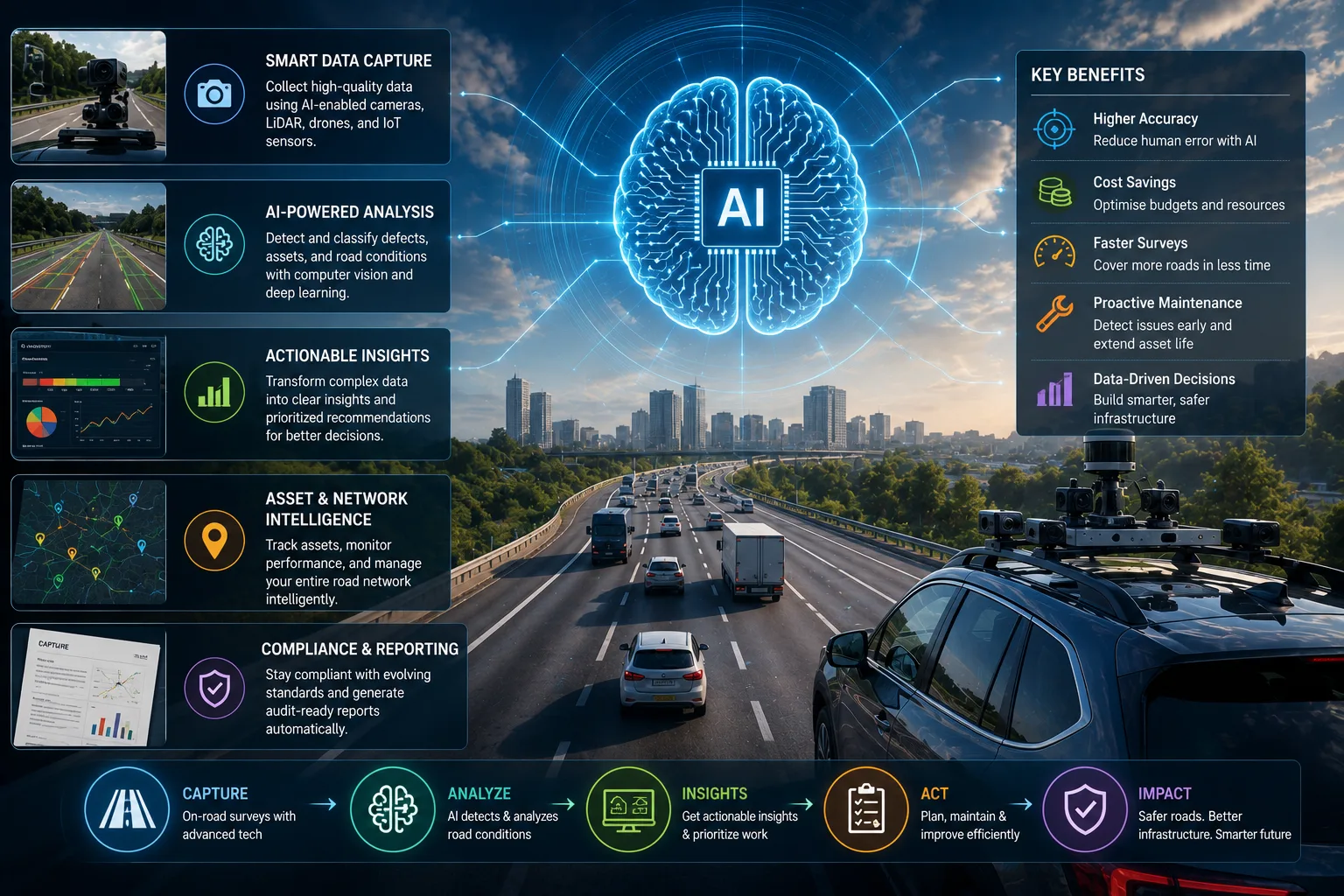
Road infrastructure intelligence refers to the use of AI, data integration, and analytics to build a comprehensive, continuously updated understanding of a road network's condition, performance, and risk profile. Rather than treating road condition monitoring, traffic management, asset inventories, and maintenance records as separate systems, infrastructure intelligence platforms bring these data streams together, using AI to identify patterns, generate insights, and support decision-making across the entire lifecycle of road infrastructure.
In practice, this means moving beyond simple detection "there is a pothole here" toward genuine understanding: why this road segment deteriorates faster than others, which factors most strongly predict future failure, and where limited maintenance budgets will generate the greatest safety and cost benefit.
Why Road Infrastructure Intelligence Matters Now
Several forces are converging to make infrastructure intelligence both more necessary and more achievable than ever before:
Data Abundance: Cameras, IoT sensors, satellite imagery, connected vehicles, and citizen reporting apps now generate far more raw data about road conditions than agencies could ever manually process.
AI Maturity: Advances in computer vision, predictive analytics, and large language model reasoning have made it possible to extract genuine insight from this data volume, rather than simply drowning in it.
Aging Infrastructure Under Growing Strain: Many road networks worldwide were built decades ago and now face increased traffic loads, more extreme weather events, and tightening maintenance budgets raising the stakes for smart prioritization.
Fragmented Legacy Systems: Most agencies still operate multiple disconnected systems GIS platforms, work order software, traffic management tools—making it difficult to see the full picture without a unifying intelligence layer.
Rising Public and Political Expectations: Citizens and elected officials increasingly expect transparent, data-driven justification for infrastructure spending decisions, rather than opaque or purely reactive maintenance programs.
Core Capabilities of Road Infrastructure Intelligence Platforms
1. Unified Data Integration
At its foundation, infrastructure intelligence requires consolidating data from multiple sources road condition surveys, traffic sensors, weather feeds, maintenance history, asset inventories, and citizen reports into a single, coherent data model. Without this integration layer, even sophisticated AI analysis remains limited by fragmented, incomplete information.
2. AI-Powered Condition Monitoring
Computer vision and sensor fusion techniques automatically detect and classify road surface defects, sign conditions, and structural anomalies from camera, LiDAR, and sensor data, forming the continuous data foundation that infrastructure intelligence depends on.
3. Predictive Analytics and Deterioration Modeling
By analyzing historical patterns alongside real-time data, AI models can forecast how specific road segments are likely to deteriorate over time, factoring in traffic load, material type, climate exposure, and maintenance history. This shifts planning from reactive repair to genuinely predictive asset management.
4. Risk-Based Prioritization
Infrastructure intelligence platforms combine condition data with contextual risk factors proximity to schools or hospitals, traffic volume, accident history, and emergency route designation—to generate prioritized, defensible maintenance recommendations rather than simple worst-first repair lists.
5. Scenario Planning and Digital Twins
Some advanced platforms incorporate digital twin capabilities, allowing planners to simulate the long-term impact of different maintenance strategies or budget allocations before committing real resources, testing "what if" scenarios against predicted deterioration models.
6. Automated Reporting and Decision Support
Rather than requiring analysts to manually compile reports, infrastructure intelligence platforms generate real-time dashboards, budget justification reports, and compliance documentation automatically, freeing staff to focus on decision-making rather than data compilation.
7. Cross-System Coordination
By integrating with traffic management, utility coordination, and emergency response systems, infrastructure intelligence platforms can help identify conflicts and opportunities such as coordinating road repairs with planned utility work to avoid redundant excavation.
How AI Transforms Raw Data into Infrastructure Intelligence
The distinction between simple data collection and genuine infrastructure intelligence lies in how AI processes and contextualizes information:
Pattern Recognition Across Data Types: AI models can identify correlations that would be nearly impossible for human analysts to spot manually—for example, linking specific drainage patterns to accelerated pavement failure in certain soil conditions.
Continuous Learning from Outcomes: As maintenance actions are completed and their effectiveness observed, AI models can refine their predictive accuracy over time, improving future recommendations based on real-world results.
Natural Language Insight Generation: Increasingly, large language models are being used to translate complex technical data into clear, actionable summaries for non-technical stakeholders, such as elected officials or the public.
Anomaly Detection at Scale: AI can flag unusual patterns—a road segment deteriorating faster than similar segments nearby, or a spike in reported incidents at a specific intersection that might otherwise go unnoticed until a more serious failure occurs.
Reduced Long-Term Costs: Predictive maintenance driven by genuine deterioration modeling is significantly cheaper than reactive repair or emergency reconstruction.
Improved Cross-Department Coordination: A unified intelligence layer reduces duplicated work and miscommunication between road, utility, and traffic management teams.
Stronger Accountability and Transparency: Automated, data-backed reporting supports clearer justification of infrastructure investment decisions to elected officials and the public.
For Road Users and Communities
Safer Roads: Predictive, proactive maintenance reduces the likelihood of hazards developing unnoticed between inspection cycles.
Reduced Disruption: Better cross-department coordination means fewer redundant road closures or repeated excavation of the same road segment.
More Responsive Public Services: Faster, more consistent handling of citizen-reported issues improves public trust in infrastructure management.
For Infrastructure Planners and Engineers
Scenario Testing: The ability to model different maintenance strategies before committing resources reduces the risk of costly planning mistakes.
Reduced Analytical Burden: Automated reporting and pattern detection free engineering staff to focus on complex judgment calls rather than manual data compilation.
Real-World Applications of Road Infrastructure Intelligence
Citywide Asset Management Platforms: Municipalities are increasingly consolidating road condition, sign inventory, traffic, and maintenance data into unified intelligence platforms that support comprehensive infrastructure planning.
Predictive Maintenance Programs: Transportation agencies use deterioration modeling to shift from fixed maintenance schedules to predictive, condition-based intervention timing.
Multi-Agency Coordination Hubs: Some regions have developed shared intelligence platforms that coordinate road, utility, and emergency service data across multiple jurisdictions or departments.
Climate Resilience Planning: Infrastructure intelligence platforms are increasingly used to model how climate-related stressors—flooding, extreme heat, freeze-thaw cycles—will affect specific road segments over time, supporting long-term resilience planning.
Post-Disaster Recovery Coordination: Following major weather events, infrastructure intelligence platforms help coordinate rapid damage assessment with existing asset data to prioritize repair sequencing efficiently.
Challenges in Building Road Infrastructure Intelligence Capabilities
Data Silos and Legacy Systems: Many agencies still operate disconnected legacy systems that require significant integration work to feed into a unified intelligence platform.
Data Quality and Consistency: AI-driven insights are only as reliable as the underlying data; inconsistent historical records or sparse sensor coverage can limit predictive accuracy.
Organizational Change Management: Shifting from siloed departmental workflows to a unified, data-driven decision-making culture requires sustained leadership commitment and staff training.
Upfront Investment: Building comprehensive infrastructure intelligence capabilities requires meaningful investment in data infrastructure, integration work, and AI platform licensing.
Governance and Explainability: As AI-driven recommendations play a larger role in budget and maintenance decisions, agencies need clear governance frameworks to ensure recommendations are explainable, auditable, and appropriately reviewed by human decision-makers.
The Future of Road Infrastructure Intelligence
As data availability grows and AI capabilities continue to advance, road infrastructure intelligence is likely to become an increasingly central, expected capability for transportation agencies of all sizes. Emerging directions include:
Agentic AI for Autonomous Coordination: Building on infrastructure intelligence data, AI agents may increasingly take on autonomous coordination roles—automatically triggering maintenance workflows or cross-department alerts based on real-time analysis.
Deeper Digital Twin Integration: Full digital replicas of road networks will likely become more common, enabling increasingly sophisticated scenario planning and long-term resilience modeling.
Regional and National Data Sharing: Broader data-sharing frameworks between municipalities, regions, and national transportation bodies could enable infrastructure intelligence to operate at a much larger scale, supporting coordinated investment planning.
Integration with Connected and Autonomous Vehicles: As vehicle connectivity increases, infrastructure intelligence platforms will likely incorporate direct vehicle-generated data, further enriching the accuracy and timeliness of road condition insights.
Climate-Adaptive Infrastructure Planning: Infrastructure intelligence platforms are expected to play an increasingly central role in helping agencies adapt road networks to long-term climate trends, rather than simply responding to individual weather events.
Conclusion
Road infrastructure intelligence represents the natural evolution of road technology from isolated monitoring tools toward a unified, AI-powered understanding of how entire road networks behave, deteriorate, and respond to intervention. By integrating condition monitoring, predictive analytics, risk-based prioritization, and cross-system coordination into a single intelligence layer, agencies can move beyond reactive, fragmented management toward genuinely proactive, defensible, and efficient infrastructure planning. As AI capabilities continue to mature, road infrastructure intelligence is set to become a foundational layer of how cities and transportation agencies manage one of their most critical public assets.
Frequently Asked Questions (FAQs)
1. What is road infrastructure intelligence?
Road infrastructure intelligence is the use of AI and integrated data analytics to build a comprehensive, continuously updated understanding of a road network's condition, performance, and risk profile, supporting smarter planning and maintenance decisions.
2. How is road infrastructure intelligence different from road condition monitoring?
Road condition monitoring focuses on detecting and reporting individual defects, while infrastructure intelligence integrates monitoring data with traffic, maintenance history, and contextual risk factors to generate predictive, prioritized insights across an entire network.
3. What data sources feed into a road infrastructure intelligence platform?
Common data sources include AI-based road condition surveys, traffic sensors, weather data, maintenance and repair history, asset inventories, and citizen-reported issues.
4. Can road infrastructure intelligence predict future road deterioration?
Yes, many platforms use predictive analytics and deterioration modeling, analyzing historical patterns and current conditions to forecast how specific road segments are likely to deteriorate over time.




.webp)
.webp)
.webp)