
Build-Operate-Transfer (BOT) operators face a uniquely demanding challenge: they must maintain roads to agreed service levels across long concession periods often 20 to 30 years while managing costs tightly enough to keep the project commercially viable. A pothole ignored today becomes a contractual breach tomorrow. A missed maintenance cycle can trigger penalties, damage reputation, and in worst cases, endanger lives.
For decades, BOT operators relied on periodic manual inspections, reactive maintenance crews, and largely paper-based reporting. That era is rapidly ending. Artificial intelligence applied to road monitoring through sensors, cameras, drones, and connected vehicles is giving BOT operators a fundamentally new way to see, understand, and manage their road assets management in real time.
This practical guide walks through what AI road monitoring actually means for BOT operators, how to evaluate and adopt these technologies, and what measurable benefits organizations are already seeing in the field.
.webp)
AI road monitoring refers to the use of artificial intelligence including machine learning, computer vision, and predictive analytics to automatically detect, classify, and prioritize road defects and surface deterioration across a road network.
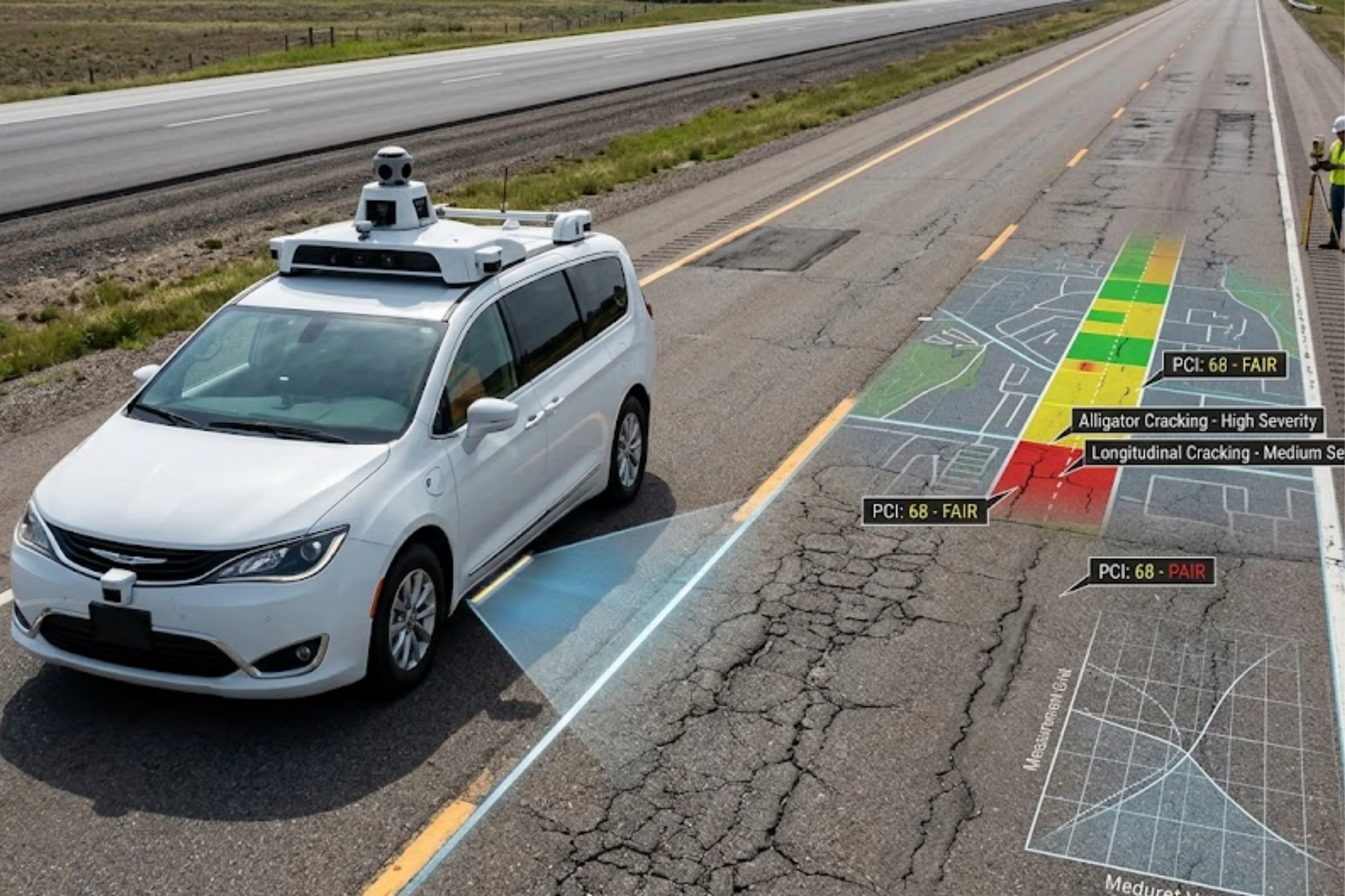
Rather than waiting for a manual inspection team to drive a route every few months, AI-powered systems can continuously analyze data from multiple sources:
The AI layer ingests this raw data, identifies defects such as cracking, pothole formation, rutting, and edge deterioration, quantifies severity, and integrates the findings into a dashboard where operations teams can see the full condition picture of their concession in near real time
BOT operators are not ordinary road users they are contractually accountable road managers. Their entire business model depends on maintaining highway assets management to defined standards while controlling the cost of doing so. Several factors make AI road monitoring particularly compelling for this operating model
Concession Agreement Compliance
Most BOT concession agreements specify pavement condition requirements in terms of roughness indices, distress levels, or service quality standards. Falling below these thresholds can trigger financial penalties, force emergency repairs at short notice, or even jeopardize concession renewal. AI monitoring provides continuous, auditable evidence that service level commitments are being met or flags when intervention is needed before a formal inspection reveals a breach.
Long Asset Lifecycles Demand Predictive Thinking
A BOT operator cannot afford to think only about today's potholes. A 25-year concession requires understanding how the pavement is aging, which sections will need resurfacing in 3–5 years, and how traffic growth will accelerate deterioration in specific corridors. AI-powered deterioration modeling turns current condition data into credible forecasts, enabling multi-year maintenance planning and budget certainty.
Kilometre-Scale Networks Are Impossible to Inspect Manually at Required Frequency
Large BOT concessions often cover hundreds or thousands of kilometers of highway. Manually inspecting these at the frequency required to catch defects early is neither practical nor cost-effective. AI monitoring especially when leveraging data from existing fleet vehicles dramatically increases inspection frequency without proportional cost increases.
Liability and Safety
When an accident occurs on a BOT-operated road, one of the first questions asked is: what did the operator know, and when did they know it? AI monitoring systems create a documented, timestamped record of road condition monitoring AI assessments. This audit trail is invaluable in demonstrating due diligence in maintenance obligations.
Understanding the technology stack helps BOT operators make informed procurement and deployment decisions. Here are the primary components of a modern AI road monitoring system
Computer Vision for Defect Detection
Deep learning models trained on large datasets of labeled road images can now detect and classify pavement distresses longitudinal cracking, transverse cracking, alligator cracking, pothole formation, edge failures, and surface raveling with accuracy that matches or exceeds trained human inspectors. Critically, these systems work at scale and speed that humans cannot match.
Modern computer vision models are typically trained on tens of thousands of annotated images across diverse road types, lighting conditions, and climates making them robust to the real-world variability that BOT operators encounter across their networks.
LiDAR and 3D Profiling
LiDAR (Light Detection and Ranging) sensors generate precise three-dimensional maps of the road surface. Combined with AI analysis, LiDAR data can accurately measure rut depth, surface texture, and elevation changes that two-dimensional cameras may miss. For BOT operators managing high-speed motorways where rutting and surface deformation are primary concerns, LiDAR adds a critical layer of measurement precision.
Machine Learning for Deterioration Prediction
Once a road's current condition is known, machine learning models can predict how it will deteriorate over time based on factors including traffic volume, axle loading, climate, pavement age, and historical maintenance records. These predictions inform Maintenance and Rehabilitation (M&R) planning, helping BOT operators allocate budgets optimally across their network.
Cloud-Based Pavement Management Platforms
The data generated by AI road monitoring systems feeds into cloud-based platforms that present condition information through intuitive dashboards, mapping interfaces, and automated reporting tools. These platforms become the operational nerve center for maintenance planning, contractor management, and concession compliance reporting.
For BOT operators considering AI road monitoring adoption, a phased approach reduces risk and builds organizational capability systematically
Step 1: Establish Your Baseline
Before deploying AI monitoring, conduct a comprehensive baseline condition survey of your entire concession. This gives you a clear starting point against which AI-generated data can be validated and provides the historical context that deterioration models need to generate reliable forecasts.
Step 2: Define Your Use Cases and Data Requirements
Not all AI monitoring applications require the same data inputs. Be clear about your primary use cases: Are you primarily focused on compliance reporting? Predictive maintenance planning? Safety monitoring? Contractor performance verification? Defining these priorities will guide your technology selection and data collection strategy.
Step 3: Select Your Data Collection Method
BOT operators typically have multiple options for data collection. Vehicle-mounted systems on dedicated survey vehicles provide the highest data quality but require investment in equipment and survey operations. Leveraging existing maintenance fleet vehicles with smartphone-based sensors offers lower cost and higher frequency at some accuracy tradeoff. For operators managing high-value motorways with strict compliance requirements, a hybrid approach inertial profiler surveys for compliance certification combined with fleet-based AI monitoring for ongoing awareness is increasingly common.
Step 4: Integrate with Existing Asset Management Systems
AI monitoring data delivers maximum value when integrated with your existing pavement management system, maintenance management software, and financial planning tools. Ensure your chosen platform offers open APIs or native integrations with the systems your organization already relies on.
Step 5: Train Your Teams
Technology adoption succeeds or fails based on how well operations teams understand and trust the tools. Invest in training for maintenance managers, field supervisors, and planning staff ensuring they can interpret AI-generated condition reports, act on maintenance recommendations, and contribute to continuous improvement of the monitoring system.
Step 6: Establish a Continuous Improvement Cycle
The best AI road monitoring implementations treat the system as a living tool that improves over time. Regularly validate AI-detected defects against field verification. Feed confirmed findings back into the model training pipeline. Update deterioration models as new maintenance history accumulates. This cycle of validation and refinement progressively increases the accuracy and value of your monitoring investment
Organizations that have deployed AI road monitoring are reporting tangible benefits across multiple dimensions of their operations
Reduction in Inspection Costs: Automated monitoring reduces the need for frequent manual inspection runs, cutting field survey costs by 40–60% in documented cases while actually increasing inspection frequency.
Earlier Defect Detection: AI systems consistently detect pavement distress at earlier stages than periodic manual inspections meaning interventions are less costly and less disruptive because they address minor deterioration before it progresses to major structural failure.
Better Maintenance Budget Allocation: Network-level condition data enables evidence-based prioritization of maintenance spending, directing resources to sections with the highest risk of deterioration or concession compliance breach.
Improved Contractor Accountability: When AI monitoring independently verifies the condition of roads before and after maintenance interventions, BOT operators have objective data to verify contractor work quality and reject substandard repairs.
Stronger Concession Compliance Posture: Continuous monitoring creates a proactive compliance culture operations teams know in advance which sections risk falling below KPI thresholds and can schedule preventive interventions rather than scrambling to respond to formal inspection findings
The question for BOT operators is no longer whether to adopt AI road monitoring it is how quickly they can do so without operational disruption. The combination of dramatically lower costs for sensor hardware, the maturation of computer vision AI pavement inspection, and the emergence of integrated cloud-based platforms has made this technology accessible to operators of all sizes.
Those who move early will build data assets, operational expertise, and predictive models that compound in value over time. Those who wait will find themselves managing concessions reactively responding to formal inspection findings, absorbing avoidable penalties, and making maintenance decisions based on incomplete information.
AI road monitoring is not a replacement for engineering judgment or experienced maintenance teams. It is a powerful tool that makes those teams dramatically more effective giving them the visibility, data, and decision support they need to maintain roads to high standards efficiently and sustainably across the full lifecycle of a BOT concession.
Book a demo with RoadVision AI to explore how AI-driven road surveys can improve highway maintenance, safety, and infrastructure decision-making
A: Modern AI computer vision systems, when properly trained and validated, achieve detection accuracy rates of 85–95% for common pavement distresses such as cracking and pothole identification. For structured condition surveys, AI performance is comparable to experienced human inspectors with the significant advantage of consistency, speed, and scalability. Accuracy improves further when systems are fine-tuned on local road types and surface conditions specific to a given concession.
Q: How does AI road monitoring integrate with existing concession agreement reporting requirements?
A: Leading AI road monitoring platforms are designed with compliance reporting in mind. They generate audit-ready reports that align with common pavement condition KPIs IRI thresholds, distress index scores, response time documentation in formats acceptable to concession authorities and lenders. Always verify that your chosen platform's reporting outputs align with your specific concession agreement requirements before deployment.
Q: How should BOT operators handle data privacy and road user data?
A: Road monitoring systems that use cameras or connected vehicle data must be designed in compliance with applicable data protection regulations. Reputable AI road monitoring vendors build privacy safeguards into their platforms including automatic anonymization of vehicle license plates and faces captured in survey imagery. BOT operators should confirm their vendor's data handling practices and ensure alignment with national data protection frameworks before deployment.
The Autonomous Road Engineer
AI-powered road condition monitoring, asset management, & infrastructure intelligence helping agencies move from reactive maintenance to predictive road management.


.webp)
.webp)