
At any given moment on a busy highway, thousands of vehicles pass a fixed point every hour. Each one carries a number plate a small rectangle of aluminium or plastic that is, in fact, one of the most information-rich identifiers in the entire transportation ecosystem. A number plate connects a vehicle to its registered owner, its insurance status, its emissions compliance record, its outstanding fines, its travel history across a monitored network, and in some cases, its connection to active law enforcement investigations.
For most of road monitoring history, extracting that information required a human officer, a manual check, and a traffic stop. The process was slow, dangerous, and applicable to only a vanishingly small fraction of the vehicles actually using the road at any moment.
Automatic Number Plate Recognition (ANPR) also known as Automatic License Plate Recognition (ALPR) changes that reality entirely. By combining high-speed cameras, computer vision, and AI-powered optical character recognition, ANPR systems can read, record, and cross-reference vehicle plates at highway speeds, in any lighting condition, across multiple lanes simultaneously and return a match result in under 200 milliseconds.
The applications of this capability across road monitoring are vast and growing. From toll collection and traffic enforcement to stolen vehicle recovery, border security, and smart city analytics, ANPR technology has become one of the foundational layers of modern intelligent transportation infrastructure.
RoadVision AI delivers ANPR solutions engineered for the full complexity of real-world road environments built for speed, accuracy, privacy compliance, and seamless integration with existing road monitoring and enforcement infrastructure.
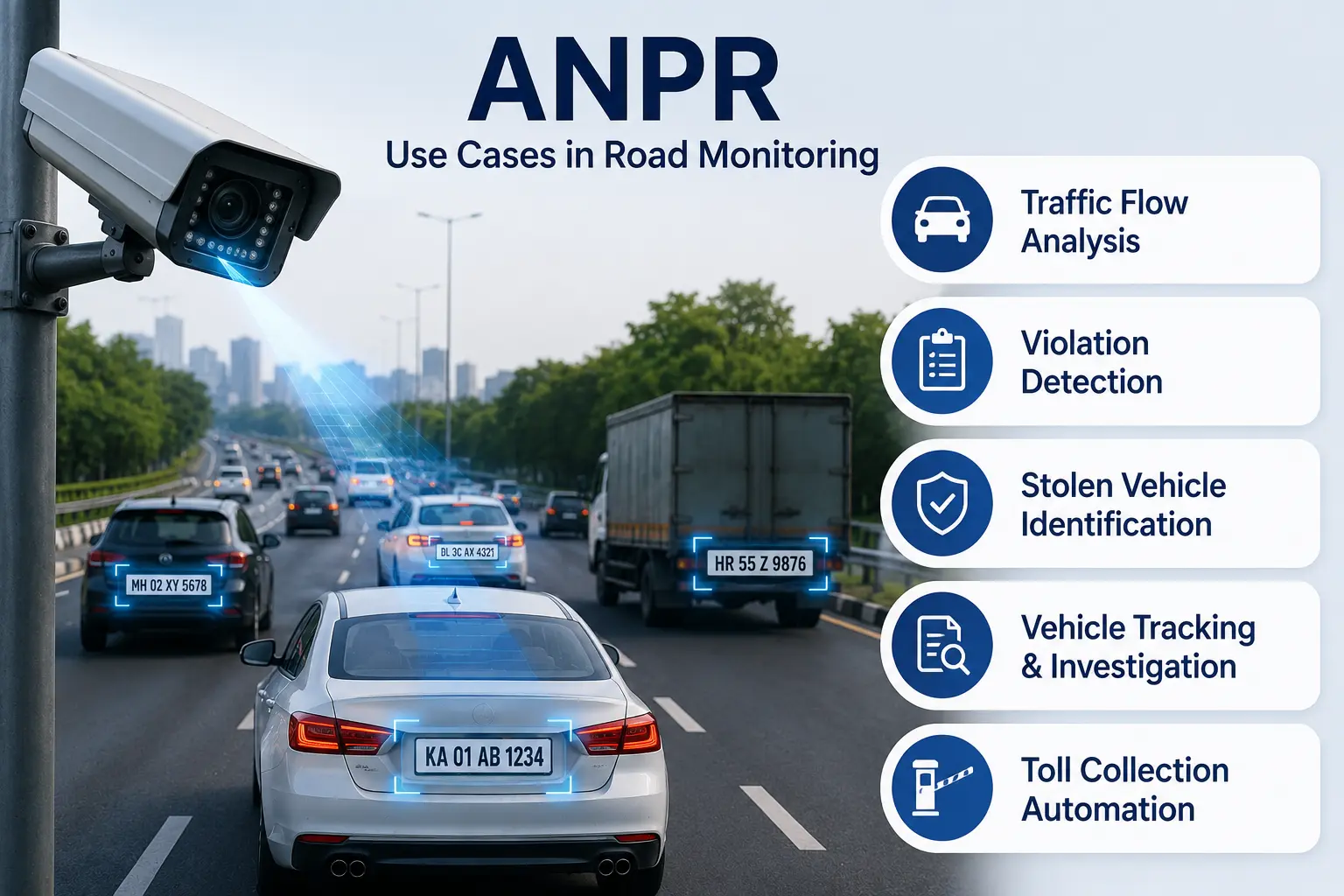
Automatic Number Plate Recognition (ANPR) is a technology that uses optical character recognition (OCR) applied to camera imagery to automatically read vehicle number plates and convert them into machine-readable text data in real time, at scale, without human intervention.
A complete ANPR system comprises several integrated components working in sequence:
Image Capture Specialized cameras typically high-speed, high-resolution units with infrared illumination capture clear images of vehicle plates regardless of vehicle speed, time of day, or ambient lighting. Infrared illumination is critical for consistent plate readability at night and in adverse weather, as it eliminates the glare and shadow variability that defeats standard cameras.
Plate Detection A computer vision model locates the number plate within the full camera frame, isolating the plate region from the surrounding vehicle and background imagery. Modern deep learning-based detectors handle varied plate positions, angles, partial occlusion, and damage with high reliability.
Character Segmentation and Recognition An OCR engine trained specifically on number plate fonts, spacing conventions, and regional plate formats reads the individual characters of the detected plate and assembles them into a complete plate string. Advanced models handle faded plates, dirt obscuration, non-standard fonts, and damage-related character distortion.
Database Cross-Reference The recognized plate string is instantly checked against one or more databases vehicle registration records, stolen vehicle lists, outstanding warrant flags, watch lists, toll account records, or permit registries and a match result is returned within milliseconds.
Logging and Action Triggering Every read matched or unmatched is logged with timestamp, GPS location, camera identifier, and confidence score. Matched records trigger configured actions: alerts to enforcement officers, barrier opening at toll plazas, access grant or denial at controlled facilities, or flagging for subsequent investigation.
RoadVision AI's ANPR platform integrates all of these components with accuracy rates exceeding 98.5% across standard Canadian and North American plate formats, operating reliably at vehicle speeds up to 200 km/h.
Toll collection is one of the most widespread and economically significant ANPR applications in road infrastructure. Traditional toll plazas requiring vehicles to stop or slow significantly create traffic bottlenecks, increase accident risk, generate emissions from idling vehicles, and require substantial staffing costs.
Free-flow tolling, enabled by ANPR, eliminates all of these problems. Gantry-mounted cameras read every vehicle's plate as it passes at full highway speed. The system matches the plate to a registered toll account and processes payment automatically or issues a violation notice to vehicles without a valid account. No stopping. No booths. No queues.
RoadVision AI's free-flow tolling platform handles multi-lane, multi-vehicle environments with a plate-read accuracy and account-match rate that meets the operational requirements of concession highway operators, bridge authorities, and provincial toll programs. The system integrates with all major transponder technologies, enabling hybrid environments where transponder-equipped vehicles are processed via electronic means while plate recognition serves as both the primary method for non-transponder vehicles and the enforcement backstop for transponder non-reads.
Beyond standard toll collection, ANPR enables distance-based charging calculating tolls based on the actual distance a specific vehicle travels on a tolled network between entry and exit points and congestion pricing dynamically adjusting tolls based on real-time traffic density to manage demand and reduce peak-hour congestion.
ANPR is a foundational technology for automated traffic enforcement removing the requirement for a police officer to be physically present at every enforcement point and enabling consistent, 24-hour-a-day enforcement across an unlimited number of locations simultaneously.
Red Light Enforcement ANPR-integrated red light cameras capture the plates of vehicles entering an intersection after the signal has turned red, associating the violation with the registered vehicle owner for infringement notice issuance. RoadVision AI's system captures front and rear plate images simultaneously, providing comprehensive evidence packages that withstand legal challenge.
Speed Enforcement Fixed and mobile speed enforcement systems use ANPR to associate speed measurements derived from radar, LiDAR, or point-to-point average speed calculation with specific vehicle registrations. Average speed enforcement, where ANPR reads at two fixed points and calculates the average speed across the intervening distance, is particularly effective at sustained compliance rather than the localized speed reduction that spot-check radar produces.
Bus Lane and HOV Enforcement High-occupancy vehicle lane and bus lane compliance enforcement is a significant and growing ANPR application in congested urban corridors. Cameras mounted in dedicated lanes read plates of vehicles using the lane, cross-referencing against exemption registries to identify and fine non-compliant vehicles without requiring traffic officers to stand in active traffic.
School Zone and Construction Zone Enforcement Automated ANPR enforcement in school zones and active construction zones, where speed limits are reduced and penalties are elevated, provides consistent deterrent effect around the clock not only during the hours when enforcement officers are physically deployed.
One of the highest-impact law enforcement applications of ANPR is real-time stolen vehicle detection. Law enforcement ANPR networks deployed on highway gantries, patrol vehicles, and fixed installations at key road network nodes continuously cross-reference every plate read against the national stolen vehicle database.
When a stolen plate is detected, an instant alert is generated to the nearest patrol unit, including the vehicle's location, direction of travel, and speed enabling rapid interception without the dangerous high-speed pursuits that manual detection often necessitates.
RoadVision AI's ANPR platform connects to the Canadian Police Information Centre (CPIC) database and provincial law enforcement records systems, enabling real-time flagging of stolen vehicles, suspended registrations, uninsured vehicles, and vehicles associated with active warrants providing road monitoring networks with a continuous, automated layer of law enforcement intelligence.
At land border crossings and ports of entry, ANPR is deployed to pre-screen arriving vehicles before they reach a primary inspection officer dramatically improving throughput and focusing officer attention on genuinely high-risk vehicles rather than routine passenger traffic.
Advance plate reads allow border systems to retrieve the vehicle's crossing history, importation records, and any applicable watch-list flags before the vehicle reaches the booth, enabling officers to make faster, better-informed decisions. For trusted traveller programs such as NEXUS in Canada ANPR provides the vehicle verification layer that enables expedited processing lanes to operate with minimal officer interaction.
RoadVision AI's border-capable ANPR platform handles the full range of North American and international plate formats, including U.S. state and Canadian provincial plates across all 50 states and 13 provinces and territories, as well as Mexican plates and the most common international formats encountered at marine and air cargo facilities.
Urban parking enforcement has been transformed by ANPR. Mobile ANPR units mounted on enforcement vehicles scan entire streets as the vehicle drives its patrol route, automatically identifying vehicles in violation expired meters, permit zone violations, street cleaning infractions without requiring officers to physically examine each vehicle.
The productivity difference is dramatic: a manual parking enforcement officer can check approximately 50 to 80 vehicles per hour. An ANPR-equipped enforcement vehicle scans 1,000 or more plates per hour with consistent accuracy. Municipal parking authorities using RoadVision AI's mobile enforcement platform report 200 to 400% increases in violation detection rates alongside significant reductions in officer exposure to traffic hazards.
For controlled access facilities private parking structures, hospital campuses, corporate parks, secure government facilities, and residential complexes ANPR provides frictionless access control. Registered vehicles are recognized and gates open automatically without the driver stopping to present a card or ticket. Unregistered or unauthorized vehicles are denied entry and logged for security review.
Beyond enforcement, ANPR generates exceptionally rich traffic intelligence data. By reading and recording plates across a network of monitoring points without storing personally identifiable information ANPR systems build a precise, real-time picture of how vehicles actually move through a road network.
Origin-destination studies — traditionally conducted through expensive and statistically limited roadside interview surveys can be replaced by ANPR-derived plate matching between network entry and exit points, producing far larger sample sizes at a fraction of the cost.
Journey time monitoring — calculating actual travel times between ANPR points on a corridor provides transportation authorities with live congestion measurement data that is far more accurate than speed loop detectors or GPS probe vehicle sampling alone.
Traffic volume and classification counts — derived from ANPR reads combined with vehicle type classification models give highway authorities the detailed, vehicle-class-disaggregated traffic data required for pavement design, bridge loading analysis, and transportation demand modeling.
RoadVision AI's analytics platform processes ANPR read data through a privacy-preserving anonymization pipeline plate strings are hashed immediately after matching, ensuring no personally identifiable travel history is retained while producing all required traffic analytics outputs.
Heavy vehicle overloading causes disproportionate pavement damage a single overloaded axle causes road damage equivalent to thousands of standard passenger vehicle passes. Identifying and enforcing against overweight vehicles is a significant highway asset protection priority.
ANPR integrated with weigh-in-motion (WIM) sensor networks enables automated pre-screening of heavy vehicles. When a WIM sensor flags a vehicle as potentially overweight, the simultaneously captured ANPR read identifies the specific vehicle and operator enabling targeted enforcement without requiring all heavy vehicles to stop at weigh stations.
RoadVision AI's platform supports integration with WIM systems, bridge weigh-in-motion installations, and virtual weigh station networks, delivering commercial vehicle compliance monitoring that is both more comprehensive and less disruptive to freight movement than traditional static weigh station programs.
At the city scale, ANPR data — aggregated and anonymized — becomes a powerful urban mobility intelligence asset. Cities deploying RoadVision AI's ANPR platform at key network points gain a continuously updated picture of vehicle volumes, journey patterns, and network utilization that informs:
The power of ANPR creates an obligation to deploy it responsibly. RoadVision AI's platform is built on privacy-by-design principles that ensure ANPR delivers its public safety and traffic management benefits without creating disproportionate surveillance infrastructure.
Data minimization — only the data required for the specific operational purpose is captured and retained. Enforcement applications retain the minimum evidence package required for infringement notice issuance. Analytics applications anonymize plate data immediately after matching.
Retention limits — configurable data retention periods ensure that historical plate read records are automatically purged after the operationally required period typically 24 to 72 hours for non-matched reads in monitoring applications, or the statutory limitation period for enforcement records.
Access controls — all plate read data is accessible only to authorized personnel for authorized purposes, with full audit logging of every data access event.
Regulatory compliance — RoadVision AI's platform is configurable to meet the requirements of PIPEDA, provincial privacy legislation, and applicable municipal by-laws governing the deployment of vehicle monitoring technology.
Our approach reflects a clear principle: ANPR is a road monitoring and safety tool, not a mass surveillance instrument. Deployed with appropriate governance and technical controls, it delivers substantial public benefit while respecting the privacy rights of road users.
RoadVision AI brings together the technical depth of an AI-first engineering organization with the operational understanding of a team that has worked directly with transportation authorities, law enforcement agencies, and infrastructure operators across Canada and North America.
Our ANPR platform is not a white-labeled generic product it is engineered for the specific challenges of Canadian road environments: extreme temperature ranges, variable lighting, provincial plate format diversity, bilingual plate text, winter-condition plate obscuration, and the specific database integration requirements of Canadian law enforcement and transportation systems.
We offer end-to-end deployment support from site survey and camera specification through system integration, operator training, and ongoing performance monitoring ensuring that every ANPR deployment achieves and maintains the accuracy and reliability standards that public-facing road monitoring applications demand.
The number plate has been a fixture of road vehicles for over a century but for most of that time, its potential as a real-time road monitoring tool was limited by the speed at which humans could read it. Automatic Number Plate Recognition removes that limitation entirely, transforming a passive identifier into an active, continuously readable data point that powers a remarkable breadth of road monitoring, enforcement, safety, and analytics applications.
From free-flow toll collection and automated speed enforcement to stolen vehicle recovery, smart parking management, and urban traffic intelligence, ANPR is becoming as fundamental to road infrastructure as the markings painted on the road surface itself.
RoadVision AI delivers ANPR technology that is accurate enough for enforcement, fast enough for highway speeds, robust enough for Canadian winters, and governed carefully enough to meet the privacy standards that public trust demands. Whether your application is a single controlled-access facility or a province-wide enforcement and monitoring network, RoadVision AI has the platform, the expertise, and the Canadian operational experience to make it work.
Ready to explore what ANPR can do for your road monitoring operations? Contact RoadVision AI today to discuss your requirements or arrange a live system demonstration.
RoadVision AI's ANPR platform achieves plate recognition accuracy exceeding 98.5% across standard Canadian and North American plate formats under normal operating conditions. Performance is maintained across day and night conditions, vehicle speeds up to 200 km/h, and common environmental variables including rain, snow, and dust. Accuracy on damaged, faded, or heavily obscured plates is lower and is flagged for manual review.
Yes. RoadVision AI's multi-lane ANPR configuration processes simultaneous plate reads across up to eight lanes from a single gantry installation, with no reduction in read speed or accuracy. The system is designed for high-volume deployments including freeway mainline monitoring, toll plazas, and border crossing lanes.
The platform recognizes all Canadian provincial and territorial plate formats, all U.S. state plate formats, Mexican federal and state plates, and the most common international plate formats encountered at Canadian ports of entry. Custom format training is available for specialized applications requiring recognition of non-standard plates.
RoadVision AI's camera hardware is rated for operation at temperatures as low as –40°C. Infrared illumination provides consistent plate visibility regardless of ambient light or winter darkness. The plate detection model includes training examples for snow-obscured and road-salt-contaminated plates, maintaining high accuracy across seasonal conditions. Heavily snow-covered plates that obscure characters are flagged as low-confidence reads for manual follow-up.
The Autonomous Road Engineer
AI-powered road condition monitoring, asset management, & infrastructure intelligence helping agencies move from reactive maintenance to predictive road management.


.webp)
.webp)
.webp)