
Bridges and roads are often managed as if they were entirely separate categories of infrastructure different inspection teams, different software systems, different budget lines, different regulatory frameworks. In reality, they're deeply interconnected: a bridge is simply a specialized, higher-risk segment of the road network it carries. When these two asset classes are managed in isolation, agencies lose the ability to make coordinated, network-wide decisions about where to invest limited maintenance dollars.
A Bridge & Road Management System (BRMS) addresses this by bringing bridge and road asset data together into a single, integrated management platform. And increasingly, AI is being layered into these systems to automate data collection, improve condition assessment accuracy, and support smarter, more predictive maintenance planning. In this blog, we'll explore what a BRMS is, its core components, why integrating bridge and road management matters, and how AI is reshaping what these systems can do.
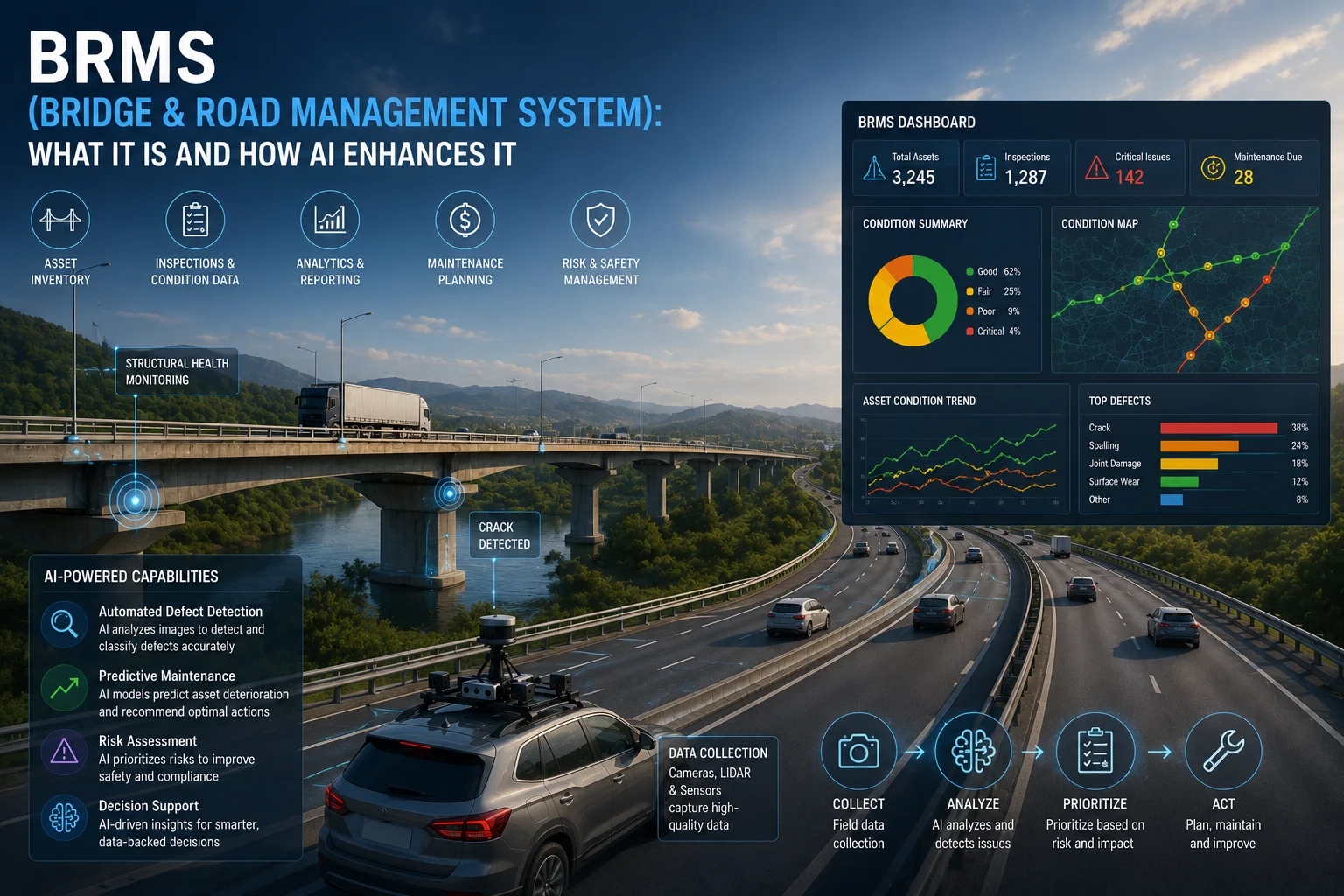
A Bridge & Road Management System is an integrated software platform used by transportation agencies to plan, track, and manage the condition, maintenance, and lifecycle of both bridge structures and road pavement within a single system. Rather than operating separate bridge management systems (BMS) and pavement management systems (PMS) as disconnected tools, a BRMS unifies these functions, allowing agencies to:
The core value of a BRMS lies in this integration giving planners and engineers a single, coherent view of infrastructure condition and risk across an entire transportation network, rather than fragmented views limited to individual asset types.
Historically, bridge and road management have evolved as distinct disciplines, each with its own specialized engineering practices, inspection protocols, and software tools:
While these distinctions are legitimate from an engineering standpoint, they create a real planning problem: when bridge and road budgets, condition data, and prioritization processes are managed entirely separately, agencies lose the ability to make holistic, network-level decisions. A bridge approach road might be in urgent need of resurfacing while the structure itself is in excellent condition or vice versa and without integrated visibility, these interconnected priorities can be poorly coordinated.
A comprehensive digital inventory of every bridge and road segment within the network, including structural details, materials, age, and geospatial location, forming the foundational dataset for all other BRMS functions.
Centralized storage and management of inspection records for both bridges and roads, including standardized condition ratings, historical trends, and supporting documentation such as photos or inspection reports.
Analytical tools that use historical condition data, traffic loads, environmental exposure, and material characteristics to forecast how specific assets are likely to deteriorate over time, supporting proactive rather than reactive maintenance planning.
Prioritization and budgeting modules that help agencies allocate limited maintenance funding across both bridge and road assets based on condition, risk, traffic significance, and available budget scenarios.
Functionality to generate, assign, and track maintenance and repair work orders, closing the loop between identified needs and completed work.
Geographic information system integration that allows planners to visualize bridge and road condition data spatially, identifying clusters of risk or coordinating nearby maintenance projects.
Standardized reporting tools that help agencies meet regulatory and compliance requirements specific to bridge inspection frequency, structural rating systems, and road maintenance documentation.
AI-powered computer vision, applied to imagery from drones, vehicle-mounted cameras, or fixed sensors, can automatically detect and classify surface defects on roads and visible structural issues on bridges such as cracking, spalling, or corrosion staining nsignificantly reducing the manual effort required for routine condition documentation.
AI models can analyze far more variables and historical patterns than traditional statistical deterioration curves, incorporating traffic loads, weather exposure, material properties, and maintenance history to generate more accurate, asset-specific deterioration forecasts for both bridges and roads.
For critical bridge structures, AI can analyze data from embedded sensorsnstrain gauges, accelerometers, tilt sensors to detect early signs of structural stress or movement, enabling proactive intervention before issues become visible through traditional visual inspection alone.
AI-driven analytics can help agencies optimize maintenance prioritization across combined bridge and road portfolios, factoring in interdependencies such as coordinating a bridge deck repair with resurfacing of the connecting road segment to minimize repeated traffic disruption.
AI models can flag unusual patterns in inspection data an asset deteriorating faster than comparable structures, or a sudden change in sensor readings—that might not be immediately apparent through standard reporting, prompting earlier investigation.
AI, including large language model-based tools, can help translate complex technical condition data into clear, accessible summaries for non-technical stakeholders, supporting budget justification and public communication.
By combining deterioration modeling with maintenance history and budget constraints, AI can recommend optimized maintenance schedules that balance cost efficiency with risk management across the entire bridge and road portfolio.
As AI capabilities and sensor technology continue to advance, BRMS platforms are likely to become increasingly predictive, integrated, and automated. Emerging directions include:
A Bridge & Road Management System represents a meaningful step toward more coordinated, evidence-based infrastructure management breaking down the historical silos between bridge and pavement engineering to support genuinely network-level planning and investment decisions. With AI layered into these systems, agencies gain not just integration, but significantly enhanced capabilities: automated condition detection, more accurate deterioration forecasting, and smarter, cross-asset maintenance prioritization. As AI and sensor technology continue to mature, BRMS platforms are set to become an increasingly essential tool for transportation agencies managing the safety, reliability, and long-term resilience of their combined bridge and road infrastructure.
BRMS stands for Bridge & Road Management System, an integrated software platform used to manage the condition, maintenance, and lifecycle of both bridge structures and road pavement within a single system.
A BRMS integrates bridge and road asset data into one unified platform, enabling coordinated, network-level planning and prioritization, whereas separate systems manage each asset type independently without shared visibility.
AI enhances BRMS platforms through automated condition data collection from imagery and sensors, more accurate deterioration forecasting, structural health monitoring analysis, and AI-driven cross-asset maintenance prioritization.
No. AI can support and enhance data collection and analysis, particularly for surface-level defect detection and sensor data trends, but critical structural safety determinations for bridges typically still require qualified structural engineering judgment.

The Autonomous Road Engineer
AI-powered road condition monitoring, asset management, & infrastructure intelligence helping agencies move from reactive maintenance to predictive road management.


.webp)
.webp)
.webp)