
Every highway authority, road agency, and BOT operator manages two road networks simultaneously. There is the physical one asphalt, bridges, signs, drainage, guardrails and the informational one: everything that is known about those physical assets, from construction dates and material specifications to current condition scores and maintenance histories.
For most of the history of modern road management, these two worlds have been poorly connected. Physical inspections generated paper reports filed in cabinets. Condition data lived in spreadsheets disconnected from spatial context. Maintenance records existed in systems that could not communicate with planning tools. The result was a persistent and costly gap between what road managers knew about their network and what they needed to know to manage it well.
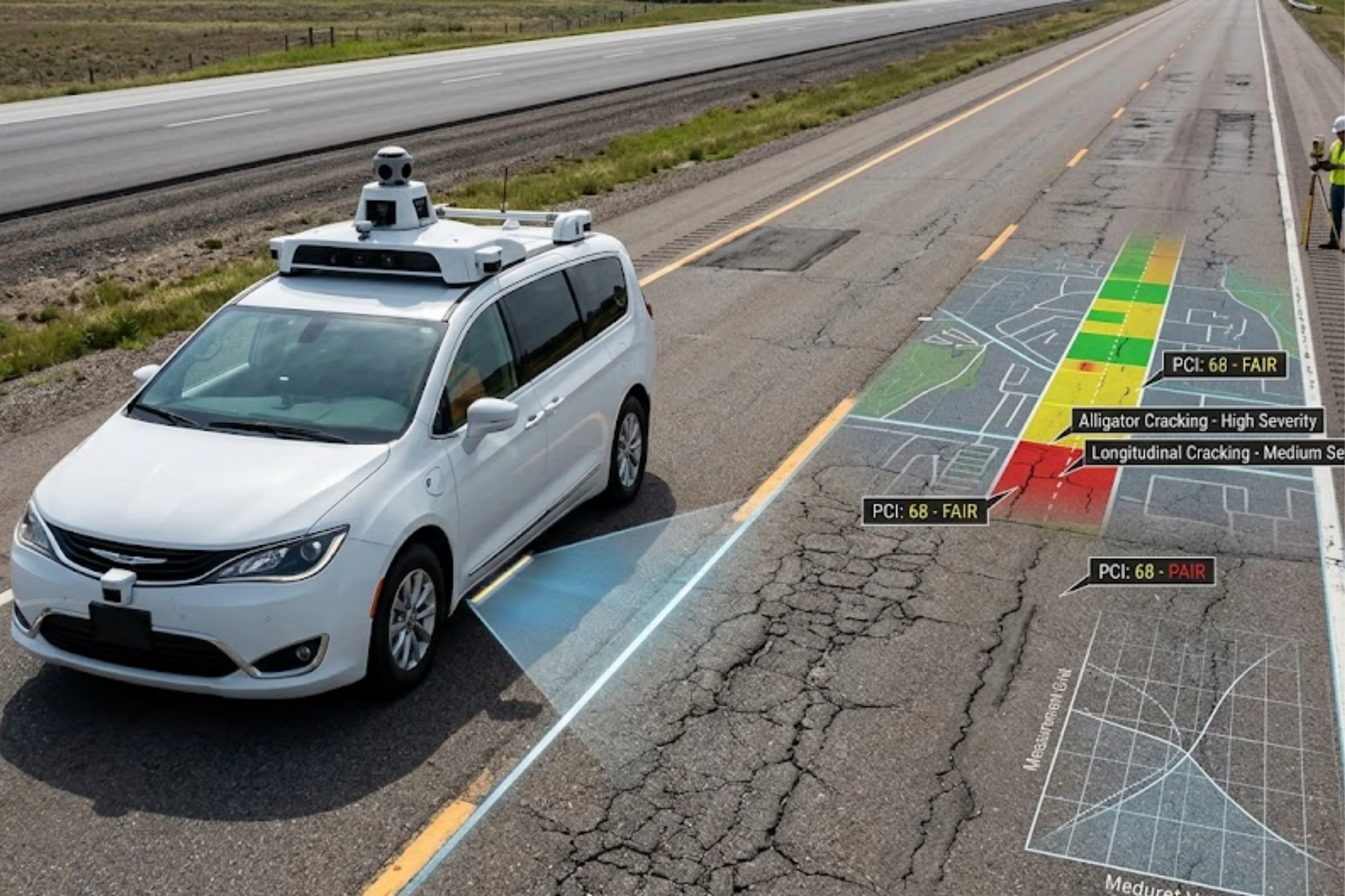
GIS Geographic Information System technology is closing that gap. And its most powerful application in road infrastructure today is the concept of the highway digital twin: a dynamic, spatially accurate, continuously updated virtual representation of a road network that mirrors the real asset in real time and enables operators to make better decisions than they ever could from physical inspection alone.
This blog explores what GIS road asset management means in practice, how digital twins are built, what they can do for highway operators, and how organizations of any size can begin the journey toward a fully connected asset management capability.
.webp)
GIS road asset management is the practice of capturing, storing, analyzing, and acting on information about road infrastructure assets pavements, bridges, culverts, signs, markings, lighting, barriers, and more within a spatially referenced framework that ties every data point to its precise location on the road network.
At its foundation, a GIS road asset management system answers questions that spreadsheets and non-spatial databases fundamentally cannot:
The spatial dimension transforms AI asset management from inventory-keeping into decision intelligence. When every asset is located on a map with its full attribute history attached the road network becomes something that can be analyzed, modeled, and optimized rather than merely recorded.
The term "digital twin" originated in manufacturing, where precise virtual replicas of physical machines enabled engineers to simulate performance, test changes, and predict failures without touching the real equipment. Applied to highways, the concept scales dramatically in scope but the principle remains the same: create a virtual model of the physical asset that is accurate enough, rich enough in data, and current enough in its updates to serve as a reliable proxy for reality.
A highway digital twin is not simply a map with asset locations marked. It is a living, integrated data environment that combines:
Geometric accuracy — the road network represented in three dimensions with survey-grade positional accuracy, capturing alignment, gradient, cross-section, and surface profile.
Asset inventory — every maintainable component of the road infrastructure catalogued with attributes including type, material, dimensions, age, manufacturer, installation date, and design life.
Condition data — regularly updated pavement condition scores, structural assessments, distress surveys, and defect records linked spatially to the precise locations where they were collected.
Operational data — traffic counts, axle load surveys, speed profiles, and incident records that describe how the road is being used and what stresses it is experiencing.
Maintenance and intervention history — a complete record of every treatment applied to every asset, enabling accurate deterioration modeling and warranty tracking.
Environmental and contextual data — climate zone, drainage characteristics, soil conditions, and proximity to utilities or sensitive areas that influence maintenance decisions.
When these layers are integrated within a GIS environment and kept current through automated data feeds, sensor inputs, and structured update workflows, the result is a digital twin capable of supporting decisions that would be impossible with any single data source alone.
Building a highway digital twin starts with understanding the data layers that underpin it. Each layer has its own collection methodology, update frequency, and management requirements.
Network Geometry Layer
The foundation of any road GIS system is an accurate representation of the road network itself centerlines, carriageway extents, intersection topology, and kilometrage referencing. Linear referencing systems (LRS) are particularly important in road asset management, as they allow any feature or event a pothole, a speed limit sign, a maintenance treatment to be located precisely on the network by route and chainage, enabling consistent cross-referencing across datasets collected by different methods at different times.
Pavement Asset Layer
This layer captures the pavement structure across the network surface type, base construction, pavement age, and construction history. When combined with condition data and traffic loading, it enables pavement family grouping for deterioration modeling and life-cycle cost analysis.
Condition Data Layer
Pavement condition surveys including roughness (IRI), rutting, cracking, texture, and skid resistance are stored as time-stamped condition events linked to the network geometry. Multiple survey vintages allow trend analysis: the system can show not just current IRI but how IRI has evolved at each location over successive survey cycles, enabling credible remaining life estimates.
Inventory Assets Layer
Bridges, culverts, retaining walls, tunnels, signs, road markings, lighting columns, barriers, and drainage infrastructure all constitute discrete assets that need to be inventoried, inspected, and maintained. Each asset carries its own attribute set, inspection schedule, and condition grading framework within the GIS environment.
Maintenance History Layer
Every treatment resurfacing, patching, crack sealing, drainage clearing, sign replacement is recorded as a spatial event on the network with treatment type, material, contractor, cost, and date. This layer is essential for understanding where money has been spent, validating deterioration models, and demonstrating concession compliance.
Risk and Hazard Layer
Flood risk zones, landslide susceptibility areas, high-accident locations, and other spatial risk factors can be overlaid on the asset layers to prioritize maintenance and capital investment in locations where asset failure has the highest consequence.
For organizations beginning or advancing their GIS road asset management journey, a structured implementation approach avoids common pitfalls and builds capability systematically.
Phase 1: Data Foundation and Network Referencing
Everything in a highway digital twin depends on accurate network geometry and a robust linear referencing system. Invest in this foundation before layering on condition data or asset inventories. Errors or inconsistencies in network geometry propagate into every dataset linked to it, undermining the reliability of the entire system.
Commission a high-accuracy mobile mapping survey using LiDAR and calibrated cameras to capture the road network in three dimensions with centimeter-level positional accuracy. Establish a clear linear referencing convention and ensure all existing data can be re-referenced to it.
Phase 2: Asset Inventory
Conduct a systematic inventory of all maintainable assets across the network. For large road networks, mobile mapping vehicles equipped with AI-powered object recognition can accelerate sign, marking, and furniture inventories dramatically compared to manual field recording. The output of this phase is a complete, spatially accurate asset register — the skeleton on which condition data and maintenance history will be built.
Phase 3: Condition Baseline Survey
Collect a comprehensive baseline condition survey across the network using certified measurement equipment. For pavement, this means inertial profiler surveys for IRI, automated distress surveys for cracking and surface defects, and falling weight deflectometer (FWD) testing for structural assessment on priority sections. Load all condition data into the GIS environment linked to the network geometry.
Phase 4: Historical Data Migration
Existing maintenance records, previous condition surveys, construction records, and AI road inspection reports hold valuable information about how the network has behaved over time. Invest in migrating and geo-referencing this historical data into the GIS environment even imperfect historical data significantly improves the quality of deterioration modeling and remaining life estimates.
Phase 5: Integration and Automation
A digital twin that requires constant manual data entry quickly becomes stale and unreliable. Build automated data pipelines that feed condition updates, maintenance records, and sensor data into the GIS environment with minimal human intervention. Connect the GIS platform with maintenance management systems, financial systems, and external data sources such as traffic counters and weather stations.
Phase 6: Analysis, Modeling, and Decision Support
With data flowing consistently into the digital twin, the focus shifts to extracting value through analysis. Configure deterioration models calibrated to your network's characteristics. Set up condition threshold alerts that notify maintenance managers when sections approach compliance boundaries. Build scenario analysis tools that let planners compare the long-term network condition and cost outcomes of different M&R budget strategies.
Organizations that have invested in GIS road asset management and digital twin capabilities consistently report benefits across financial, operational, and compliance dimensions.
Optimized Maintenance Spending: Network-level visibility of condition and deterioration trajectories enables evidence-based budget allocation directing spending to where it prevents the most deterioration relative to cost, rather than where complaints are loudest.
Extended Pavement Service Life: Timely preventive treatments guided by digital twin condition data consistently outperform reactive maintenance in life-cycle cost analysis. Treating a road at the right time with the right intervention can add years to pavement service life at a fraction of the cost of deferred rehabilitation.
Regulatory and Concession Compliance: Digital twins provide continuous, auditable documentation of network condition invaluable for compliance reporting to concession authorities, regulators, and infrastructure lenders.
Improved Emergency Response: When an incident occurs a flood, a landslide, a structural failure a digital twin gives emergency managers immediate access to detailed asset information, surrounding infrastructure context, and maintenance history to support rapid, well-informed response.
Stakeholder Communication: GIS-based visualizations of road condition, planned maintenance programs, and investment priorities communicate complex technical information clearly to non-technical stakeholders including elected officials, investors, and the public.
Roads are among the most capital-intensive assets that governments and private concessionaires manage. The decisions made about when to maintain them, where to invest, and how to sequence interventions have consequences that play out over decades and involve billions in public and private funds.
GIS road asset management and the highway digital twin concept represent a step change in the quality of information available to support those decisions. By creating a spatially accurate, data-rich, continuously updated virtual model of the physical road network, operators gain visibility, predictive capability, and decision confidence that simply cannot be achieved through periodic manual inspection and disconnected data systems.
The technology is mature, accessible, and proven. Organizations that invest in building their highway digital twin today are not just improving their operational efficiency they are building the data foundation that will power AI-driven road monitoring, automated maintenance optimization, and next-generation AI infrastructure management for the decades ahead.
Book a demo with RoadVision AI to explore how AI-driven road surveys can improve highway maintenance, safety, and infrastructure decision-making.
A: AI pavement management system focuses specifically on pavement condition data, deterioration modeling, and maintenance treatment optimization for road surfaces. A GIS road asset management system is broader it encompasses all road infrastructure assets (pavements, bridges, signs, drainage, etc.) within a spatially referenced environment. In practice, many modern platforms combine both capabilities, using GIS as the spatial backbone and incorporating PMS-style analytical functions for pavement-specific decision support.
A: You can begin with what you have. A basic network geometry layer and a single condition survey cycle are enough to start building value. The digital twin becomes progressively more powerful as additional asset inventory data, historical records, and condition survey vintages are added. The key is establishing the data architecture correctly from the outset so that new data integrates cleanly as it is collected.
A: Esri's ArcGIS platform particularly ArcGIS for Roads and Highways is the most widely used in large public road agencies globally. QGIS is a capable open-source alternative used by smaller agencies and in developing countries. Specialist road asset management platforms including Bentley AssetWise, Pitney Bowes Confirm, and dTIMS often include native GIS integration. The right choice depends on organizational scale, existing IT infrastructure, budget, and the technical capabilities of your team.
A: Absolutely. Cloud-based GIS platforms and lower-cost mobile data collection tools have dramatically reduced the entry barriers for smaller organizations. A municipality managing a few hundred kilometers of road can build a meaningful digital twin using smartphone-based surveys, open-source GIS tools, and cloud-hosted asset management software at a fraction of the cost that was required a decade ago. The analytical and compliance benefits scale down effectively to smaller networks.

The Autonomous Road Engineer
AI-powered road condition monitoring, asset management, & infrastructure intelligence helping agencies move from reactive maintenance to predictive road management.


.webp)
.webp)