
Ask any road construction contractor or civil engineering firm about their biggest operational headache, and the answer rarely involves laying asphalt or operating heavy equipment. The real pain the one that consumes thousands of hours of skilled staff time, drives up overhead costs, and quietly determines whether a company grows or stagnates happens long before a single machine touches the road.
It happens in procurement.
Road tender monitoring and bid preparation are among the most labour-intensive, error-prone, and inefficiently managed processes in the entire infrastructure sector. At any given moment, transportation authorities across a province, state, or country are publishing dozens sometimes hundreds of road maintenance and construction tenders across government procurement portals, municipal websites, and industry databases. Staying on top of every relevant opportunity requires dedicated staff scanning multiple platforms daily. Missing a tender means missing revenue. Responding to the wrong ones wastes resources.
And when a relevant tender is identified, the work has only just begun. Bid preparation for road contracts involves compiling condition assessments, calculating quantities, sourcing subcontractor quotes, reviewing specifications, building cost models, and assembling submission packages a process that can consume 40 to 200 hours of professional time per bid, with no guarantee of success.
AI-powered road tender monitoring and bid preparation is changing this equation dramatically. RoadVision AI's intelligent procurement platform automates the discovery, evaluation, and preparation phases of the road contract lifecycle enabling contractors and road authorities alike to work faster, bid smarter, and win more efficiently than any manual process allows.
To appreciate what AI automation delivers, it is necessary to first understand just how dysfunctional the status quo remains even in an era where most other business processes have been digitized and streamlined.
Tender discovery is fragmented and manual. Road tenders in Canada alone are published across dozens of platforms Merx, Biddingo, provincial ministry procurement portals, municipal websites, and regional authority databases. There is no single authoritative aggregator. Contractors either pay staff to manually scan every platform daily, subscribe to expensive and incomplete aggregation services, or most commonly miss opportunities because no one got around to checking a particular portal on a particular day.
Relevance filtering requires specialist knowledge. Not every road tender is relevant to every contractor. Scope, geography, bonding requirements, pre-qualification criteria, equipment requirements, and contract value all determine whether a tender represents a genuine opportunity or a waste of bid resources. Evaluating relevance requires someone with enough technical knowledge to read and interpret specifications accurately typically a senior estimator or project manager whose time is genuinely scarce.
Bid preparation is document-intensive and repetitive. The majority of content in any road construction bid company credentials, equipment schedules, safety records, methodology statements, insurance documentation is largely the same from one submission to the next. Yet most companies rebuild this documentation from scratch for every bid, or maintain chaotic filing systems where finding the right version of a document becomes a project in itself.
Quantity takeoff is slow and error-prone. Translating road condition data, specification drawings, and scope documents into accurate material quantities and cost estimates is the most technically demanding part of bid preparation and the part where errors have the most severe financial consequences. Manual quantity takeoff from PDF drawings is tediously slow and introduces transcription errors that compound through the cost model.
Deadline management is reactive. With multiple bids in simultaneous preparation, managing submission deadlines, addendum releases, pre-bid meeting attendance, and bond procurement across a portfolio of active opportunities is a coordination challenge that frequently results in missed deadlines or rushed, under-quality submissions.
RoadVision AI addresses every one of these failure points through a connected, AI-powered procurement intelligence platform.
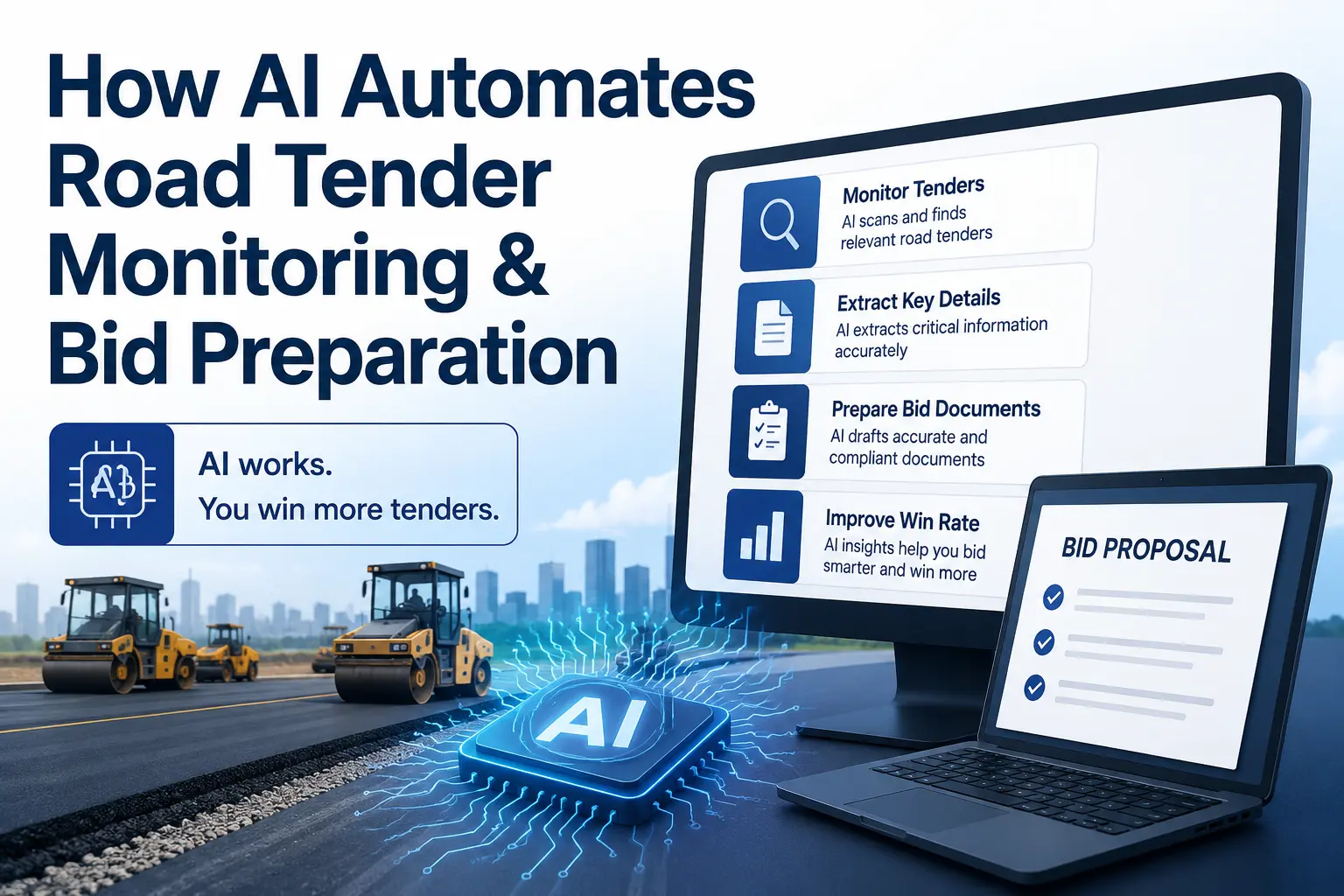
AI-powered tender monitoring is the automated, continuous scanning, aggregation, and intelligent filtering of procurement sources to surface relevant road contract opportunities in real time without manual platform-by-platform searching.
AI-powered bid preparation is the use of machine learning, natural language processing, and automated data pipelines to accelerate and improve the assembly of compliant, competitive bid submissions reducing the human hours required while improving accuracy and consistency.
Together, these capabilities form a complete procurement intelligence system that transforms road contracting from a reactive, labour-intensive process into a proactive, data-driven competitive advantage.
Core capabilities of RoadVision AI's procurement platform include:
RoadVision AI's platform deploys automated crawlers and API connections across the full landscape of road procurement sources government eTendering portals, municipal procurement systems, provincial ministry databases, and private sector procurement platforms. New tenders are ingested continuously, 24 hours a day, seven days a week.
Each ingested tender is immediately processed by the platform's relevance scoring engine, a machine learning model trained on the contractor's historical bid activity, win patterns, capability profile, geographic coverage area, and strategic preferences. Every new opportunity receives a relevance score and a recommended action pursue, monitor, or pass alongside an AI-generated summary of the key scope, value, and deadline information.
The result: instead of staff spending hours daily scanning procurement portals, they receive a prioritized, pre-evaluated daily opportunity brief. Relevant tenders surface immediately. Irrelevant ones never reach the desk.
When a tender is flagged for pursuit, RoadVision AI's natural language processing engine goes to work on the specification documents which in road contracts can run to hundreds of pages of technical requirements, general conditions, special provisions, and standard drawings.
The platform extracts and structures the critical information procurement teams need to make go/no-go decisions and begin bid preparation: scope of work summary, key technical requirements, pre-qualification criteria, bonding and insurance requirements, evaluation methodology, submission checklist, addendum schedule, and contract duration. This structured summary is generated in minutes, replacing hours of manual document review.
The system also automatically flags non-standard contract conditions, unusual liability clauses, or requirements that fall outside the contractor's typical scope giving estimators and legal reviewers a targeted list of items requiring close attention rather than requiring them to read every page to find the exceptions.
Quantity takeoff the extraction of material volumes, linear metres of pavement, lane kilometres of treatment, and associated quantities from tender drawings and specifications has historically been among the most time-consuming steps in road bid preparation.
RoadVision AI's platform applies computer vision to tender drawings and structured data extraction to specification documents, automatically generating a preliminary quantity schedule that estimators can review, verify, and refine rather than build from scratch. For standard road maintenance tender types — surface treatment, pothole patching, crack sealing, asphalt overlay the system's extraction accuracy consistently exceeds 90%, reducing takeoff time by 60 to 75%.
When RoadVision AI's road inspection data is available for the tender corridor, the platform can cross-reference specification quantities against actual measured pavement condition analysis data, identifying discrepancies between the authority's estimated quantities and ground-truth measurements a capability that can significantly sharpen bid pricing and reduce quantity risk exposure.
The most repetitive element of bid preparation assembling the standard documentation that every submission requires is handled automatically by RoadVision AI's bid content library.
The platform maintains a structured, version-controlled repository of all reusable bid content: company profile, key personnel CVs, equipment schedules, safety statistics, quality management documentation, insurance certificates, bonding capacity letters, past project references, and methodology statements. When a new bid is initiated, the system automatically assembles the applicable content package based on the tender requirements, flagging only the items that require customization or updating.
For the narrative sections that do require tender-specific content project understanding, proposed methodology, quality plan. RoadVision AI's AI writing assistance tools generate structured first drafts based on the specification requirements and the contractor's past successful bid language, which estimators and proposal writers refine rather than author from zero.
RoadVision AI's pricing intelligence module aggregates historical bid pricing data from publicly available contract award records across road procurement databases, providing estimators with market context for every major cost category labour rates, material unit prices, equipment costs, subcontractor pricing for comparable work in the relevant geographic market.
This market intelligence layer does not replace estimator judgment it informs it. Estimators see how their preliminary cost model compares to the market range for similar work, where their pricing appears competitive, and where it may be leaving margin unnecessarily or creating risk of under-pricing.
RoadVision AI's workflow management module tracks every active bid opportunity through a structured pipeline from tender receipt through go/no-go decision, quantity takeoff, pricing, internal review, bonding procurement, and final submission. Automated deadline alerts ensure that no submission date, addendum release, pre-bid meeting, or bond request deadline is missed.
For organizations managing multiple simultaneous bids, the platform provides a consolidated bid pipeline dashboard that gives management complete visibility into resource allocation, upcoming deadlines, and bid portfolio composition at a glance.
More Opportunities Captured Automated tender monitoring across all relevant procurement sources ensures that no qualifying opportunity goes unnoticed due to the limitations of manual searching. Contractors consistently report identifying 25 to 40% more relevant tender opportunities within the first three months of platform deployment.
Lower Cost Per Bid By automating the most repetitive elements of bid preparation document review, content assembly, quantity extraction, and deadline tracking. RoadVision AI reduces the professional staff hours required per bid by 40 to 65%, directly reducing overhead cost and enabling teams to pursue more opportunities with the same headcount.
Higher Win Rates Bids prepared with AI assistance are more consistent, more complete, and better priced relative to market intelligence. RoadVision AI customers report win rate improvements of 15 to 30% within the first year of deployment a result of better opportunity selection, more accurate pricing, and higher-quality submission documents.
Reduced Bid Risk Automated specification flagging, quantity cross-referencing, and contract condition review reduce the likelihood of submitting a bid based on a misread requirement, a missed addendum, or a quantity error risks that can turn a winning bid into a loss-making contract.
Strategic Competitive Intelligence Win/loss analytics and market pricing intelligence give contractors a continuously improving picture of their competitive position enabling smarter go/no-go decisions, refined pricing strategies, and better resource allocation across the bid portfolio.
AI-powered tender and procurement platforms are not only valuable for contractors road authorities and municipal procurement teams benefit significantly from the technology as well.
Improved Tender Quality When tendering authorities use AI tools to develop bid documents informed by actual pavement condition data and accurate quantity measurements, the tenders they issue are more precise reducing the risk of contractor claims, scope disputes, and contract variations that plague inaccurately scoped road contracts.
Faster Procurement Cycles AI-assisted specification development, evaluation criteria structuring, and bid evaluation support compress procurement timelines, enabling road authorities to move from tender issue to contract award more quickly critical for time-sensitive maintenance work.
Better Value for Public Money More accurately scoped tenders attract more competitive bids. When contractors understand the scope precisely and trust the quantities, they price with confidence rather than loading contingency for uncertainty resulting in more competitive pricing and better outcomes for infrastructure budgets.
Regional Road Construction Contractors Mid-sized contractors bidding on provincial highway maintenance contracts and municipal road rehabilitation programs use RoadVision AI to monitor the full regional tender landscape and manage bid portfolios of 20 to 50 active opportunities simultaneously.
Civil Engineering Consultancies Engineering firms preparing bid documents on behalf of public sector clients use the platform to streamline specification development, quantity estimation, and procurement document assembly.
National Infrastructure Groups Large infrastructure groups managing national tender pipelines across multiple provinces or states use RoadVision AI's enterprise tier to coordinate bid activity across regional offices, enforce consistent bid standards, and aggregate competitive intelligence across all markets.
Municipal Public Works Departments Municipal procurement teams use RoadVision AI's authority-side tools to develop accurately scoped road maintenance tenders, manage vendor pre-qualification, and evaluate bids consistently against defined criteria.
Road tender monitoring and bid preparation have long been among the most resource-intensive, error-prone, and strategically under-invested processes in the infrastructure sector. The result is a market where significant revenue opportunities go unnoticed, bid costs erode margins, and the quality of submissions is limited by the hours available rather than the capability of the team preparing them.
RoadVision AI's AI-powered procurement platform closes that gap automating tender discovery, accelerating bid preparation, sharpening pricing intelligence, and giving contractors and road authorities the tools to compete more effectively in a procurement landscape that rewards speed, accuracy, and consistency.
Whether you are a regional contractor looking to capture more of the local market, a national infrastructure group managing a complex multi-market bid portfolio, or a road authority seeking to issue better-scoped, more competitive tenders, RoadVision AI delivers the intelligence advantage that manual procurement processes simply cannot provide.
Ready to transform your road procurement operations? Contact RoadVision AI today to schedule a platform demonstration or begin your onboarding conversation.
RoadVision AI monitors all major Canadian procurement platforms including Merx, Biddingo, Ontario Tenders Portal, BC Bid, SEAO (Quebec), Alberta Purchasing Connection, and individual provincial ministry and municipal procurement portals. Coverage extends to U.S. federal and state highway procurement sources for clients operating cross-border. The platform is continuously updated as new sources are identified.
During onboarding, RoadVision AI's platform is configured with a detailed capability profile for your organization covering trade categories, geographic service areas, contract value range, bonding capacity, pre-qualification statuses, and strategic priorities. The relevance model is then refined continuously based on your go/no-go decisions and bid outcomes, becoming more accurately calibrated to your specific business profile over time.
Yes. RoadVision AI's specification parsing and quantity takeoff capabilities cover the full spectrum of road maintenance and construction contract types, from routine surface treatment and pothole patching programs through to major pavement rehabilitation, new construction, and bridge-related road work. Specialized modules handle both unit-price and lump-sum contract structures.
The platform supports data export to all major estimating platforms in standard formats, and offers direct API integration with commonly used construction estimating tools. Quantity schedules and cost model templates generated by RoadVision AI can be imported directly into your estimating workflow, eliminating manual re-entry.

The Autonomous Road Engineer
AI-powered road condition monitoring, asset management, & infrastructure intelligence helping agencies move from reactive maintenance to predictive road management.


.webp)
.webp)
.webp)