
Every pothole has a backstory. Long before there's a hole in the road, there's a crack thin, easy to miss, and usually ignored because it doesn't look urgent. That's the exact window where the cheapest possible fix is available, and it's also the window that most road maintenance programs miss entirely. By the time a crack is reported, it's often already a pothole.
AI-based crack detection exists to close that gap. Instead of waiting for cracking to fail into a pothole, computer vision systems can scan road surfaces continuously, catch cracking at its earliest visible stage, and route it into a repair queue while the fix is still a quick seal job rather than a full-depth patch.
This piece explains how a crack actually becomes a pothole, how AI identifies and classifies cracking before that happens, and why catching this early stage is one of the highest-leverage things a road maintenance program can do.
A pothole doesn't appear out of nowhere. It's the final stage of a process that usually starts small and progresses predictably if left unaddressed.
The critical insight here is that steps 1 through 4 can take weeks or months and during nearly all of that window, the fix is cheap: a crack seal or surface treatment. Step 5 is where the cost jumps dramatically, requiring full-depth patching or worse. Catching the problem anywhere before step 5 is the entire game.
If catching cracks early is this valuable, the obvious question is why it doesn't happen more often. The answer comes down to how most road networks are actually inspected.
The result is a maintenance system structurally biased toward reacting to potholes rather than preventing them, simply because cracks are much harder to systematically catch in time.
AI-based crack detection follows the same underlying collection approach used for broader pavement and defect monitoring, but with models specifically tuned to identify cracking patterns at an early stage.
Dashcams mounted on any regular vehicle patrol cars, maintenance trucks, buses, delivery fleets capture GPS-tagged video of the road surface as part of routes already being driven. No dedicated survey vehicles or lane closures are required, which is what makes frequent, network-wide coverage practical in the first place.
Computer vision models scan each frame to identify pavement distress and classify it by crack type, since different crack patterns indicate different underlying problems:
Identifying the type matters because alligator cracking, for example, signals a structural problem that a simple surface seal won't fix while a single transverse crack might be a straightforward, low-cost repair.
For each identified crack, the AI measures:
Every detected crack gets a severity score and exact GPS location, feeding into a prioritized maintenance list. This is where the real value shows up instead of a raw list of defects, agencies get a ranked queue that separates "seal this within 90 days" from "this needs monitoring next survey" from "this is already progressing toward a pothole and needs attention now."
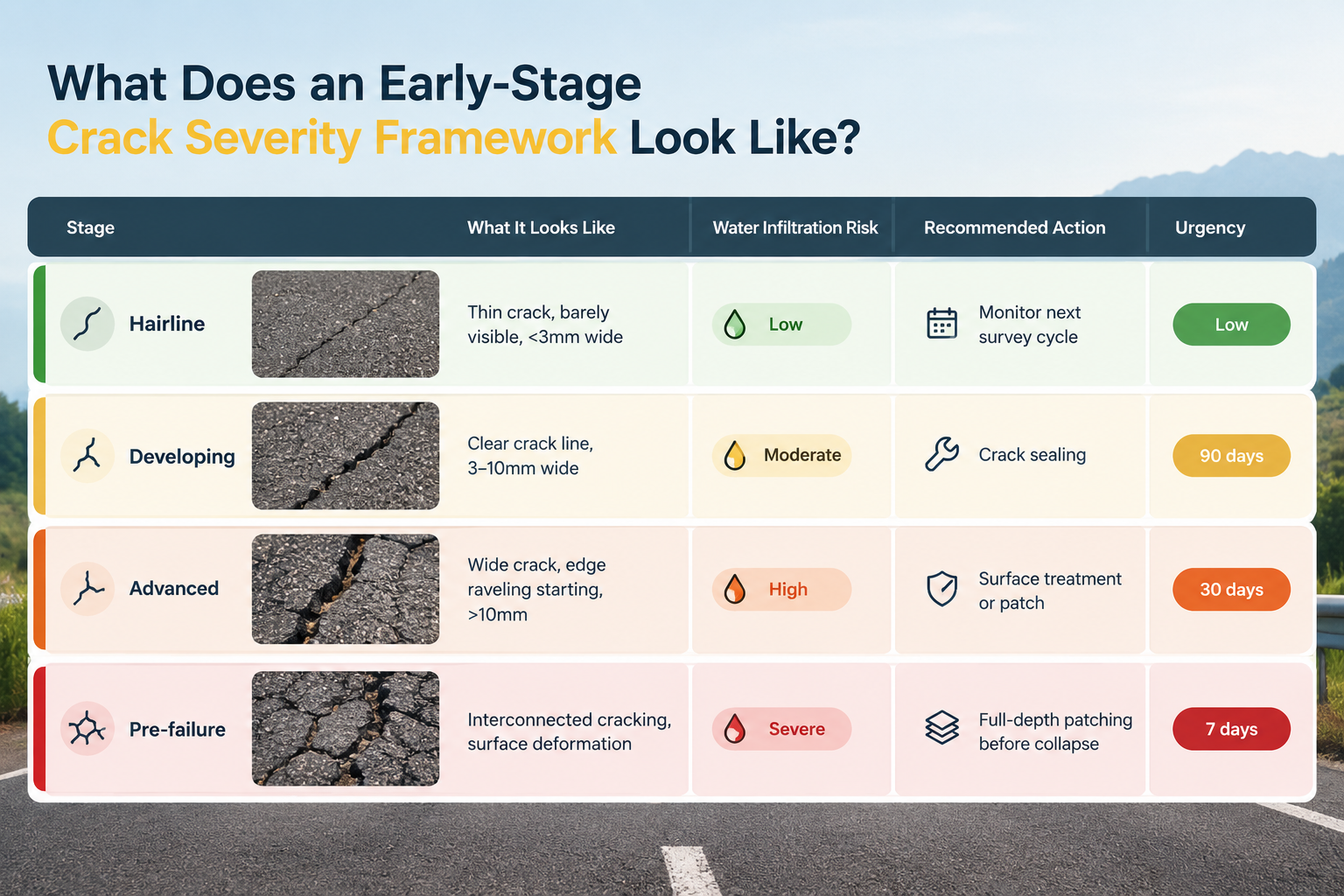
The cost curve for pavement repair is not linear it's closer to exponential the longer damage is left unaddressed. Engineering cost estimates commonly show that deferred repair costs 3 to 5 times more than the same defect fixed early, and that multiplier only grows once a crack has become a full pothole requiring full-depth reconstruction.
This is the core economic argument for AI-based crack detection: it's not really about finding more damage it's about finding the same damage earlier, when the fix is still cheap, so the multiplier never gets a chance to compound.
Crack detection is most powerful when it's not a one-time survey but a repeating monitoring cycle:
This turns crack monitoring from a snapshot into a trend line which is what actually lets an agency get ahead of pothole formation instead of just detecting cracks slightly earlier and still reacting to each one individually.
RoadVision AI's Collect–Process–Execute–Deliver pipeline applies the same dashcam-based survey approach used for pothole detection to earlier-stage crack monitoring. RoadGPT, RoadVision AI's vision-language model, reviews every frame of footage to identify and classify cracking by type, measure severity, and geotag each finding all from footage captured by vehicles already on the road, with no dedicated survey fleet or lane closures required.
The result is a live GIS dashboard showing crack progression across the network, an auto-generated maintenance plan that separates urgent structural cracking from routine sealing candidates, and trend tracking that flags stretches deteriorating faster than expected. When a crack is sealed, the next survey pass automatically confirms the repair held giving agencies a genuinely closed loop from early detection through verified resolution.
RoadVision AI has surveyed more than 3 million kilometers of road globally and detects 65+ pavement defect types across deployments in 17+ countries helping road agencies catch damage while it's still a crack, not after it's already a pothole.
Want to see how much cheaper prevention is than repair? Get in touch with RoadVision AI to learn how AI-based crack detection can help your road network catch problems before they become expensive ones.
AI models measure crack width, length, density, and pattern type, then compare these against known severity thresholds. Interconnected patterns like alligator cracking are flagged as more serious than an isolated hairline crack, since they usually indicate deeper structural fatigue.
Yes — that's the core value proposition. Since cracking is the precursor stage to pothole formation, continuous AI monitoring can flag a crack while it's still in the cheap-to-fix window, well before water infiltration and traffic loading cause it to collapse into a pothole.
Typically just a dashcam mounted on vehicles already in use patrol cars, maintenance trucks, or buses or a smartphone-based collection app. No specialized survey vehicles or road closures are needed.
This depends on traffic volume and climate, but high-priority corridors benefit from monthly or quarterly surveys, since cracking can progress from minor to severe within a single season, especially in freeze-thaw climates.
Crack type matters significantly. A transverse crack from thermal contraction may just need sealing, while alligator cracking often signals structural fatigue that requires a deeper fix. Treating all cracks the same risks under-fixing serious structural problems.
RoadVision AI is an AI-powered road condition monitoring and engineering platform helping road agencies and city governments worldwide detect, prioritize, and verify road maintenance work from early-stage cracking to potholes and pavement markings. Learn more at roadvision.ai.
The Autonomous Road Engineer
AI-powered road condition monitoring, asset management, & infrastructure intelligence helping agencies move from reactive maintenance to predictive road management.


.webp)
.webp)
.webp)