Independent Engineer (IE) Road Monitoring: How AI Replaces Fieldwork
On this page
In road concession and public-private partnership (PPP) projects whether structured as BOT (Build-Operate-Transfer), HAM (Hybrid Annuity Model), TOT (Toll-Operate-Transfer), or other arrangements the Independent Engineer (IE) plays a critical, often underappreciated role. As a neutral third party appointed to verify construction quality, monitor ongoing maintenance obligations, and certify performance against contractual standards, the IE's assessments directly influence milestone payments, annuity releases, penalty determinations, and dispute resolution. Getting that assessment right, consistently, and on time matters enormously to every party involved.
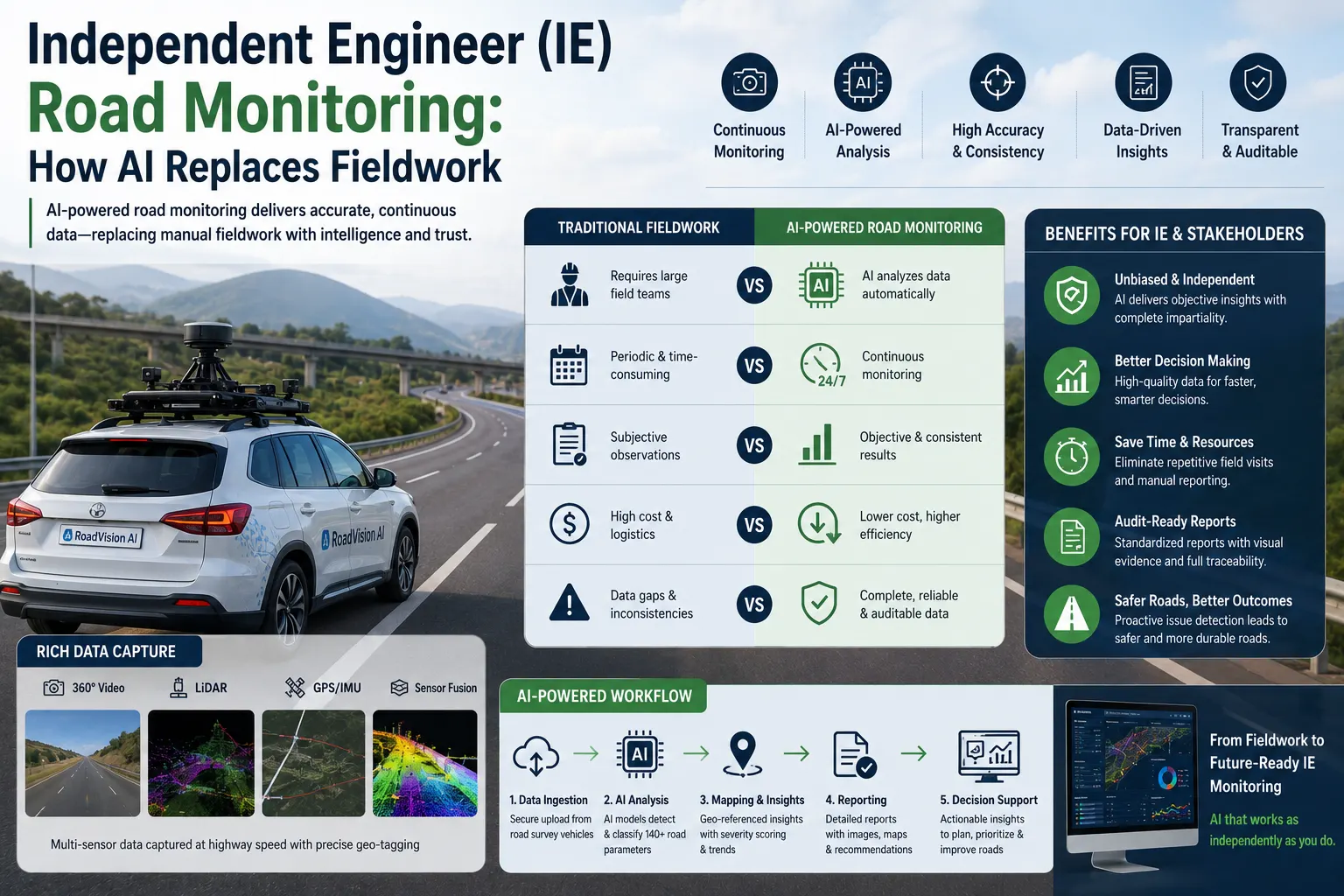
Traditionally, this role has depended heavily on physical fieldwork: IE teams driving concession corridors, conducting visual inspections, measuring pavement condition indicators, and compiling reports largely by hand. It's a model that's worked, but one that's slow, resource-intensive, and increasingly difficult to scale across growing concession portfolios. AI-powered monitoring technology is now reshaping how much of this work gets done automating large portions of data collection and analysis that once required extensive manual fieldwork. In this blog, we'll explore the IE's role in road projects, why traditional fieldwork-heavy monitoring is under strain, and how AI is changing what's possible.
What Does an Independent Engineer Do in Road Projects?
An Independent Engineer is a qualified, contractually appointed third-party technical expert responsible for objectively verifying that a road project—whether under construction or in its operations and maintenance phase meets the technical and performance standards defined in the concession agreement. Depending on the project structure, IE responsibilities typically include:
Construction Quality Verification: Confirming that construction work meets design specifications and quality standards before milestone payments are released.
Periodic Condition Assessment: Conducting or reviewing regular pavement condition surveys to verify that the concessionaire is meeting ongoing maintenance obligations.
Performance Standard Certification: Verifying compliance with defined performance indicators, such as International Roughness Index (IRI) thresholds, rutting limits, or other measurable condition standards specified in the concession agreement.
Payment and Penalty Recommendations: Providing technical certification that supports annuity payments, toll revenue release, or penalty assessments based on documented performance.
Dispute Resolution Support: Serving as a neutral technical reference point when disagreements arise between the concessionaire and the granting authority regarding project condition or compliance.
Because IE certifications carry direct financial and contractual consequences, the accuracy, consistency, and defensibility of their assessments matter enormously not just to the immediate parties, but often to lenders and investors relying on IE reports as part of project financing covenants.
Why Traditional Fieldwork-Based IE Monitoring Is Under Strain
The conventional IE monitoring model periodic site visits, manual visual inspection, and spot measurements—has served the industry for decades, but it faces mounting pressure from several directions:
Growing Concession Portfolios: As more roads move to concession-based operating models, individual IE firms are often responsible for monitoring larger, more geographically dispersed networks than traditional fieldwork capacity can efficiently support.
High Cost of Repeated Site Visits: Frequent manual fieldwork across long corridors, sometimes in remote or difficult terrain, involves significant travel, labor, and equipment costs that ultimately factor into project economics.
Subjectivity and Inconsistency Risk: Manual visual assessment, even by qualified engineers, can introduce a degree of subjectivity that creates friction or disputes when concessionaires and IEs disagree on condition ratings.
Time Lag Between Inspection and Reporting: Manual data collection and report compilation can introduce delays between an actual site condition and its formal documentation, which matters when payment or penalty decisions are time-sensitive.
Difficulty Demonstrating Continuous Compliance: Periodic, point-in-time fieldwork struggles to demonstrate ongoing compliance between formal inspection dates, leaving potential gaps in the monitoring record.
Increasing Lender and Investor Scrutiny: As project financing structures become more sophisticated, lenders increasingly expect more frequent, more granular, and more auditable performance data than traditional periodic fieldwork can efficiently deliver.
How AI Is Changing Independent Engineer Road Monitoring
1. Automated Pavement Condition Data Collection
Rather than relying solely on manual field measurements, AI-powered systems using vehicle-mounted cameras, LiDAR, and sensors can automatically capture and quantify key condition indicators roughness, rutting, cracking across an entire concession corridor, often at a fraction of the time and cost of manual survey methods.
2. Objective, Standardized Measurement
AI-based measurement systems apply consistent, algorithmic criteria across every inspection, significantly reducing the subjective variability that can arise between different human inspectors or between the concessionaire's and IE's own assessments—helping reduce disputes rooted in inconsistent condition interpretation.
3. Continuous or High-Frequency Monitoring
Where traditional fieldwork might occur quarterly or semi-annually, AI-powered road monitoring particularly when integrated with fleet-based data collectioncan support far more frequent, even near-continuous, condition tracking, closing the gap between formal inspection dates.
4. Automated Compliance Scoring Against Contractual Standards
AI systems can be configured to automatically compare measured condition data against specific concession agreement thresholds—such as maximum allowable IRI values—flagging non-compliant segments immediately rather than waiting for manual analysis and report compilation.
5. Geotagged, Timestamped, Auditable Records
Every AI-collected data point is automatically geotagged and timestamped, creating a precise, auditable record that strengthens the defensibility of IE certifications in the event of disputes or lender audits.
6. Faster Report Generation
AI-assisted reporting tools can automatically compile collected data, compliance analysis, and supporting imagery into structured reports, significantly reducing the manual effort historically required to produce IE certification documentation.
7. Historical Trend Analysis
Because AI-based systems generate consistent, structured data over time, they enable much richer historical trend analysis—helping IEs and granting authorities identify degradation patterns or emerging compliance risks earlier than periodic manual assessments would typically reveal.
Does AI Fully Replace Independent Engineer Fieldwork?
It's important to be precise here: AI dramatically reduces the volume and frequency of manual fieldwork required, but it does not eliminate the fundamental role or professional judgment of the Independent Engineer. In practice, AI-powered monitoring typically shifts the IE's work in several important ways:
From Data Collection to Data Interpretation: Rather than spending the majority of their time physically measuring road conditions, IEs increasingly focus on reviewing, validating, and interpreting AI-generated data, applying professional judgment to edge cases and ambiguous findings.
From Routine Surveys to Targeted Verification: AI-powered continuous monitoring can flag specific segments requiring closer attention, allowing IEs to focus limited field time on verification of flagged issues rather than blanket, corridor-wide manual surveys.
From Manual Reporting to Oversight and Certification: IEs remain the qualified professionals responsible for final certification and sign-off, even as AI handles much of the underlying data compilation and initial analysis.
Structural and Safety Judgment Still Requires Human Expertise: For structural assessments, dispute resolution, or ambiguous compliance questions, qualified engineering judgment remains essential and isn't something current AI systems are designed to replace.
In short, AI transforms the IE role from primarily manual data gatherer to a more analytical, judgment-focused oversight function work that arguably makes better use of an Independent Engineer's professional expertise than routine, repetitive fieldwork ever did.
Benefits of AI-Enhanced IE Monitoring
For Concession Authorities and Granting Bodies
Faster, More Frequent Compliance Verification: Continuous or high-frequency monitoring reduces the risk of undetected non-compliance persisting between formal inspection cycles.
Stronger Audit Trails: Automated, geotagged, timestamped data provides a more defensible record for regulatory or lender audits.
Reduced Dispute Risk: Objective, consistent measurement reduces the likelihood of disagreements rooted in subjective condition interpretation.
For Independent Engineers
Reduced Fieldwork Burden: Less time spent on routine manual data collection allows IE teams to focus on higher-value analytical and certification work.
Improved Report Turnaround: Automated data compilation significantly speeds up the reporting process, supporting faster milestone and payment certification.
Scalability Across Larger Portfolios: AI-powered monitoring allows IE firms to responsibly oversee larger or more geographically dispersed concession portfolios without proportional increases in field staff.
For Concessionaires
Clearer, More Objective Performance Feedback: Consistent, data-driven condition reporting helps concessionaires understand and address compliance issues more precisely and proactively.
Reduced Dispute Friction: Objective measurement data can reduce disagreements over condition assessments, supporting a more collaborative working relationship with the IE and granting authority.
For Lenders and Investors
More Frequent, Granular Performance Data: AI-enhanced monitoring supports more robust, more frequent performance reporting aligned with lender due diligence and covenant monitoring requirements.
Real-World Applications
BOT and Toll Concession Monitoring: AI-powered condition monitoring is increasingly used to support ongoing IE certification of maintenance obligations across toll road concessions, particularly for corridors with defined performance-linked revenue structures.
HAM Project Annuity Verification: In hybrid annuity model projects, where semi-annual annuity payments are tied to demonstrated maintenance performance, AI-based monitoring can support faster, more consistent IE verification ahead of payment cycles.
TOT Asset Transfer Due Diligence: During toll-operate-transfer transactions, AI-generated historical condition data can support more efficient and accurate due diligence assessment of asset condition prior to transfer.
Multi-Corridor Portfolio Oversight: IE firms responsible for monitoring multiple concession corridors across a region use AI-powered platforms to maintain consistent oversight standards without proportionally scaling field staff.
Challenges in Adopting AI-Enhanced IE Monitoring
Contractual Recognition of AI-Based Measurement: Concession agreements often specify particular measurement methodologies; incorporating AI-based data collection may require contractual amendments or explicit recognition by granting authorities.
Validation Against Established Standards: AI-based measurement systems need to be validated against established, recognized measurement standards to ensure their outputs are accepted as equivalent or superior to traditional methods.
Stakeholder Trust and Transition: Concessionaires, lenders, and granting authorities may require time and demonstrated reliability before fully trusting AI-generated data in place of traditional fieldwork-based reporting.
Integration with Existing Contractual Reporting Formats: AI-generated data and reports need to align with the specific reporting formats and terminology required under existing concession agreements.
Maintaining Independence and Objectivity: As AI tools become more central to the monitoring process, IE firms must ensure their use of technology, including any vendor relationships, doesn't compromise their fundamental independence and objectivity.
The Future of AI in Independent Engineer Road Monitoring
As AI-powered monitoring technology matures and gains broader acceptance within concession and PPP frameworks, several trends are likely to shape its continued adoption:
Standardized AI Measurement Recognition: Industry bodies and granting authorities may increasingly develop standardized frameworks for recognizing AI-based measurement as equivalent to traditional fieldwork methods within concession agreements.
Real-Time Compliance Dashboards: Continuous monitoring data may increasingly feed into real-time compliance dashboards accessible to IEs, concessionaires, and granting authorities simultaneously, improving transparency across all parties.
Expanded Scope Beyond Pavement Condition: AI-powered monitoring is likely to expand beyond core pavement metrics to cover additional contractual performance indicators, such as signage, drainage, and roadside safety features.
Deeper Integration with Digital Twin and Infrastructure Intelligence Platforms: IE monitoring data is increasingly likely to become one component within broader infrastructure intelligence platforms supporting comprehensive concession asset management.
Conclusion
AI-powered road monitoring is fundamentally reshaping how Independent Engineers approach road concession oversight dramatically reducing the manual fieldwork burden while improving the speed, consistency, and auditability of compliance verification. Rather than replacing the Independent Engineer's essential professional role, AI is shifting that role toward higher-value analytical work, freeing IE teams to focus their expertise on judgment-intensive verification and certification rather than routine, repetitive data collection. As AI-based measurement gains broader recognition and trust across concession frameworks, it's set to become a standard, expected component of how road concessions are monitored and certified going forward.
Frequently Asked Questions (FAQs)
1. What is the role of an Independent Engineer in road concession projects?
An Independent Engineer is a neutral, contractually appointed technical expert responsible for verifying construction quality and ongoing maintenance compliance in road concession projects, supporting payment certification and dispute resolution.
2. Does AI completely replace fieldwork for Independent Engineers?
No. AI significantly reduces the volume of routine manual fieldwork required, but Independent Engineers still play an essential role in reviewing, validating, and certifying data, particularly for structural assessments and disputed findings.
3. How does AI improve the accuracy of road condition data used by IEs?
AI-based measurement systems apply consistent, algorithmic criteria across every survey, reducing the subjective variability that can occur between different human inspectors using manual visual assessment methods.
4. Can AI-based monitoring data be used for concession compliance certification?
In many cases, yes, though this typically depends on the specific concession agreement's recognition of measurement methodologies; some agreements may require formal validation or amendment to explicitly accept AI-based data collection.




.webp)
.webp)
.webp)