
India's highways are the arteries that keep the nation moving—critical for trade, mobility, and economic development. But with rapid urbanisation, rising traffic volumes, and increasing environmental pressures, traditional road construction and maintenance practices are no longer sustainable. Premature pavement failures, high maintenance costs, and carbon-intensive construction methods continue to burden infrastructure agencies.
In this evolving landscape, aligning engineering standards with modern digital technologies has never been more urgent. The Indian Roads Congress (IRC)—India's apex body for road engineering—offers the framework for this shift. Specifically, IRC 32, a foundational guideline for the geometric design of rural roads and highways, provides the principles that can now be integrated with advanced tools such as AI-based pavement monitoring, predictive road maintenance, and digital road inspection systems.
As the old saying goes, "The best time to fix the roof is before the rain starts." For India's road sector, that moment is now.
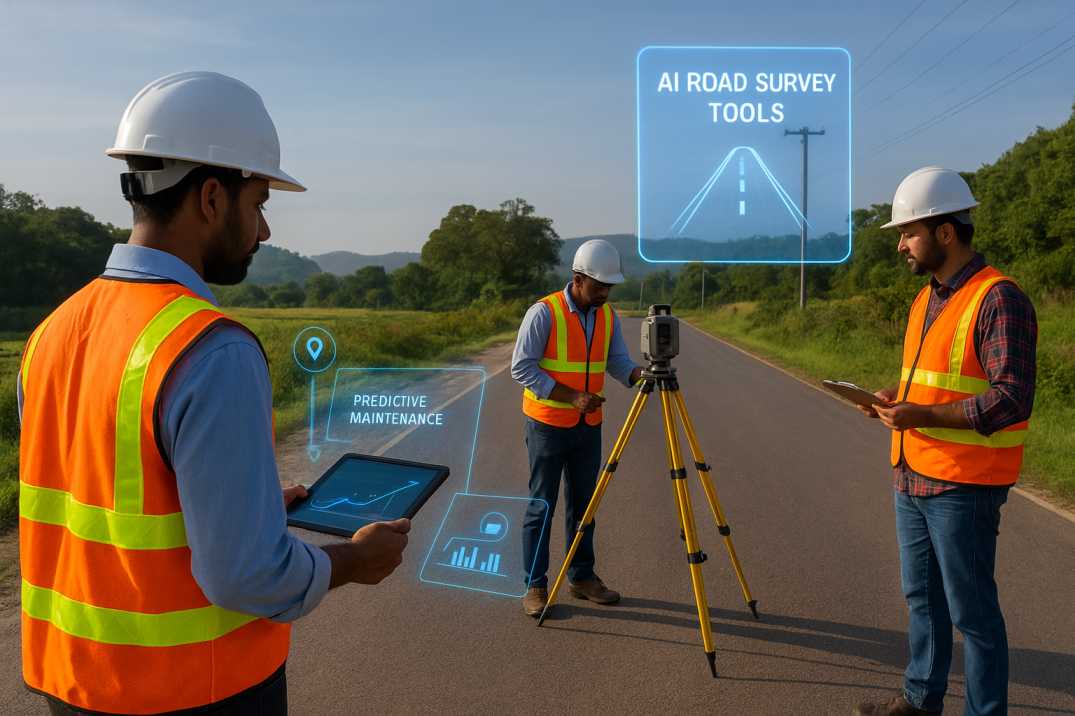
Environmental responsibility is no longer a choice but a necessity. With climate change leading to intense rainfall, heatwaves, and faster pavement deterioration, sustainable road design is crucial. Construction materials contribute heavily to carbon emissions, while poor drainage and misaligned road geometry amplify ecological damage.
Key sustainability challenges in India's road sector include:
India is committed to sustainable development under its international climate commitments, and the road sector must lead from the front. Integrating green construction practices with digital tools reduces waste, conserves natural resources, and extends pavement life, ensuring that future generations inherit a safer, cleaner, and more resilient road network.
IRC 32 outlines geometric design standards for rural roads and highways, focusing on safety, economy, and long-term performance. While the code is primarily known for its design parameters, it also embeds several sustainability-aligned principles:
Key IRC 32 Sustainability-Oriented Principles
2.1 Minimising Environmental Disturbance
Careful alignment selection reduces cut-and-fill volumes, preserves natural topography, and minimises disruption to ecosystems and water bodies.
2.2 Use of Locally Available Materials
Specifying locally sourced aggregates and materials reduces haulage emissions and supports regional economies while lowering the carbon footprint of construction.
2.3 Robust Drainage Design
Proper drainage prevents soil erosion, waterlogging, and slope instability—protecting both the road and surrounding environment from damage.
2.4 Optimised Geometry
Efficient alignment reduces construction volumes, minimizes land take, and ensures vehicles operate at optimal speeds, reducing emissions.
2.5 Resource-Efficient Construction Methods
Encouraging techniques that minimize waste and energy consumption during construction.
2.6 Long-Term Performance Focus
Designing for durability reduces the frequency of reconstruction, conserving materials and energy over the asset lifecycle.
When combined with digital tools like AI-based monitoring and predictive maintenance through the Pavement Condition Intelligence Agent, these principles can guide the creation of greener, longer-lasting pavements.
Industry leaders such as RoadVision AI are enabling agencies to merge IRC standards with modern technology, building a foundation for sustainable road development through its integrated suite of AI agents.
3.1 AI-Based Pavement Monitoring
The Pavement Condition Intelligence Agent provides automated, high-resolution pavement surveys that detect:
—well before they escalate. This directly supports IRC 32's emphasis on preventive care and extends pavement life, reducing the need for resource-intensive reconstruction.
3.2 Digital Road Monitoring Systems
RoadVision AI creates digital twins of road networks through the Roadside Assets Inventory Agent, enabling continuous performance assessment. These datasets support environmentally conscious decision-making, such as:
3.3 Predictive Road Maintenance
Instead of waiting for roads to deteriorate, predictive algorithms from the Pavement Condition Intelligence Agent forecast future failures based on:
This aligns with IRC 32's lifecycle cost principles and promotes material conservation through timely, targeted interventions.
3.4 Road Safety Audits & Traffic Insights
The Road Safety Audit Agent provides integrated audits aligned with IRC geometric design norms to ensure safe, efficient alignments that:
3.5 Support for Green Construction Initiatives
RoadVision AI helps identify opportunities to:
3.6 Lifecycle Carbon Assessment
The platform enables tracking of:
This synergy of engineering standards and digital intelligence builds "future-ready" green highways that serve both mobility needs and environmental goals.
While the trajectory is positive, several challenges remain:
4.1 Data Integration & Digital Adoption
Agencies must upgrade systems to integrate real-time AI data with existing workflows—a transition that requires planning and investment.
AI Solution: Phased implementation and flexible APIs enable gradual integration without disrupting current operations.
4.2 Training & Skill Development
Engineers and contractors need training on interpreting AI outputs and applying digital tools in line with IRC guidelines.
AI Solution: Comprehensive training programs and user-friendly interfaces ensure successful adoption.
4.3 Budget Prioritisation
Initial investments in AI platforms may be a concern for smaller agencies, though long-term benefits far outweigh costs.
AI Solution: Demonstrated ROI through extended pavement life and reduced maintenance costs builds the business case.
4.4 Ensuring Uniform Compliance
Standardised implementation across states is crucial for consistency with IRC 32 and national sustainability goals.
AI Solution: Configurable outputs mapped to specific state requirements while maintaining core standards.
4.5 Environmental Variability
India's diverse climate zones—from Himalayan regions to coastal plains—require adaptable AI models that accurately interpret pavement conditions across terrains.
AI Solution: Models trained on diverse Indian conditions account for regional variations.
4.6 Measuring Sustainability Outcomes
Quantifying environmental benefits requires consistent metrics and baseline data.
AI Solution: Automated sustainability reporting tracks key indicators over time.
These challenges are surmountable with policy support, capacity-building, and phased digital adoption through platforms like RoadVision AI.
IRC 32 is far more than a geometric design standard—it is a guiding framework that, when harmonised with AI and digital technologies through the Pavement Condition Intelligence Agent, Traffic Analysis Agent, Road Safety Audit Agent, and Roadside Assets Inventory Agent, can drive India's transition to greener, more resilient road infrastructure. By combining time-tested engineering principles with next-generation digital tools, India can drastically reduce lifecycle costs, enhance safety, and minimise environmental impact.
The platform's ability to:
transforms how sustainability is integrated into road asset management.
As the proverb goes, "Well begun is half done." Embracing AI today ensures that India's road network is prepared for tomorrow—delivering not just mobility, but environmental stewardship for future generations.
RoadVision AI stands at the forefront of this transformation—leveraging digital twins, computer vision, and predictive analytics to deliver smarter maintenance, improved safety audits, and sustainable road planning. Fully aligned with IRC Codes, it empowers engineers and policymakers to reduce costs, minimise risks, and enhance environmental sustainability.
To explore how your organisation can integrate AI-based road maintenance with IRC 32 standards and contribute to India's green infrastructure goals, book a demo with RoadVision AI today and take the first step towards building greener roads for India's future.
Q1. What is IRC 32 in road construction?
IRC 32 provides guidelines for the geometric design of rural roads in India, focusing on safety, efficiency, and sustainability.
Q2. How does IRC 32 support sustainable highways?
It promotes eco-friendly design, optimized alignments, and drainage systems that minimize environmental impacts.
Q3. Can AI be integrated with IRC 32 standards?
Yes. Technologies like AI road survey tools and AI-based pavement monitoring align with IRC 32 to improve road safety and predictive maintenance.
The Autonomous Road Engineer
AI-powered road condition monitoring, asset management, & infrastructure intelligence helping agencies move from reactive maintenance to predictive road management.


.webp)
.webp)
.webp)