
Every time you hit a pothole, feel your car vibrate over a cracked surface, or notice that one stretch of highway that somehow feels like riding on a cloud you're experiencing what engineers have spent decades trying to quantify. The International Roughness Index, commonly known as IRI, is the global standard that turns that gut feeling of a good or bad road into a precise, measurable number.
Whether you're a highway engineer, a city planner, a fleet manager watching vehicle maintenance costs climb, or simply a commuter tired of rough rides, understanding the road roughness index is the first step toward demanding and building better roads. In this blog, we'll break down everything you need to know about IRI what it is, how it's measured, what the scores mean in practice, and how modern IRI measurement software is transforming pavement management.
.webp)
The International Roughness Index is a standardized measure of road surface irregularities that affect ride quality and vehicle dynamics. Developed in the early 1980s by the World Bank through the International Road Roughness Experiment (IRRE) conducted in Brazil, IRI was designed to give road agencies around the world a consistent, repeatable method to evaluate pavement smoothness.
At its core, IRI quantifies the cumulative vertical movement or deviation of a vehicle's suspension as it travels over a road surface. It is expressed in units of meters per kilometer (m/km) or inches per mile (in/mi). The lower the IRI value, the smoother the road. A freshly paved highway might score as low as 0.5 m/km, while a severely deteriorated road in poor condition could reach 8 m/km or beyond.
The IRI model is based on what engineers call the "quarter-car simulation" a mathematical model that simulates how a standard reference vehicle's suspension responds to the physical texture and undulations of a road profile. This model was deliberately designed to correlate with human perception of ride comfort, making IRI both technically rigorous and practically intuitive.
One of the most useful aspects of the road roughness index is that it translates directly into meaningful categories that road agencies and the public can understand. Here's a general guide to interpreting IRI values:
IRI 0 – 2 m/km: Excellent to Good: Roads in this range offer smooth, comfortable rides. This is typical of newly constructed highways, runways, and high-speed motorways. Pavement smoothness at this level means minimal vehicle wear, better fuel efficiency, and a high-quality driving experience.
IRI 2 – 4 m/km: FairRoads in this range are acceptable but show signs of aging. Drivers may notice minor roughness, occasional surface irregularities, or early cracking. These roads are still functional but should be flagged for monitoring and future maintenance planning.
IRI 4 – 6 m/km: Poor: At this level, road ride quality deteriorates noticeably. Vehicles experience significant vibration, and there is measurable impact on fuel consumption and vehicle wear. Urgent maintenance or rehabilitation is typically recommended.
IRI Above 6 m/km: Very Poor / Failing: Roads with IRI values above 6 m/km are in critical condition. These surfaces may feature deep ruts, large cracks, potholes, or severe surface deformation. Beyond the discomfort to passengers, these roads pose genuine safety risks and impose significant hidden costs on vehicle owners through accelerated wear and damage.
Understanding these thresholds helps governments, municipalities, and private road operators allocate maintenance budgets efficiently prioritizing roads that truly need intervention over those that simply need monitoring.
The evolution of IRI measurement technology over the past four decades is a story of remarkable innovation. In the early days, engineers used simple rod-and-level surveys to manually record road profiles. While accurate, these methods were painstakingly slow and impractical for large road networks.
Profilo meters and Inertial Profilers
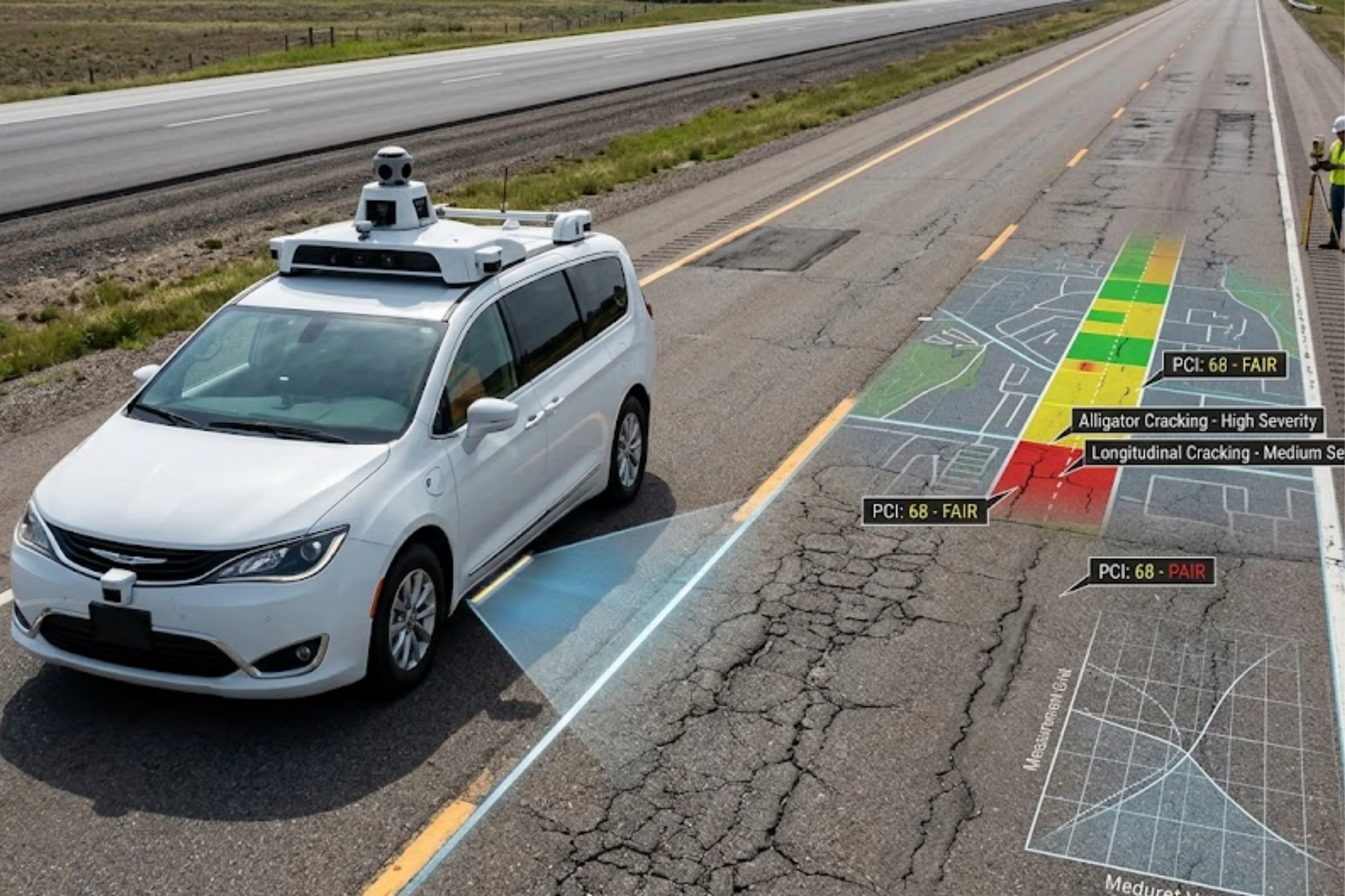
Today, the gold standard for IRI data collection is the inertial profiler a vehicle-mounted device that measures road profiles at highway speeds. These systems use a combination of:
By combining these measurements, the system can reconstruct the true road profile independent of vehicle motion a critical factor for accuracy. The resulting profile is then fed into the quarter-car model to calculate the IRI value.
Walking Profilers and Dipstick Devices
For smaller projects, pedestrian-speed profilers or manual dipstick instruments are still used. While slower, these tools provide high accuracy for localized measurements such as bridge decks, parking lots, or construction quality control.
Smartphone-Based Technologies
Emerging technologies are now enabling IRI estimation using smartphones fitted with accelerometers. While not yet as accurate as certified inertial profilers, these solutions are dramatically lowering the cost barrier for developing countries and smaller municipalities that cannot afford specialized equipment.
Collecting raw road profile data is only half the battle. The real power lies in what modern IRI measurement software can do with that data. Purpose-built software platforms have transformed how road agencies manage, analyze, and act on pavement condition information.
Key capabilities of IRI measurement software include:
Data Processing and Calculation: Raw sensor data is processed through validated algorithms to compute IRI values in real time or post-survey. Advanced software ensures compliance with ASTM E950, ASTM E1170, and other international standards for profiler certification and IRI calculation.
Network-Level Analysis: Modern platforms allow road agencies to map IRI values across entire road networks, visualizing pavement condition through color-coded heat maps that instantly communicate which roads are in good shape and which need attention.
Trend Analysis and Deterioration Modeling: By comparing IRI data collected over multiple survey cycles, software can model how pavement condition is evolving over time. This enables predictive maintenance intervening before roads deteriorate to costly failure rather than reacting after the fact.
Integration with Asset Management Systems: Leading IRI measurement software integrates with broader pavement management systems (PMS) and asset management databases, enabling agencies to combine roughness data with distress surveys, structural assessments, and traffic loading information for truly comprehensive decision-making.
Reporting and Compliance: Government agencies often require road contractors and operators to submit IRI data as part of quality assurance for new construction or resurfacing projects. Robust software makes generating these reports straightforward and defensible.
Road ride quality isn't just about passenger comfort. Poor IRI scores carry significant economic consequences that ripple far beyond the road surface itself.
Vehicle Operating Costs (VOC): Research consistently shows that rough roads increase vehicle operating costs significantly. Suspension components wear out faster, tire wear accelerates, and fuel consumption rises as vehicles work harder to maintain speed on irregular surfaces. Studies estimate that high IRI values can increase VOC by 30–50% compared to smooth roads.
Freight and Logistics: For trucking and logistics companies, poor road roughness index scores directly affect delivery schedules, cargo damage rates, and vehicle maintenance cycles. A fleet operating over rough roads faces meaningfully higher costs per kilometer traveled.
Safety: There is a well-documented relationship between poor pavement smoothness and road accidents. Rough surfaces can cause drivers to lose control, reduce braking efficiency, and increase driver fatigue especially on rural or high-speed roads.
Environmental Impact: Rough roads mean engines work harder, increasing fuel consumption and, consequently, carbon emissions. Smooth roads are, literally, greener roads. As governments worldwide set ambitious carbon reduction targets, investing in pavement smoothness through IRI-guided maintenance becomes part of the broader sustainability agenda.
One of the most valuable applications of the International Roughness Index is in new pavement construction quality control. Many road agencies now specify maximum allowable IRI values as part of construction contracts contractors are only paid in full if the finished surface meets the smoothness target.
This approach, known as "smoothness pay adjustment," has proven highly effective at incentivizing quality workmanship. When contractors know that their payment depends on delivering a road that meets a target IRI, they invest in better paving equipment, tighter quality control processes, and more careful construction practices.
Typical smoothness specifications for new asphalt highways might require an IRI of 1.5 m/km or lower. For concrete pavements, targets may be set at around 1.0–1.2 m/km given concrete's superior long-term smoothness characteristics.
IRI measurement software plays a crucial role in this process, enabling construction teams to conduct rapid post-paving surveys and identify any sections that need grinding or correction before final acceptance avoiding costly disputes and rework.
IRI is recognized as the international standard for road roughness by organizations including the World Bank, the International Road Federation (IRF), and standardization bodies such as ASTM International and ISO. This universality makes it invaluable for cross-country comparisons of road network quality.
For context, developed nations with well-maintained road networks typically report average IRI values of 2–3 m/km across their primary highway systems. Developing nations with limited maintenance budgets may see network averages of 5–7 m/km or higher, which correlates strongly with higher transport costs and economic development challenges.
The future of road roughness measurement is increasingly connected, automated, and data-rich. Key trends to watch include:
Connected Vehicle Data: Automakers and technology companies are exploring how data from the millions of connected vehicles already on the road can be aggregated to produce near-real-time road condition monitoring at a fraction of the cost of traditional surveys.
AI and Machine Learning: Artificial intelligence is beginning to play a role in analyzing IRI data alongside other pavement distress information pothole counts, cracking, rutting to produce more holistic pavement condition assessments and smarter maintenance recommendations.
Autonomous Survey Vehicles: Unmanned ground vehicles and even drones are being tested for road surveying in hazardous or difficult-to-access locations, reducing risk and cost.
The International Roughness Index is far more than a technical metric confined to engineering reports. It is a powerful tool that connects pavement condition to road ride quality, economic productivity, safety, and sustainability. By establishing a universal language for road smoothness, IRI enables road agencies of all sizes to make smarter, data-driven decisions about where to invest, when to maintain, and how to hold contractors accountable.
Whether through sophisticated inertial profilers, cutting-edge IRI measurement software, or emerging connected-vehicle technologies, the ability to accurately measure and act on road roughness index data is transforming how we build and maintain the roads that underpin modern life. For any organization serious about road quality, IRI is the place to start.
Book a Demo with RoadVision AI and see how intelligent road survey software can transform your infrastructure management.
IRI provides an objective and standardized way to evaluate pavement condition. Roads with low IRI values are smoother, offering better driving comfort, improved vehicle safety, reduced fuel consumption, and lower vehicle maintenance costs. High IRI values indicate rough surfaces that may require maintenance or rehabilitation to ensure optimal road performance.
IRI is measured using specialized equipment mounted on vehicles, such as laser profilers, inertial sensors, or AI-powered road inspection systems. These technologies collect detailed road surface data while driving at normal traffic speeds. Advanced analytics then process the data to calculate the road's roughness and generate accurate IRI scores across the network.
Transportation agencies use IRI data to identify deteriorating road segments, prioritize maintenance budgets, and track pavement performance over time. By monitoring IRI regularly, road authorities can implement preventive maintenance strategies before road conditions worsen, reducing long-term repair costs and extending pavement life.
The Autonomous Road Engineer
AI-powered road condition monitoring, asset management, & infrastructure intelligence helping agencies move from reactive maintenance to predictive road management.


.webp)
.webp)