
This is a project-level account from RoadVision AI's weekly highway survey programme for NHAI, covering the two-laning with paved shoulders of the Raebareli to Banda section of NH-232 (New NH-31/335) in UttarPradesh, delivered on an EPC basis. It sets out why the corridor needs continuous monitoring, how the survey works, what the first round found, and how NHAI can use the record to secure corrective action from the contractor
The Raebareli to Banda section of NH-232, renumbered as NH-31/335, runs approximately 133.3 km from Km 152.533 to Km 285.818. It isbeing upgraded to two lanes with paved shoulders, and NHAI oversees it throughthe Raebareli Project Implementation Unit under its Varanasi Regional Office
The paved shoulders are what set this corridor apart. Ona two-lane road the shoulder is not decoration: it is where slow traffic,breakdowns and pedestrians are absorbed, and its condition determines how muchusable width the road really offers. That makes shoulder upkeep, along side carriageway condition and road markings, a central part of keeping the corridor safe once it is open to traffic.
.webp)
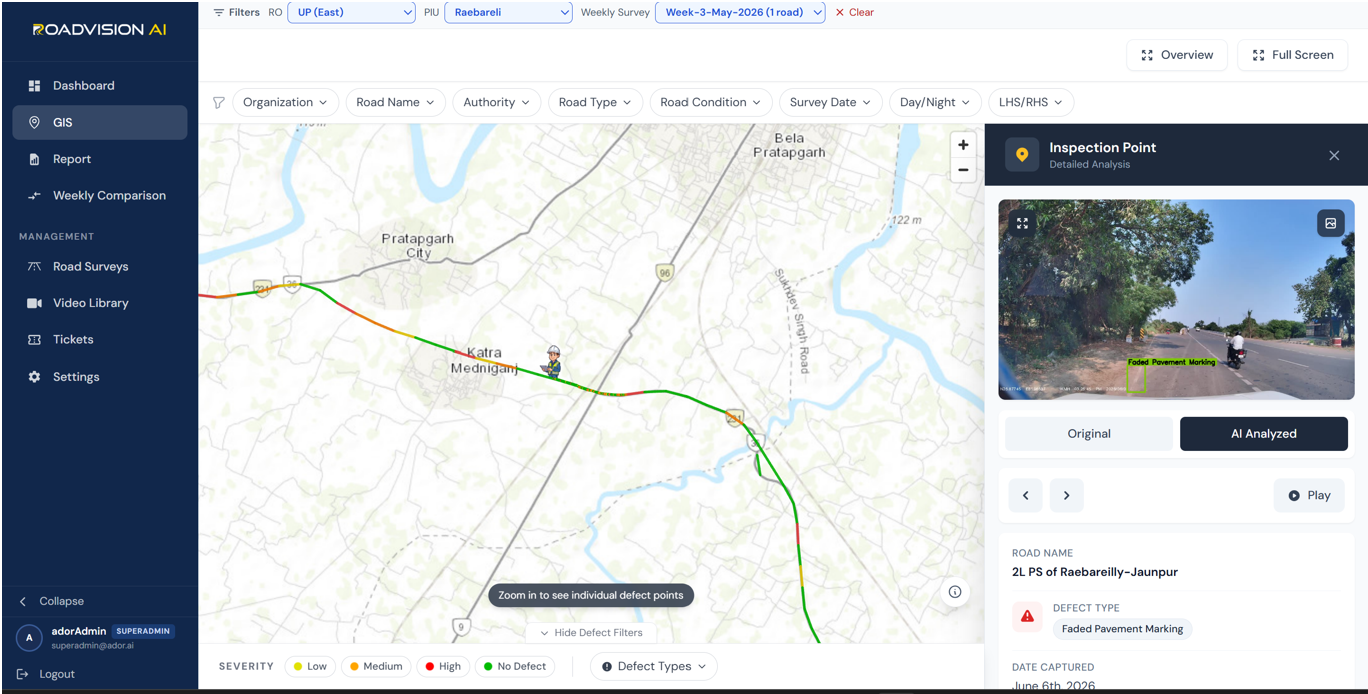
Every finding is placed on a live GIS map. An inspection point can be opened to show its exact location, the defect flagged, and the underlying frame in both original and AI-annotated form, so a line in a report can be traced to a specific stretch of road and the evidence behind it. Figure1 shows the platform on a neighbouring two-lane corridor surveyed under the same Raebareli PIU, the Raebareilly–Jaunpur road, where a faded pavement marking has been flagged.
Under an EPC contract the contractor builds the road to specification and remains responsible for making good defects that appear afterwards. NHAI and the Authority Engineer therefore need a reliable, datedview of how the asset is actually performing, not only at handover but as it settles under traffic and weather. Periodic site visits can confirm conditionon the day; they cannot show whether a problem is spreading, recurring, or being cleared.
The corridor is also long. Across 133 km of single carriageway, with the main carriageway surveyed together with its service road sand intersecting roads, manual inspection at the frequency the contract warrants is simply not practical. The more important difficulty is verification: a repaired defect only counts as resolved if the same point is checked again, under the same method, and found clear.
Surveys run weekly along the full corridor. A dashcam mounted in the survey vehicle records continuous footage while logging GPS coordinates at fixed intervals, so every frame is tied to a precise chainage .The footage is processed against a structured defect taxonomy covering pavement condition, shoulders, markings, signage, drainage, barriers, encroachment and cleanliness. Each finding is stored with a unique defect ID, its location and chainage, a severity grade and the detection model's confidence score, and both the raw and the AI-processed video are retained.
Because each finding carries a permanent ID and location, later rounds can be compared with earlier ones point by point. Round1, surveyed on 17–18 September 2026 (Survey ID N/08023/01001/UP -RCW_001_180926), is the baseline against which that comparison will be made
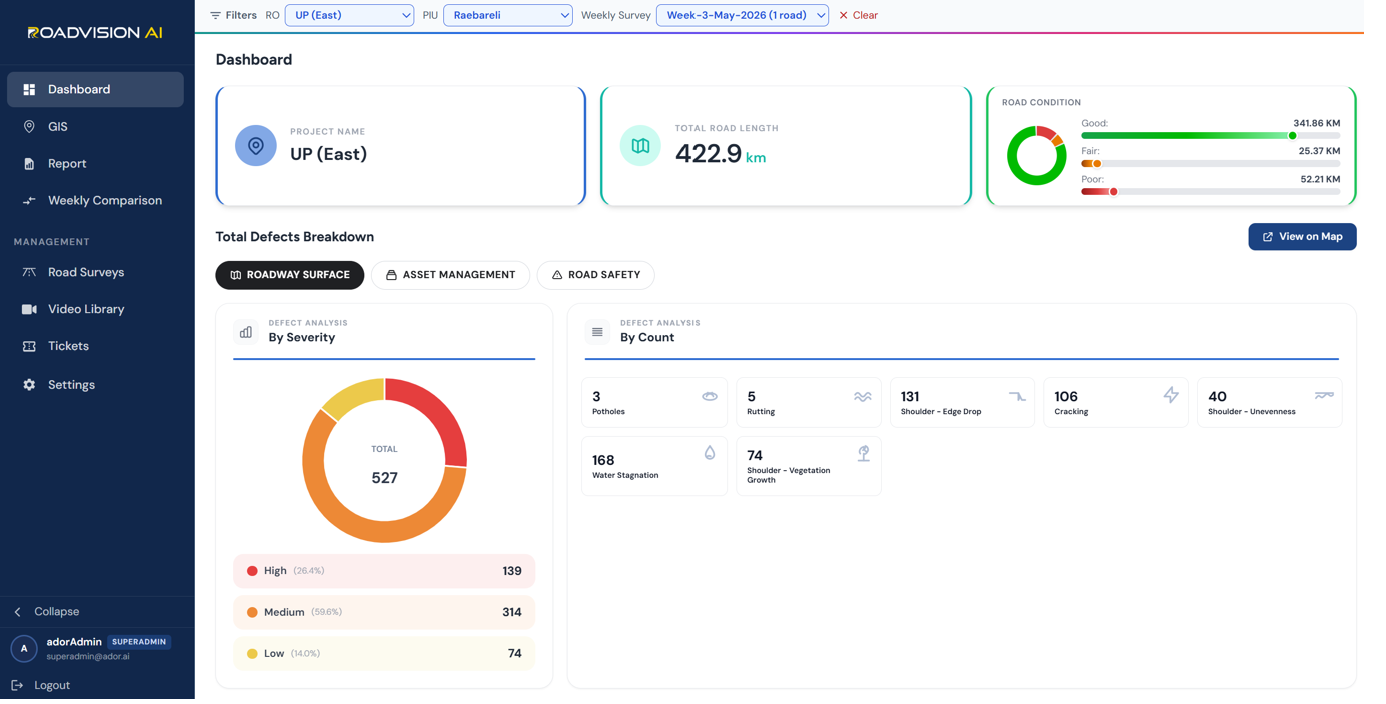
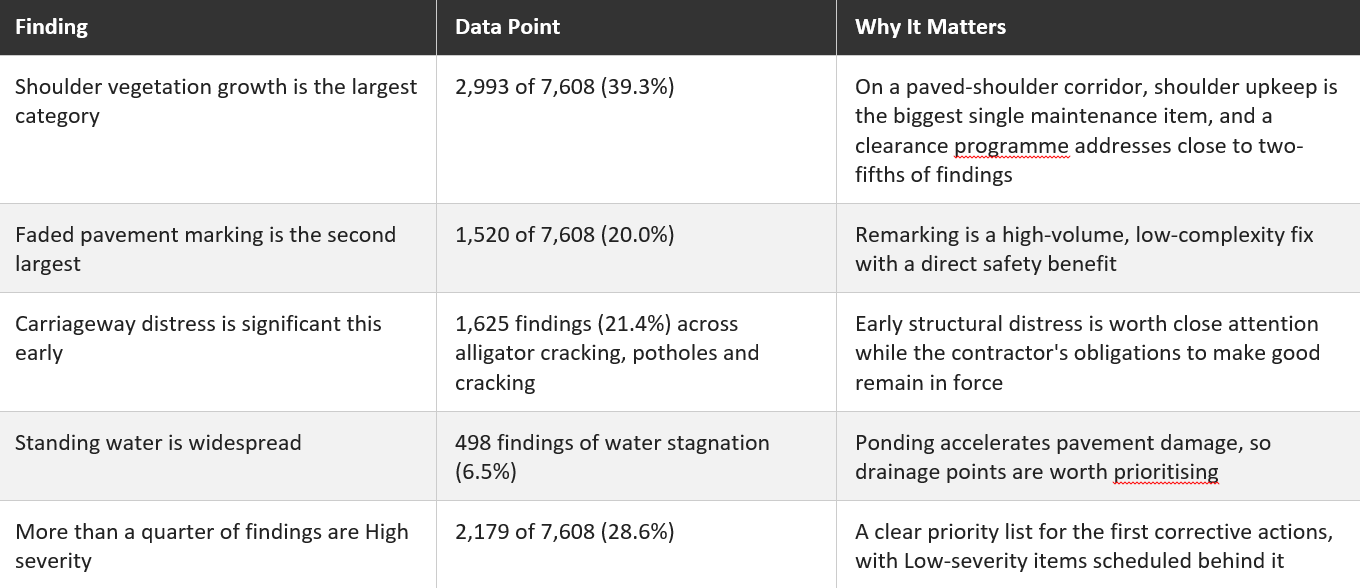
The first round recorded 7,608 findings across the corridor, with an average detection confidence of 91.7%. By severity, 2,179(28.6%) were graded High, 2,140 (28.1%) Medium and 3,289 (43.2%) Low. The main carriageway accounts for 7,438 findings (97.8%), with 88 on service roads and 82 on intersecting roads.
Shoulders dominate the picture. Vegetation growth on the shoulders alone accounts for 2,993 findings (39.3%), ahead of faded or non-visible pavement marking at 1,520 (20.0%). Carriageway distress follows,with 747 findings of alligator cracking, 463 potholes and 415 of other cracking, and there are also 498 findings of water stagnation. A further 267 findings relate to unauthorised signboards and hoardings, and 65 to damaged metal beam crash barriers.
The contractor is responsible for the works under the EPC agreement, and NHAI does not have to rely on the contractor's own account of what has been fixed. Each weekly report gives the Varanasi Regional Office and the Raebareli PIU a defect ID, chainage and round reference sufficient to raise an Action Taken Report request, and the next round re-surveys the same coordinates.
A finding is logged, an ATR is requested, the contractor acts, and the following round either confirms the defect is gone or shows that it persists. Verification rests on the same point being surveyed the same way,round after round, not on a representation from the party doing the work.
RoadVision AI is committed to continuous AI-based road condition monitoring of the Raebareli–Banda corridor for the duration of its mandate with NHAI, and to supporting the contractor accountability that this monitoring enables. A two-lane highway serves the communities along it every day. Making sure it is kept to standard, verified round after round, is central to keeping it safe for everyone who depends on it.

The Autonomous Road Engineer
AI-powered road condition monitoring, asset management, & infrastructure intelligence helping agencies move from reactive maintenance to predictive road management.


.webp)
.webp)
.webp)