
This account sets out RoadVision AI's weekly highway survey methodology as applied to the Moradabad–Bareilly section of NH-24, an operational toll highway in Uttar Pradesh. It covers why the corridor needs continuous monitoring, how the survey is designed to run, and how the resulting record is intended to support NHAI's oversight of the concessionaire's maintenance obligations. Survey findings for this corridor are pending an initial round and are not yet included; this account describes the monitoring framework ahead of that first round.
.webp)
The Moradabad–Bareilly section of NH-24 runs approximately 121.8 km, from Km 149.25 to Km 271.05, connecting Moradabad and Bareilly through Rampur and other urban centres in Uttar Pradesh. Developed under NHDP Phase-III on a Build-Operate-Transfer (Toll) basis and managed under the National Highways Authority of India, the corridor forms part of the wider Delhi–Lucknow national highway corridor a route carrying sustained inter-city and freight traffic across three districts: Moradabad, Rampur and Bareilly.
A BOT toll concession of this kind creates a maintenance obligation that runs for the life of the concession: the operator collects tolls from the travelling public in exchange for keeping the highway to a defined standard, for as long as the agreement runs. That is precisely the condition under which an independent, continuously refreshed record of the corridor's state has value giving NHAI evidence of whether the standard toll-payers are funding is actually being held, rather than relying on the concessionaire's own account.
As applied to other NHAI corridors, RoadVision AI's survey covers the full length of a highway, treating the Main Carriageway, Service Roads and Intersecting Roads as distinct facets of condition, each tracked independently in both directions. A survey vehicle fitted with a mounted dashcam records continuous footage while logging GPS coordinates at fixed intervals, so every frame can be tied to a precise chainage point. Both raw footage and the AI-processed output are retained for every round, by day and, where warranted, by night, since certain safety-relevant assets lighting, reflective markings can only be properly assessed after dark.
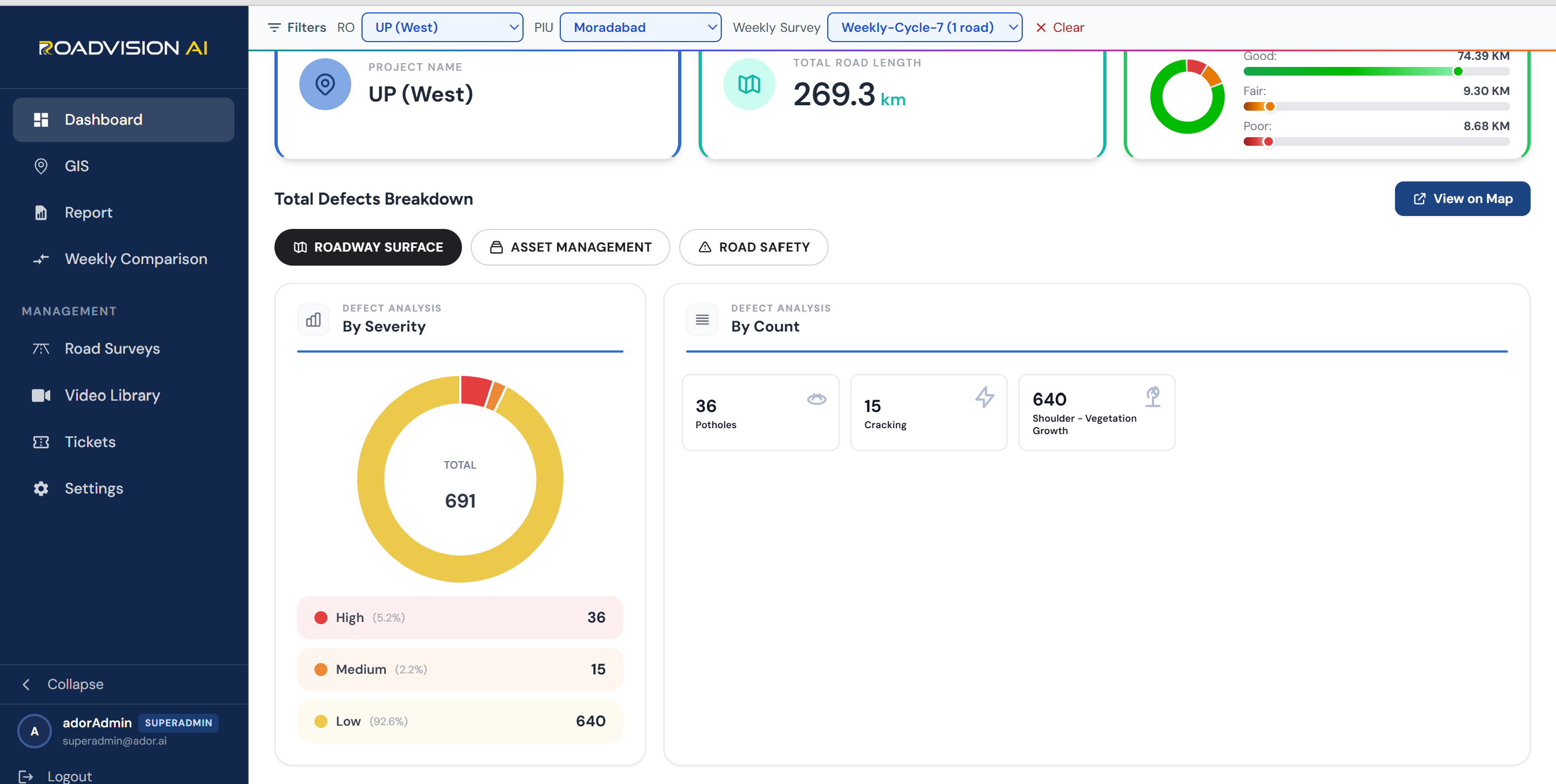
Each frame is processed against a structured defect taxonomy covering pavement condition, shoulders, road markings, signage, lighting, drainage, barriers and encroachment. Every finding generated through this process would be recorded with a unique defect ID, precise GPS coordinates and chainage, a severity grade, and a confidence score from the detection model, ensuring that each entry carries a traceable basis and can be checked against later rounds at the same location.
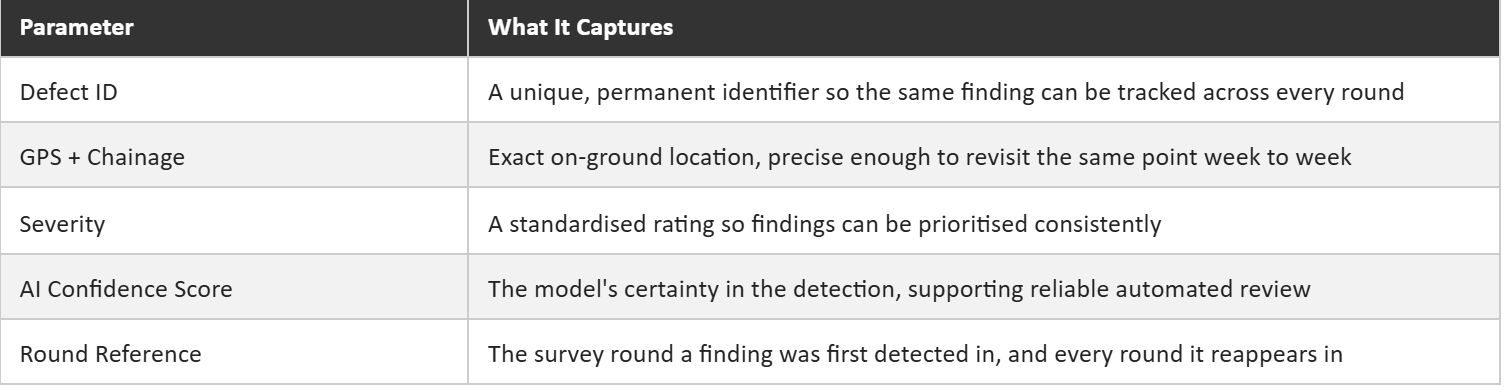
Once survey rounds begin, the corridor's BOT concessionaire remains bound to the maintenance standards set out in its agreement with NHAI for the life of the concession. NHAI would not need to rely on the concessionaire's own account of remedial work: each weekly report would give the Regional Office and Project Implementation Unit a defect ID, chainage and round reference sufficient to raise an Action Taken Report (ATR) request, with the following round's survey re-examining the same coordinates.
This is the enforcement mechanism the methodology is designed to support. A finding is logged, an ATR is requested against it, the concessionaire undertakes the required action, and the next round's survey either confirms the defect has been resolved or shows that it persists. Verification would not depend on the concessionaire's representation; it would depend on the same chainage point being surveyed under the same method, round after round, for as long as the concession runs.
RoadVision AI is committed to bringing continuous AI-based monitoring to the Moradabad–Bareilly corridor, and to supporting the concessionaire compliance that this monitoring is designed to enable. A toll highway on a corridor as significant as Delhi–Lucknow carries an obligation to the public that pays to use it. Verifying that the standard behind that toll is genuinely being held, round after round, is central to making this corridor safer for everyone who depends on it.

The Autonomous Road Engineer
AI-powered road condition monitoring, asset management, & infrastructure intelligence helping agencies move from reactive maintenance to predictive road management.


.webp)
.webp)
.webp)