
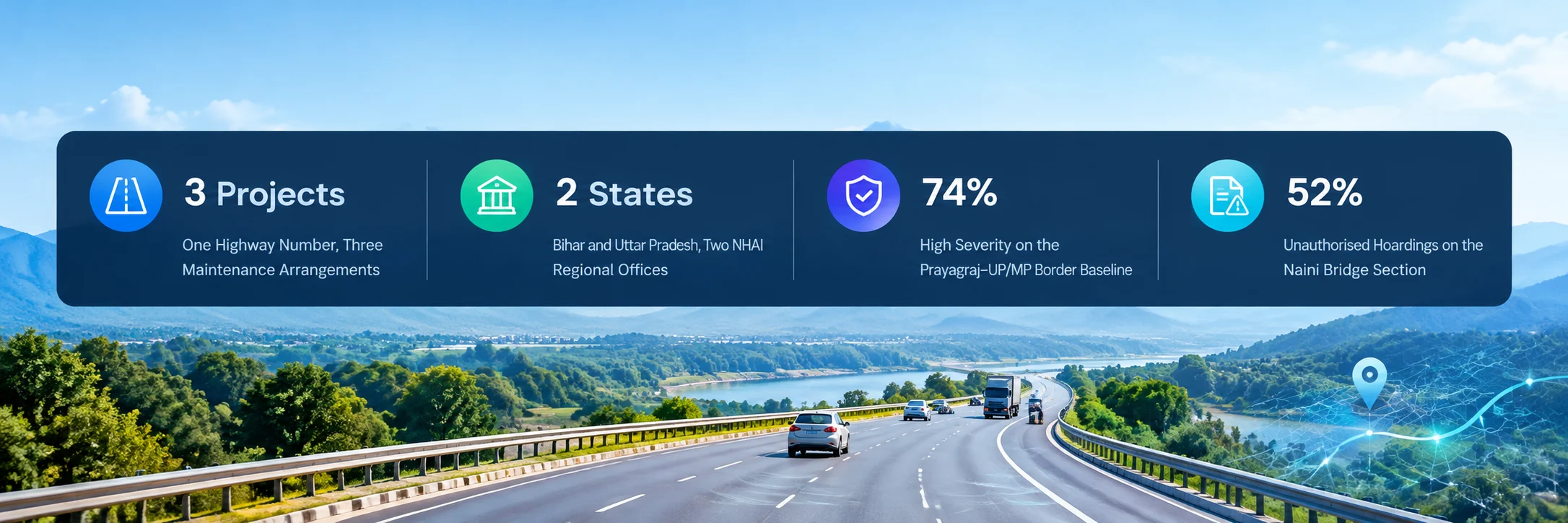
This is a portfolio-level account from RoadVision AI's road survey programme on NH-30, covering three NHAI projects on the same highway number across Bihar and Uttar Pradesh: the Patna–Bakhtiyarpur section (Km 181.300 to Km 231.950), the Naini cable-stayed bridge across the Yamuna with its approaches, and the Prayagraj to UP/MP border section (Km 4.285 to Km 46.004). Each is maintained under a different arrangement, which is exactly why a common evidence base matters
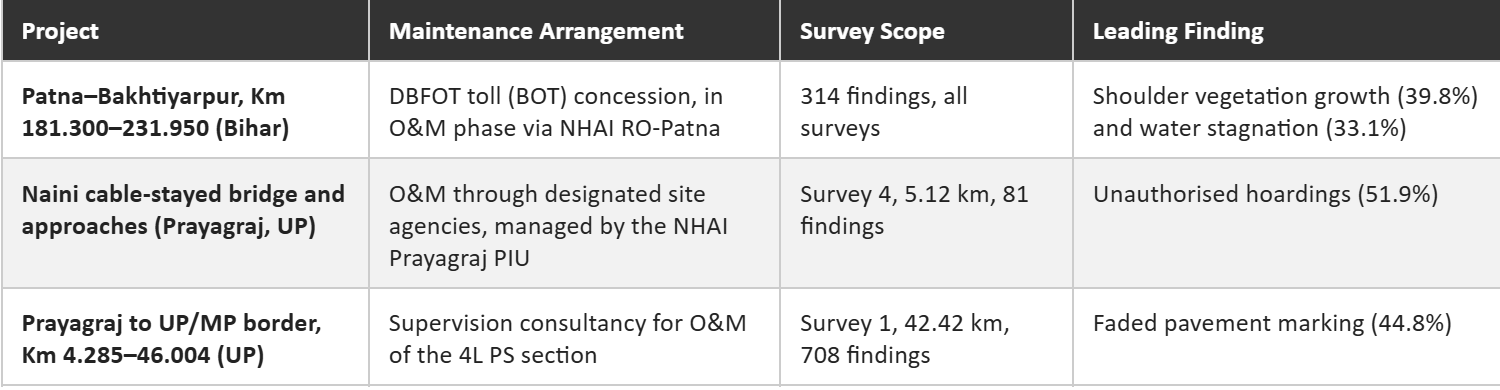
The Patna–Bakhtiyarpur section runs about 50.6 km from Km 181.300 to Km 231.950, connecting Patna city to Bakhtiyarpur in Patna district. NHAI developed it as a four-lane highway on a DBFOT toll (BOT) basis under NHDP Phase III, with Patna Bakhtiyarpur Tollway (PBTL) as concessionaire at an awarded cost of ₹574 crore. The highway is operational and in its operation and maintenance phase, monitored through NHAI's Patna Regional Office.
The Naini bridge carries NH-30 (formerly NH-27) over the Yamuna between Prayagraj and Naini. It is a four-lane cable-stayed structure about 1,510 m long, with a 260 m main cable-stayed span, and its management, operation and maintenance, approaches included, are overseen by NHAI. Routine maintenance and operation are carried out by designated site agencies, managed through NHAI's Prayagraj PIU under the UP (East) region.
Further along NH-30, the four-lane paved-shoulder (4L PS) section from Prayagraj to the UP/MP border, Km 4.285 to Km 46.004, is under operation and maintenance with consultancy services engaged to supervise it. The consultancy's scope includes routine and periodic maintenance oversight, traffic surveys and road safety condition monitoring, and inspection of structural designs, project facilities and road furniture. The section includes the Harro and Mungari toll plazas and Umapur, along with related bridge and approach segments.
A concession, a site-agency arrangement and a supervision consultancy each have a different party responsible for upkeep and a different party checking it. In every case, NHAI's regional teams and the supervising parties need the same thing: a consistent, dated, chainage-tied record that does not depend on the account of whoever is doing the work. RoadVision AI applies the same detection, severity grading and chainage reference across all three projects, so a finding on a bridge approach in Prayagraj and a finding on the Patna toll road can be read side by side.
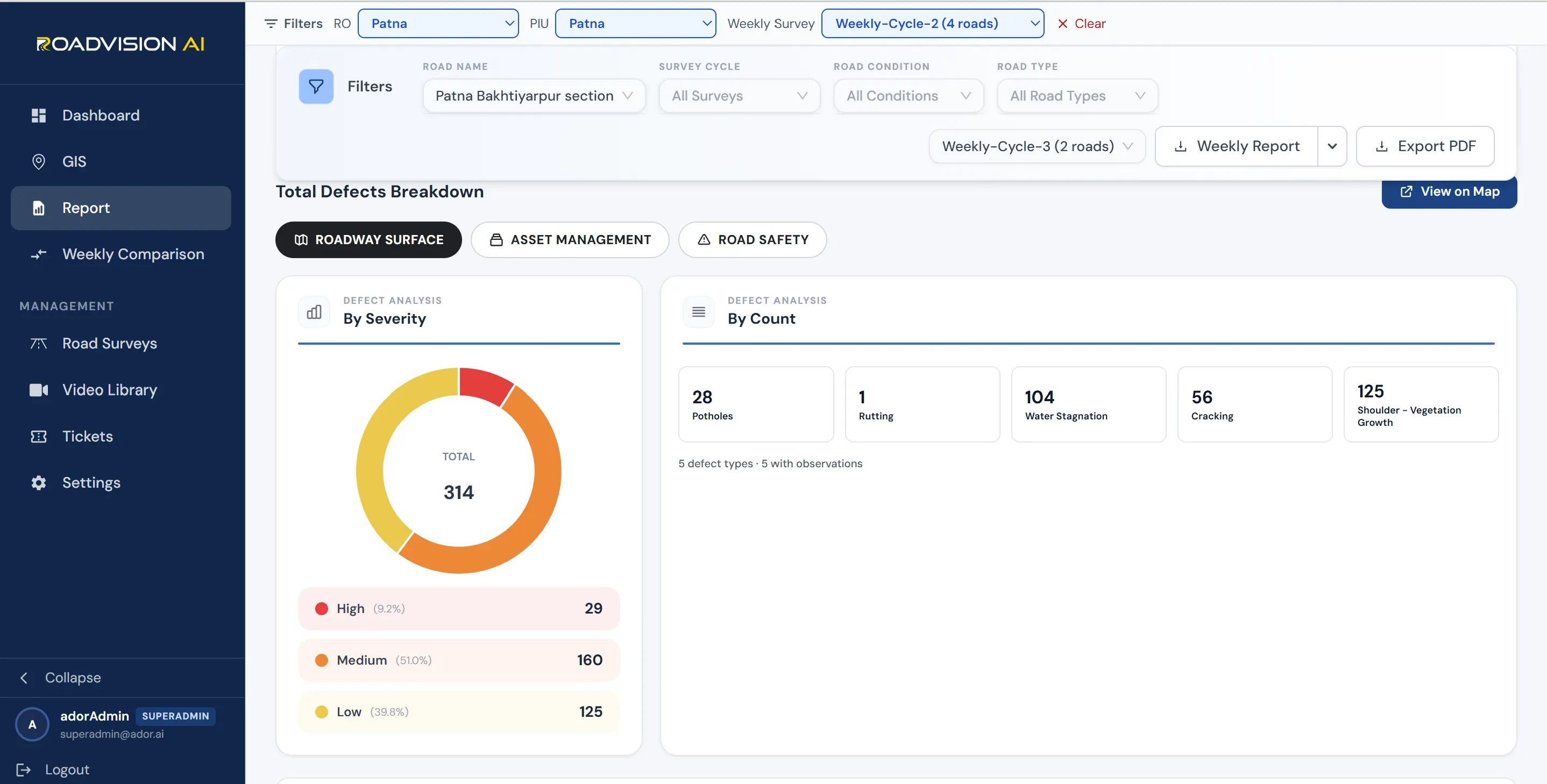
In the survey record for this section, RoadVision AI has logged 314 roadway-surface findings across five defect types. By severity, 29 (9.2%) are High, 160 (51.0%) Medium and 125 (39.8%) Low. Shoulder vegetation growth is the largest category at 125 findings (39.8%), followed by water stagnation at 104 (33.1%) and cracking at 56 (17.8%); potholes account for 28 (8.9%) and rutting for 1.
The 29 High-severity findings correspond exactly to the combined count of potholes and rutting, so the urgent items are few and easy to pick out. Water stagnation and cracking, which together make up the Medium band, point to drainage as the main upkeep issue on this stretch.
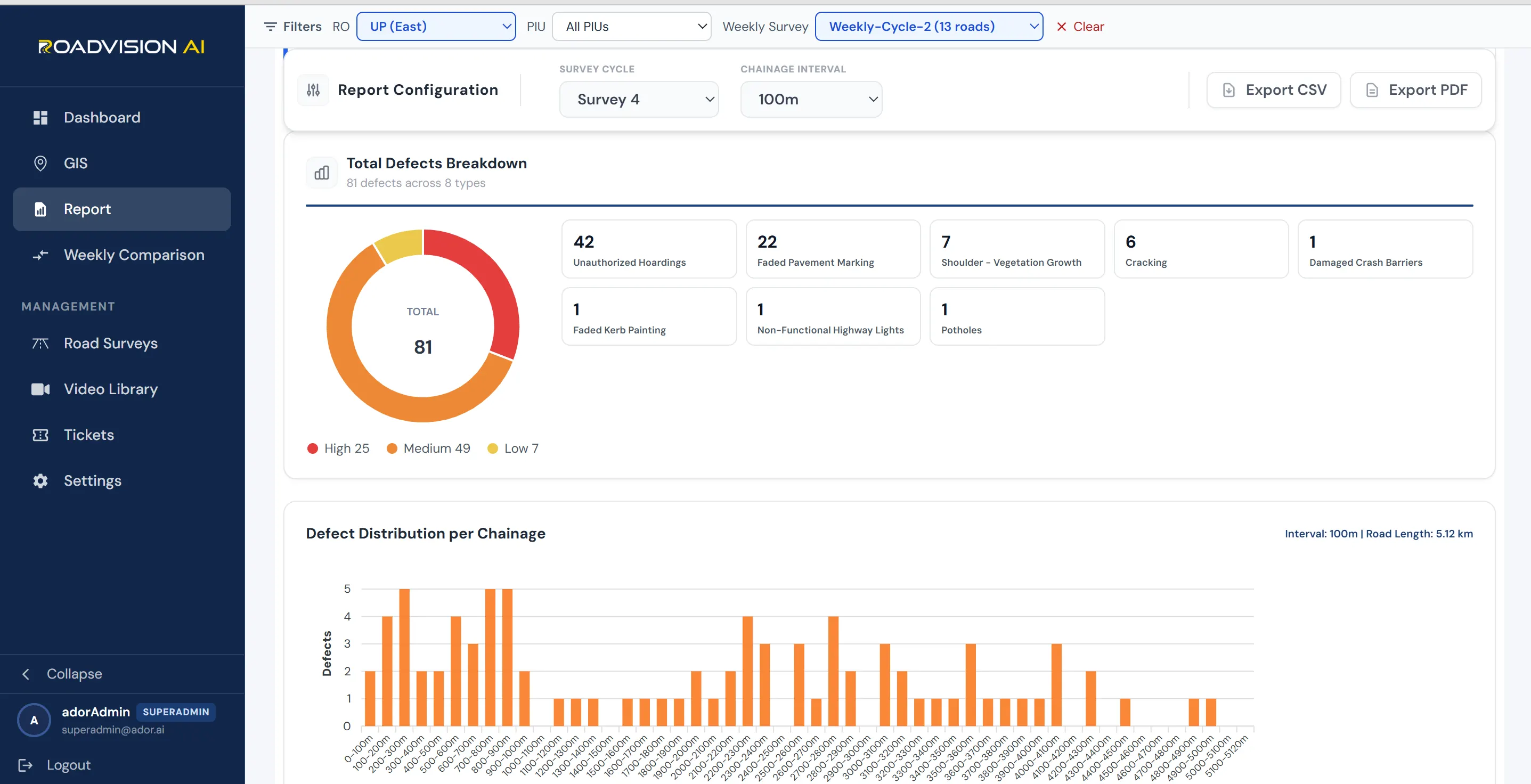
Survey 4 covered 5.12 km of the bridge section and its approaches and logged 81 findings across eight defect types. Of these, 25 (30.9%) are High severity, 49 (60.5%) Medium and 7 (8.6%) Low. Unauthorised hoardings are the largest category at 42 findings (51.9%), ahead of faded pavement marking at 22 (27.2%), with shoulder vegetation growth (7) and cracking (6) next. Single findings of a damaged crash barrier, faded kerb painting, a non-functional highway light and a pothole complete the picture.
Hoardings sit outside the carriageway, so they call for enforcement and removal rather than repair. That gives the Prayagraj PIU a distinct action path for more than half of this section's findings.
Survey 1 on this section covered 42.42 km in 418 segments at a 100 m chainage interval and logged 708 findings across seven defect types. High severity accounts for 524 findings (74.0%), Medium for 182 (25.7%) and Low for just 2. Three categories make up virtually all of it: faded pavement marking at 317 findings (44.8%), non-functional highway lights at 206 (29.1%) and unauthorised hoardings at 179 (25.3%), together 702 of the 708.
The High-severity count of 524 is almost exactly the combined count of faded markings and failed lights (523), so the two items that most affect night-time and low-visibility driving make up essentially all of the urgent findings. As a first survey, it sets the baseline against which the supervision of routine and periodic maintenance can be checked in later rounds.

Under each arrangement a different party is responsible for upkeep: the concessionaire at Patna–Bakhtiyarpur, the designated site agencies at the Naini bridge, and the agency maintaining the road under the consultancy's supervision on the Prayagraj–UP/MP border section. In each case the survey gives NHAI's Regional Office, the PIU and the supervising parties a defect ID, chainage and survey reference for every finding, and a later survey of the same chainage shows whether it has been closed out.
RoadVision AI is committed to continuous AI-based road monitoring across all three NH-30 projects, giving each of NHAI's regional teams and supervising parties the same consistent, chainage-level record whether the road is run under a concession, by site agencies, or under a supervision consultancy. Different contracts should not mean different standards of evidence.

The Autonomous Road Engineer
AI-powered road condition monitoring, asset management, & infrastructure intelligence helping agencies move from reactive maintenance to predictive road management.


.webp)
.webp)
.webp)