
This is a project-level account from RoadVision AI's road survey programme for NHAI's Patna Regional Office, covering the two-lane Mokama–Munger section of NH-80 in Bihar, from Km 1.430 to Km 70.000, surveyed under the Bhagalpur Project Implementation Unit. It sets out why a corridor under a short-term maintenance contract needs an independent condition record, and what the survey data shows so far.
NHAI's Patna Regional Office has tendered maintenance of the two-lane Mokama–Munger stretch of NH-80, from Km 1.430 to Km 70.000 in Bihar, under a Short-Term Maintenance Contract (STMC), with an estimated value of ₹6.27 crore. KAIRAV GREEN emerged as the lowest (L1) bidder in that tender.
A two-lane highway of this length, with a maintenance budget of this size, has to make every rupee count. That makes it essential to know where the defects are, which ones matter most, and whether the work done against them has actually held.
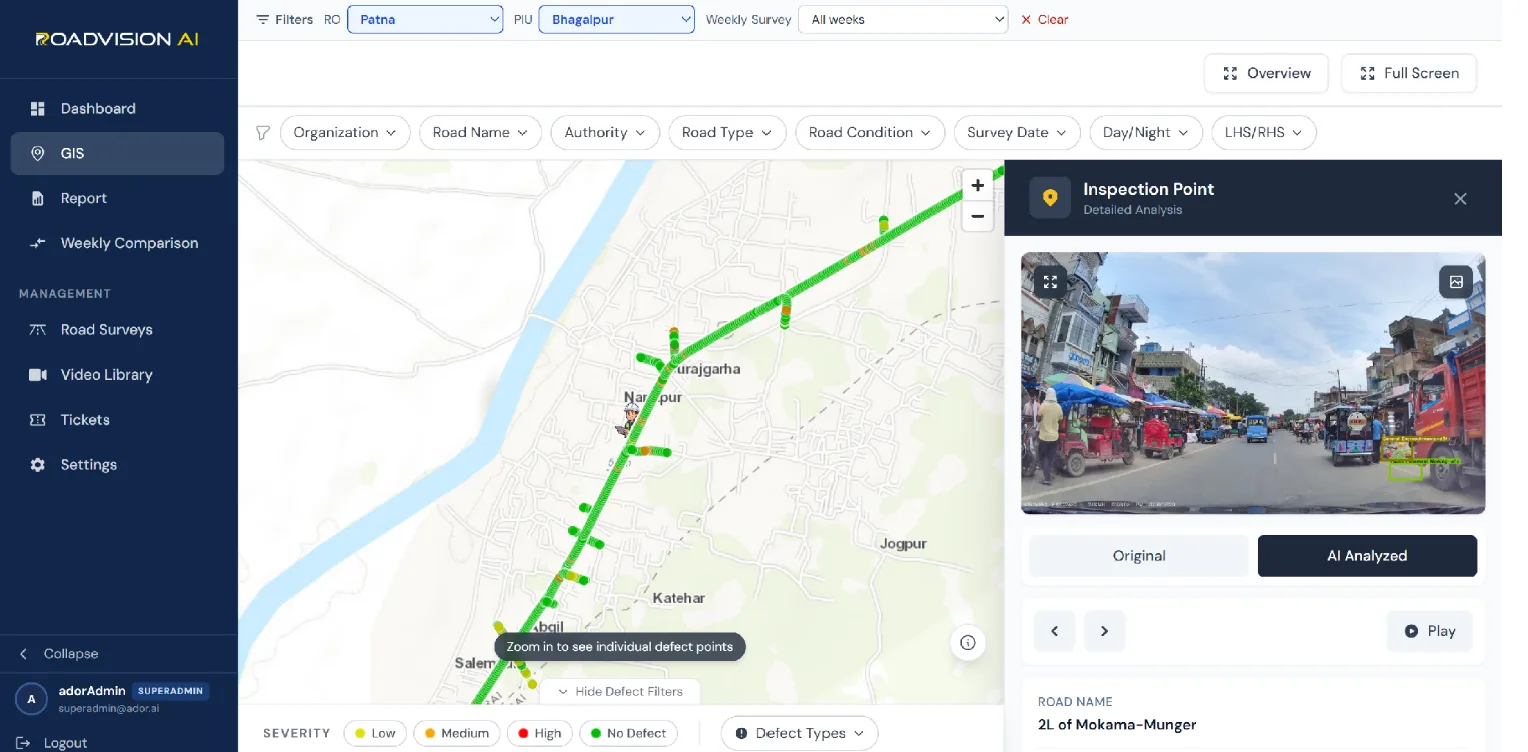
Every finding sits on a live GIS map, with each inspection point opening to its exact location, the defect flagged, and the frame behind it in both original and AI-annotated form. Figure 1 shows the corridor running beside a river channel and through built-up market stretches. The inspection point, in one such market area, flags general encroachment and faded pavement marking, with e-rickshaws, stalls and a loaded truck sharing the carriageway.
A short-term maintenance contract is, by design, limited in scope and in duration. That makes it important that the work it pays for goes to the defects that matter most, and that the corridor's condition at the end of the contract can be compared with its condition at the start. Neither is possible from site visits alone. A consistent, chainage-tied survey record gives NHAI a baseline, a way to prioritise within a limited budget, and evidence of what has changed.
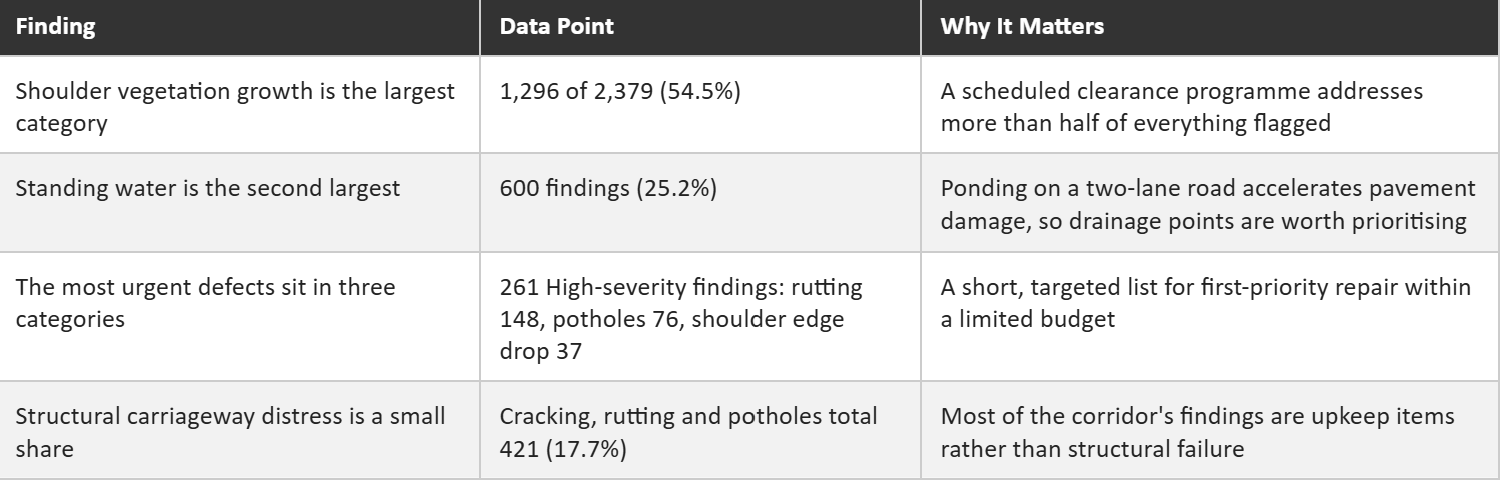
Across the surveys recorded on this road to date, RoadVision AI has logged 2,379 roadway-surface findings across seven defect types. By severity, 261 (11.0%) are High, 822 (34.6%) Medium and 1,296 (54.5%) Low.
Two categories dominate. Shoulder vegetation growth accounts for 1,296 findings (54.5%), and water stagnation for a further 600 (25.2%) together nearly 80% of the total. Cracking (197), rutting (148), potholes (76), shoulder edge drop (37) and shoulder unevenness (25) make up the remainder. The 261 High-severity findings correspond exactly to the combined count of rutting, potholes and shoulder edge drop, so the most urgent items are concentrated in a small number of categories.
.webp)
Each survey report gives the Patna RO and the Bhagalpur PIU a defect ID, chainage and survey reference for every finding, independent of the agency carrying out the maintenance. A later survey of the same chainage then shows whether a finding has been closed out, so that verification does not rest on the maintaining agency's own account.
RoadVision AI is committed to continuous AI-based road monitoring of the Mokama–Munger corridor, and to giving NHAI a consistent, chainage-level record of its condition. A limited maintenance budget stretched over a long two-lane road goes furthest when it is aimed at verified need. Keeping that record current, survey after survey, is central to making that happen.

The Autonomous Road Engineer
AI-powered road condition monitoring, asset management, & infrastructure intelligence helping agencies move from reactive maintenance to predictive road management.


.webp)
.webp)
.webp)