
This is a project-level account from RoadVision AI's weekly highway survey programme for NHAI, covering the 2-Lane with Paved Shoulder (2L PS) Aligarh to Moradabad section of Old NH-93, renumbered NH-509, in Uttar Pradesh, delivered on an EPC basis. It sets out why the corridor needs continuous monitoring even as a larger upgrade is planned around it, what a recent weekly survey found, and how NHAI can use the record to secure corrective action from the contractor.
The Aligarh to Moradabad section of Old NH-93 runs approximately 146.35 km, from Km 85.650 to Km 232.00, and was built to a 2-Lane with Paved Shoulder (2L PS) standard under NHAI, on an EPC contract executed by PNC Infratech Limited. The road, renumbered NH-509, is now fully operational and carries the region's day-to-day traffic between Aligarh and Moradabad.
NHAI has separately begun land acquisition to upgrade this corridor into a 4-lane, access-controlled greenfield highway intended to cut travel time between the two cities to around 90 minutes. That project will take years to land, design and build. Until it opens, this 2-lane road is not an interim afterthought it is the road people actually use, which is exactly why its condition needs the same continuous, independent scrutiny as any highway carrying live traffic, rather than being treated as a placeholder awaiting replacement.
Every finding is placed on a live GIS map, with each inspection point opening to show its exact location, the defect flagged, and the underlying frame in both original and AI-annotated form. Figure 1 shows an inspection point on this corridor near Bahjoi, where two instances of faded pavement marking have been flagged on the same stretch.
.webp)
An EPC contract puts the contractor on the hook for defects that appear after construction, but a road carrying live traffic for years before its eventual replacement cannot be left to occasional inspection in between. A single site visit can confirm the corridor's condition on the day it is checked; it cannot show whether a marking is fading further, whether a pothole is spreading, or whether a repaired stretch has actually held. Consolidating that picture across 146 km, consistently, is not something manual inspection can keep pace with at the frequency the corridor needs.
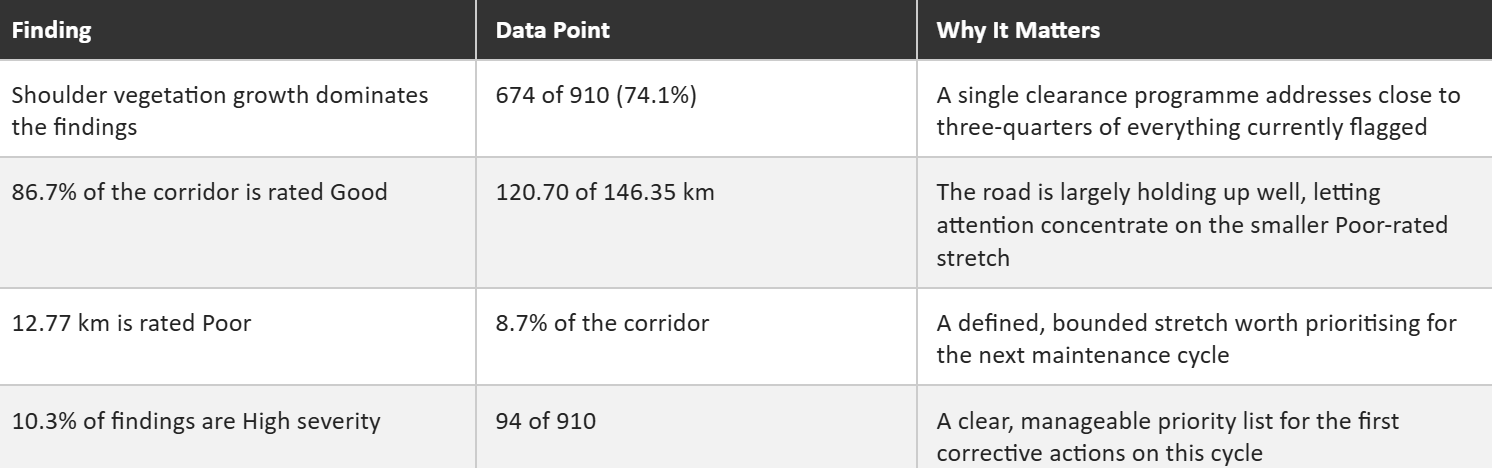
In the most recent weekly survey of this road, RoadVision AI logged 910 roadway-surface findings. Of these, 94 (10.3%) were graded High severity, 142 (15.6%) Medium, and 674 (74.1%) Low. Vegetation growth on the shoulders accounts for the great majority of the Low-severity total, at 674 findings, ahead of cracking at 142, rutting at 77, and potholes at 17. Across the corridor as a whole, 120.70 km (86.7%) is currently rated Good, 12.77 km (9.2%) Poor, and 5.65 km (4.1%) Fair.
.webp)
The contractor, PNC Infratech Limited, remains responsible for the road's upkeep under its EPC agreement with NHAI, and NHAI does not need to rely on the contractor's own account of what has been fixed. Each weekly report gives the RO and PIU a defect ID, chainage and survey reference sufficient to raise an Action Taken Report request, with the next survey re-checking the same coordinates.
RoadVision AI is committed to continuous AI-based monitoring of the Aligarh–Moradabad corridor for as long as it remains the operational link between the two cities, and to supporting the contractor accountability that this monitoring enables. A road due for eventual replacement still has years of service ahead of it, and the people using it every day deserve the same standard of oversight as any other highway. Keeping that verification current, survey after survey, is central to making this corridor safe until its successor is ready.

The Autonomous Road Engineer
AI-powered road condition monitoring, asset management, & infrastructure intelligence helping agencies move from reactive maintenance to predictive road management.


.webp)
.webp)
.webp)