
This is a project-level account from RoadVision AI's road survey programme for NHAI's Bhubaneswar Regional Office, covering two projects on NH-53 in Odisha: the four-laning of Talcher to the end of the Kamakhyanagar Bypass (Pkg-I), and the Short Term Improvement and Routine Maintenance of Chandikhole–Paradip, Km 0.000 to Km 76.588 (old NH-5A). One is a new four-lane being built out; the other is an older road under a maintenance contract. The survey shows that they produce very different kinds of findings.
The Talcher–Kamakhyanagar project is Package I of the four-laning of the road from Talcher to the end of the Kamakhyanagar Bypass. It spans two chainage ranges: Km 8.844 to Km 15.725 of NH-149 and Km 301.875 to Km 335.946 of NH-53, together about 41 km.
The Chandikhole–Paradip road, Km 0.000 to Km 76.588 of NH-53 (formerly NH-5A), is covered by a Short Term Improvement and Routine Maintenance contract, which combines short-term improvement works with routine maintenance over 76.588 km.
A four-laning package and a maintenance contract are judged against different expectations, but both depend on the same thing: knowing the actual condition of the road, in a form that can be checked again later. RoadVision AI applies the same detection, severity grading and chainage reference to both, so their findings can be compared directly even though the roads and the work are different.
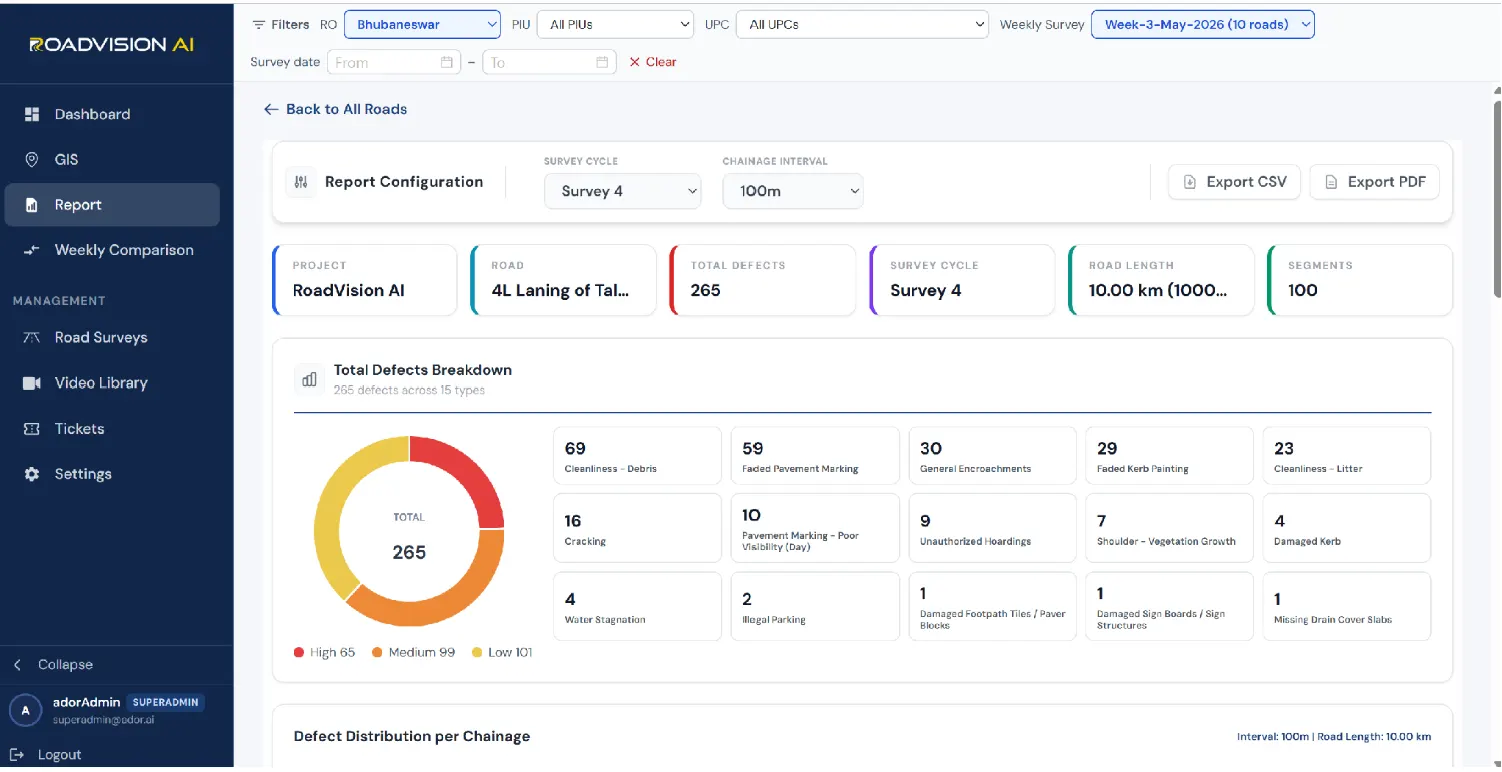
Survey 4 covered 10.00 km of the project in 100 segments at a 100 m chainage interval and logged 265 findings across 15 defect types, about 26.5 per kilometre. By severity, 65 (24.5%) are High, 99 (37.4%) Medium and 101 (38.1%) Low.
Cleanliness findings are the largest group: debris at 69 (26.0%) and litter at 23 (8.7%), together 92 (34.7%). Marking findings follow, faded pavement marking at 59 (22.3%) and poor-visibility marking at 10, together 69 (26.0%). Encroachments (30), unauthorised hoardings (9) and illegal parking (2) add 41 (15.5%), and kerb findings, faded kerb painting (29) and damaged kerb (4), another 33 (12.5%). Pavement distress is small: 16 cracking findings (6.0%) and no potholes. This section's findings are overwhelmingly about the road's surroundings and finishing rather than its structure, which is the kind of upkeep that routine management can address once it is made visible.
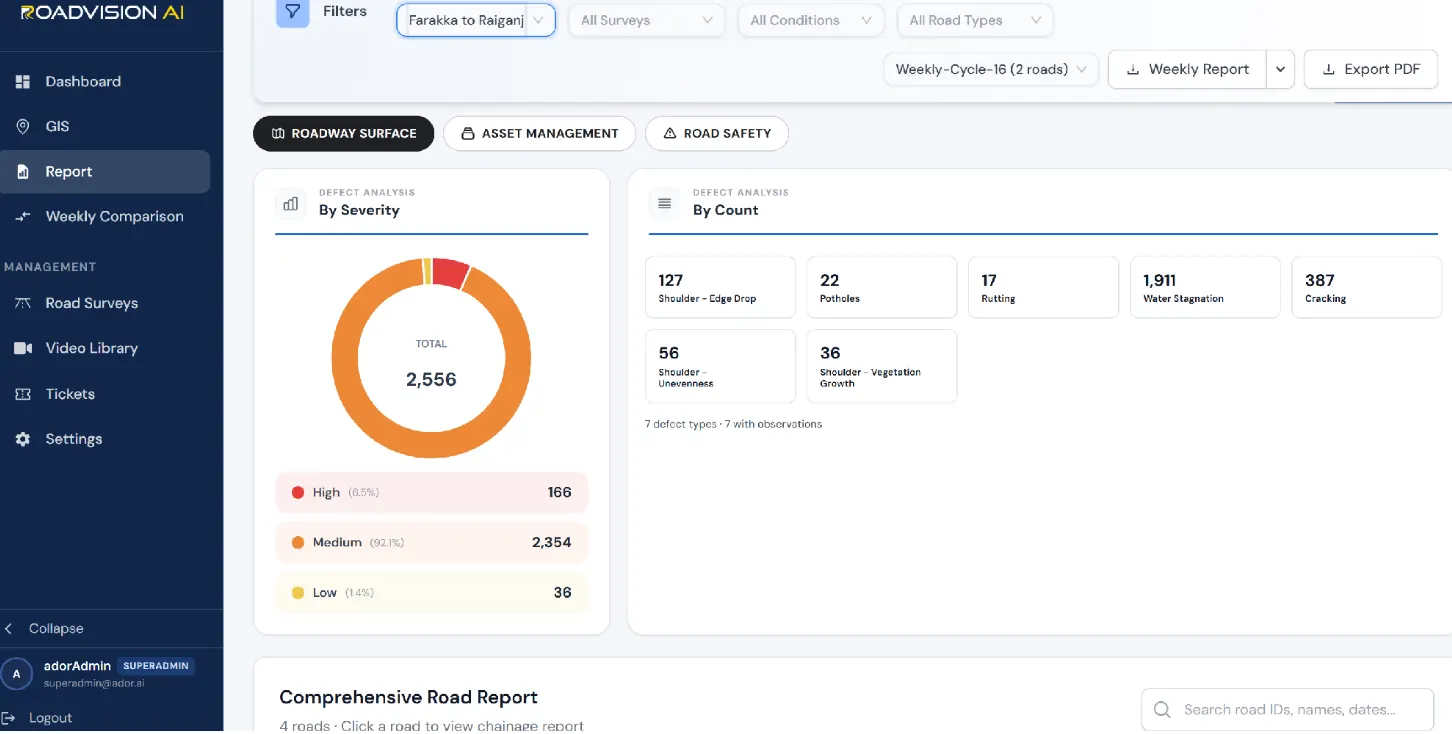
Two surveys are on record for this road. Survey 2 covered 29.80 km in 298 segments and logged 331 findings across 16 defect types; Survey 4 covered 26.96 km in 270 segments and logged 306 findings across 14 types. The two cover different lengths, so they are compared per kilometre and by share rather than as a like-for-like repeat of identical stretches.
Faded pavement marking dominates both surveys: 162 findings (48.9%) in Survey 2 and 169 (55.2%) in Survey 4. With poor-visibility marking added, marking accounts for about 60% of findings in each (61.3% and 59.2%). Findings per kilometre are broadly unchanged, at 11.1 in Survey 2 and 11.4 in Survey 4.
Two things did move. The High-severity share rose from 49.5% (164 findings) to 56.2% (172), and standing water more than doubled in density, from 29 findings (0.97 per km) to 59 (2.19 per km), reaching 19.3% of findings. On a contract that combines improvement with routine maintenance, flat finding density and rising standing water are the points most worth checking against the work programme.

The new four-lane shows more findings per kilometre but a far lower share of High-severity items; the older road shows fewer findings per kilometre but a heavier concentration of markings and, increasingly, standing water.
On both projects, each survey gives NHAI's Bhubaneswar Regional Office and the PIUs a defect ID, chainage and survey reference for every finding, independent of the agency doing the work, and a later survey of the same chainage shows whether it has been closed out. On Chandikhole–Paradip, where marking and standing water recur from one survey to the next, that check is what turns a recurring finding into a resolved one.
RoadVision AI is committed to continuous AI-based monitoring across both NH-53 projects, giving NHAI a consistent, chainage-level record whether the road is a new four-lane or an older road under routine maintenance. Different kinds of work should not mean different standards of evidence.

The Autonomous Road Engineer
AI-powered road condition monitoring, asset management, & infrastructure intelligence helping agencies move from reactive maintenance to predictive road management.


.webp)
.webp)
.webp)