
Saudi Arabia is in the middle of one of the most ambitious infrastructure build outs in modern history. Under Vision 2030. Crown Prince Mohammed bin Salman's sweeping national transformation plan the Kingdom is upgrading its highways, building smart cities from the ground up, and positioning itself as a global logistics hub. Roads are the circulatory system of this entire effort.
The scale of the challenge is real. Saudi Arabia maintains over 200,000 kilometres of highways and municipal roads from the King Fahd Causeway corridor linking Dammam and Al Khobar to the Eastern Province's petrochemical freight routes, from the Makkah–Madinah pilgrim expressways that carry millions during Hajj season to the new expressways being carved through the Tabuk desert for NEOM. Building these roads is one thing. Monitoring and maintaining them at this scale in extreme heat, shifting sand, and under relentless heavy-vehicle traffic an entirely different problem.
.webp)
For decades, road inspection in the Gulf region and across the world has relied on manual surveys. Inspectors physically walk or drive road sections, note defects on paper or basic software, and submit periodic reports. The cycle repeats every 12 to 18 months at best.
This approach has three fundamental weaknesses.
First, it is slow. By the time a defect is formally documented, it may have already grown from a hairline crack into a pothole that damages vehicles or causes accidents. Second, it is expensive. Deploying trained road engineers across thousands of kilometres is resource-intensive, particularly in the extreme heat and remote terrain of Saudi Arabia. Third, it is subjective. Two inspectors may rate the same road section differently, making it difficult to compare data across districts or set maintenance budgets fairly.
Saudi Arabia faces additional pressures specific to its environment: sand accumulation on shoulders, asphalt fatigue from daytime temperatures exceeding 50°C, and heavy axle loads from freight convoys supporting NEOM and other mega-projects. Traditional inspection simply cannot keep pace.
The General Authority for Roads (RGA) has already moved decisively. In 2025, Saudi Arabia deployed what is widely described as the region's largest AI-powered road inspection fleet vehicles fitted with high-resolution cameras, laser sensors, and GPS systems, capable of scanning dozens of kilometres per day across urban corridors in Riyadh and Jeddah as well as remote desert highways in the Northern Border and Tabuk regions. In the first phase alone, over 150,000 kilometres of roads were covered. The Ministry of Transport reports a 40% reduction in road maintenance time since adopting advanced digital survey technologies.
Traffic enforcement has similarly gone intelligent. The Saher system a network of AI-enabled cameras across Riyadh, Jeddah, Dammam, Makkah, and Madinah uses machine learning to flag speeding, seat-belt violations, and red-light running in real time, contributing to violation reductions of up to 30% in some cities. AI systems managing the Riyadh Metro and urban signal networks have cut congestion delays by 20 to 25% in pilot zones. Vision 2030's Phase 3, which entered execution mode in 2026, is now explicitly focused on translating these early wins into nationwide, data-driven road asset management not just smart enforcement, but smart maintenance.
As Riyadh expands toward its 2030 population target of 15–20 million, the pressure on road planners to move fast and move smart has never been greater. A digital traffic survey in Riyadh today does what a team of field engineers once took months to complete capturing vehicle counts, speed profiles, lane classifications, and peak-hour flow data continuously, across every major arterial from King Fahd Road to the new expressways feeding the Qiddiya corridor. The Saudi Data and AI Authority (SDAIA) has already deployed AI platforms like Sawaher and Smart C at city-scale, giving planners the predictive insight to anticipate Ramadan traffic surges, redesign bottleneck intersections, and align signal timing with live demand rather than static schedules.
This shift from periodic survey to continuous intelligence is exactly what AI road asset management in KSA is built on. Rather than waiting for a pothole complaint from a Dammam municipality contractor or a quarterly inspection report on the Riyadh–Makkah expressway, road authorities now receive weekly condition scores, GIS-tagged defect maps, and automated maintenance work orders all generated from dashcam footage processed by computer vision models trained on Saudi-specific road conditions. For concessionaires managing toll highways in the Eastern Province or freight corridors out of Jubail, this means maintenance budgets tied to real data, not guesswork, and compliance with MoTLS and RGA asset management guidelines built into the workflow from day one.
The downstream impact is measurable. Pilot deployments of AI traffic monitoring in Riyadh and Jeddah have already cut congestion delays by 20–25% through real-time signal optimisation. On the asset side, the Ministry of Transport reports a 40% reduction in road maintenance time since digital survey technologies entered the procurement mainstream. For Saudi Arabia's road sector where the stakes span Hajj pilgrim safety on the Makkah Ring Roads, NEOM logistics in Tabuk, and industrial throughput from Yanbu that kind of efficiency is not incremental. It is transformational.
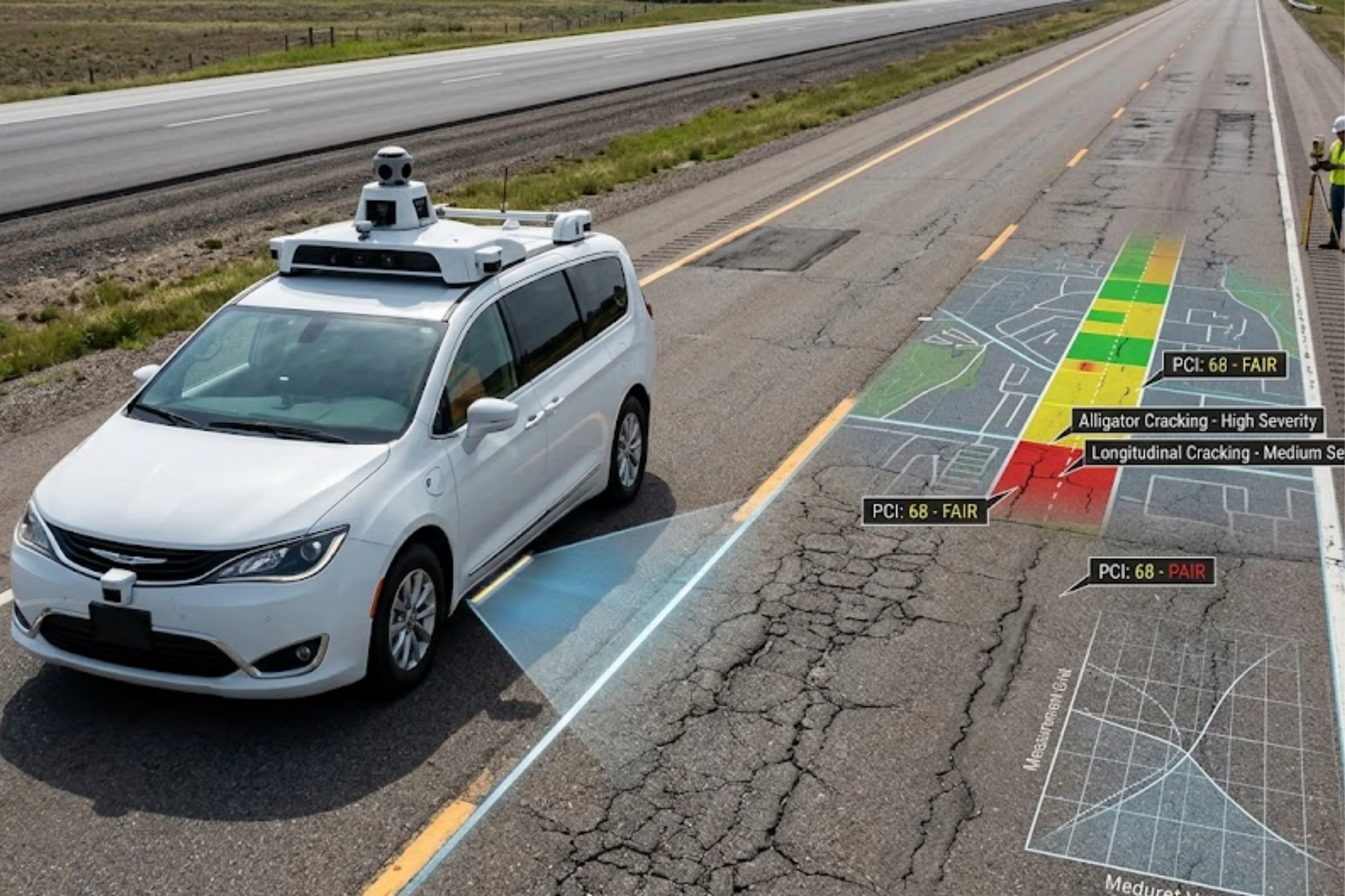
Modern AI road monitoring systems work by turning an ordinary dashcam-equipped vehicle into a mobile road inspector. The vehicle drives its normal route. The camera continuously records. AI models run in the background, analysing every frame for defects potholes, cracks, rutting, edge wear, faded lane markings, missing signage, and more.
What takes a human inspector days to survey can be completed in hours. What took 12 months to refresh is now available on a weekly basis. And crucially, the output is not a paper report it is a live GIS dashboard showing every defect, its GPS location, its severity score, and a suggested maintenance priority.
This is the foundation of platforms like RoadVision AI's AI-RAMS (AI-powered Road Asset Management System). Designed specifically for large road networks, AI-RAMS processes continuous dashcam video to detect and classify 17+ defect types, generate Pavement Condition Index (PCI) and International Roughness Index (IRI) scores, and produce full GIS outputs covering road inventory, safety parameters, and asset mapping all without any specialised LiDAR equipment or lane closures.
The system is built to comply with Saudi Arabia's official highway and infrastructure codes, specifically SHC 101 and SHC 202, meaning it fits directly into the regulatory and procurement frameworks that Saudi road agencies use.
The technology is not theoretical. RoadVision AI's AI-RAMS platform is already operational at scale. Working with the National Highways Authority of India which manages a network comparable in complexity to Saudi Arabia's the system monitors over 10,000 kilometres of roads on a weekly basis, tracking 34+ parameters across road conditions, safety, and asset monitoring. The result has been a 90% reduction in survey time and the complete replacement of manual report writing with a real-time GIS dashboard.
For Saudi Arabia, the implications are direct. Road agencies currently stretched across vast desert corridors from Riyadh to NEOM construction routes, from Hajj pilgrim roads to industrial freight corridors in Jubail can achieve the same shift: from reactive patching to proactive, data-driven maintenance.
AI traffic survey tools already deployed in Riyadh and Jeddah have shown congestion reductions of 20 to 25% through real-time signal optimisation. Work zone safety monitoring using AI agents has enabled instant hazard detection in live construction zones, sending alerts to supervisors before accidents can escalate.
Three factors make AI-powered road monitoring especially critical for the Kingdom.
Scale - With 200,000+ kilometres of road and ambitious expansion underway, no human workforce can survey the network with the frequency it requires. AI makes continuous monitoring possible.
Environment - Desert conditions accelerate pavement degradation in ways that only high-frequency, automated monitoring can catch early. AI systems trained on Saudi-specific defect patterns sand ingress, thermal cracking, bitumen fatigue provide more accurate outputs than generic tools.
Vision 2030 alignment - The Kingdom's national road safety targets include reducing fatalities to below five per 100,000 by 2030. Phase 2 of the National Road Safety Program is actively launching safer intersections, improved barriers, and treatment of high-risk sites. Intelligent monitoring infrastructure is a direct enabler of these goals.
Saudi Arabia is not just building roads it is building a data infrastructure around those roads. The integration of AI monitoring, digital traffic surveys, smart enforcement systems, and GIS-based asset management is turning the Kingdom's road network into one of the most intelligently managed in the world.
For road agencies, engineering consultancies, and infrastructure contractors operating in Saudi Arabia, the message is clear: manual inspection cycles are not aligned with Vision 2030's pace or ambition. AI-powered monitoring is not a future upgrade it is the present standard.
Platforms like RoadVision AI are purpose-built for exactly this transition: combining vision intelligence to detect and classify road conditions from standard dashcam footage, and language intelligence to convert raw data into engineering reports, maintenance work orders, and compliance summaries fully aligned with Saudi highway codes.
The Kingdom's roads are the backbone of Vision 2030. Keeping them smart, safe, and monitored in real time is how Saudi Arabia ensures that backbone holds.
RoadVision AI is an AI-powered Road Asset Management platform serving road agencies, highway concessionaires, and infrastructure companies across India, the Middle East, and beyond.
To explore how AI-RAMS can support your road monitoring programme in Saudi Arabia, visit roadvision.ai or book a demo.
Saudi Arabia is investing heavily in transportation infrastructure as part of Saudi Vision 2030. The Kingdom is developing smart cities, expanding road networks, improving logistics corridors, and enhancing road safety.
Effective monitoring helps:
Saudi Arabia's smart city developments rely heavily on real-time infrastructure intelligence.
AI monitoring supports smart cities by:
Modern AI models can achieve high detection accuracy when trained on diverse road conditions and local datasets.
Accuracy depends on:
Many agencies use AI as a decision-support tool alongside expert review for maximum reliability.

The Autonomous Road Engineer
AI-powered road condition monitoring, asset management, & infrastructure intelligence helping agencies move from reactive maintenance to predictive road management.


.webp)
.webp)