Road Inspection vs Road Survey vs Road Audit: Key Differences Explained
On this page
Anyone working in road infrastructure, transportation planning, or municipal engineering has likely encountered these three terms used somewhat interchangeably: road inspection, road survey, and road audit. In casual conversation, that's not a huge problem. But in procurement documents, regulatory compliance, budgeting, and technical scopes of work, conflating these terms can lead to real confusion—hiring the wrong type of assessment, misunderstanding what a report will actually cover, or failing to meet a specific regulatory requirement.
Each of these three activities serves a distinct purpose, follows different methodologies, and produces different types of output. In this blog, we'll clearly define road inspection, road survey, and road audit, explain how they differ, and help you understand which approach fits which situation.
Quick Overview: The Core Distinction
Before diving into details, here's the simplest way to think about the difference:
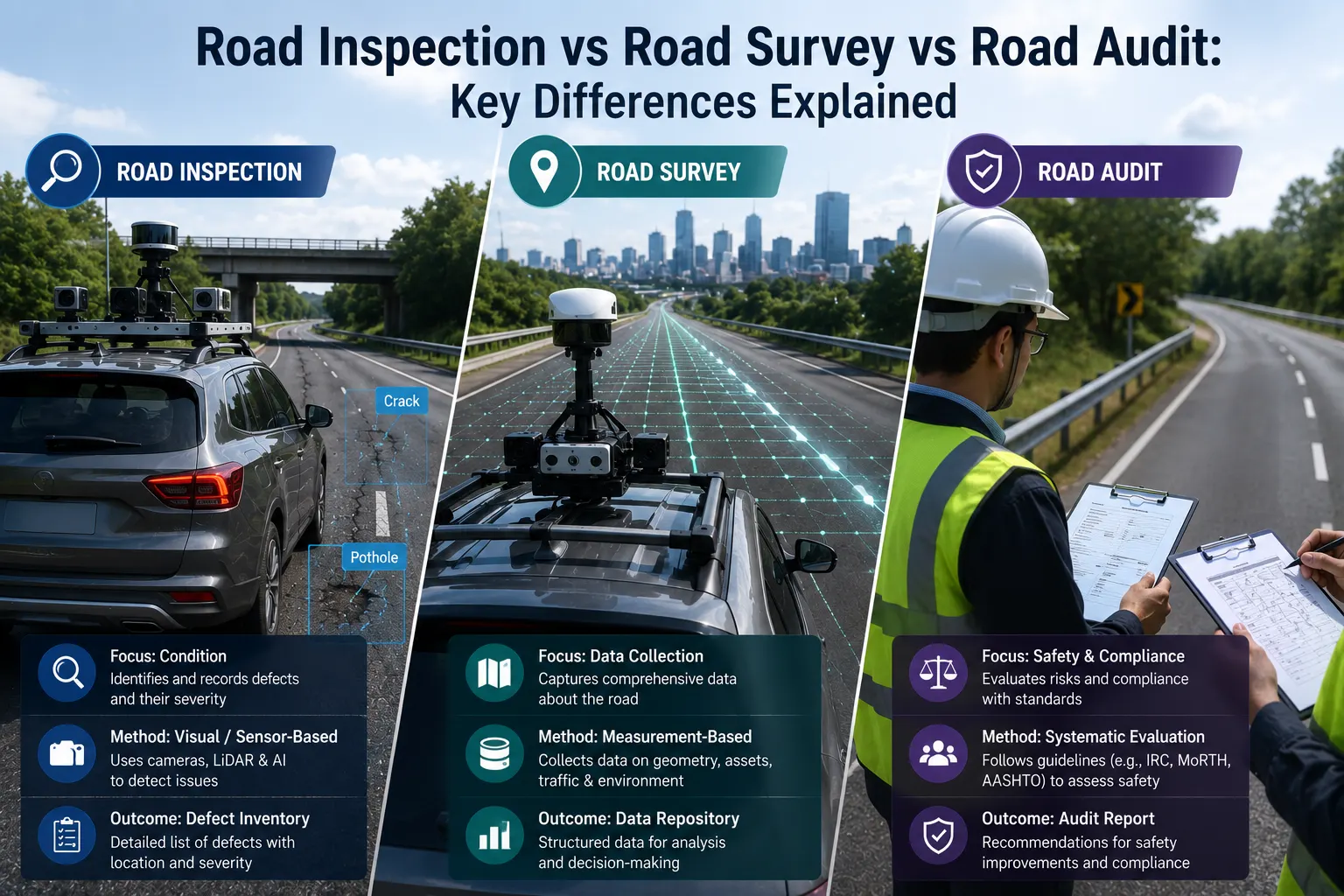
Road Inspection focuses on the current physical condition of a road identifying visible defects like potholes, cracking, or wear.
Road Survey is a broader, often more systematic and technical data-collection process, capturing detailed measurements across an entire road segment or network, which may include but isn't limited to condition data.
Road Audit is an evaluative process typically focused on safety, design, or compliance that assesses whether a road meets specific standards, identifies risks, and recommends changes, often independent of its current physical condition.
With that framing in mind, let's look at each in more depth.
What Is a Road Inspection?
A road inspection is the process of physically examining a road, or a specific segment of it, to identify visible defects and assess its current condition. Inspections are typically conducted on a recurring schedule—monthly, quarterly, or annually depending on road classification and risk level—and are primarily concerned with answering a straightforward question: What condition is this road in right now, and does it need attention?
Key Characteristics of Road Inspections
Frequency-Driven: Inspections are usually conducted on a defined, recurring schedule tied to road hierarchy, risk classification, or regulatory requirements.
Defect-Focused: The primary output is a list of identified defects potholes, cracking, rutting, faded markings—along with severity ratings and locations.
Often Visual: Many inspections rely on visual assessment methods, whether performed manually by a trained inspector (Detailed Visual Inspection or Coarse Visual Inspection) or increasingly through AI-powered automated detection using vehicle-mounted cameras.
Action-Oriented: Inspection findings typically feed directly into maintenance work order systems, triggering repair or further investigation.
Legal and Liability Relevance: In many jurisdictions, documented inspection records serve as evidence that an authority has taken reasonable care to maintain its roads, which can be critical in liability defense.
.
What Is a Road Survey?
A road survey is a more comprehensive, often technically detailed data-collection process that captures a wide range of measurements across a road network or specific corridor. While a survey often includes condition data similar to an inspection, it typically goes further—capturing precise measurements of surface roughness, rutting depth, cracking extent, skid resistance, or structural characteristics using specialized equipment.
Surveys are less about a quick check and more about building a rich, quantitative dataset that supports engineering analysis, long-term planning, and pavement management systems.
Key Characteristics of Road Surveys
Data-Intensive: Surveys typically involve specialized equipment laser profilometers, ground-penetrating radar, high-resolution imaging systems—to capture precise, quantitative measurements rather than general visual observations.
Broader Scope: A survey may cover an entire network or major corridor systematically, rather than focusing on a specific reported issue or scheduled route.
Standardized Methodology: Many surveys follow standardized national or regional methodologies (such as network-level condition surveys used by highway authorities) to ensure data consistency and comparability over time.
Supports Long-Term Planning: Survey data feeds into pavement management systems, deterioration modeling, and multi-year capital planning, rather than being used solely for immediate repair triggers.
Periodic, Not Necessarily Frequent: Because of the depth and cost involved, comprehensive surveys are often conducted less frequently than routine inspections though AI-powered, fleet-based survey approaches are increasingly enabling more continuous data collection.
A road safety audit is fundamentally different from both inspection and survey in that it's not primarily concerned with current physical condition—it's an evaluative, often independent assessment of whether a road meets specific safety, design, or regulatory standards. The most common form is a Road Safety Audit, a formal, structured process typically conducted by qualified, often independent auditors, examining a road's design and operation for safety risks.
Key Characteristics of Road Audits
Standards and Compliance Focused: Audits assess whether a road meets specific design, safety, or regulatory standards, rather than simply documenting its current physical state.
Independent and Structured: Formal road safety audits are typically conducted by qualified auditors independent of the original design or maintenance team, following a structured, staged methodology (often applied at different project stages: design, pre-opening, and in-service).
Risk-Based Analysis: Audits focus on identifying safety risks inadequate sight lines, poor signage, unsafe intersection geometry, insufficient lighting—that could contribute to accidents, regardless of the road's pavement condition.
Recommendation-Driven: The output of an audit is typically a formal report with specific recommendations for design changes, safety improvements, or risk mitigation measures.
Broader Than Pavement Condition: Audits often examine factors entirely unrelated to surface condition, such as geometric design, signage adequacy, lighting, drainage, and roadside hazards.
How These Three Activities Work Together
In a well-managed road network, inspection, survey, and audit aren't competing processes they're complementary layers of a comprehensive infrastructure management program:
Inspections provide the frequent, ongoing pulse-check that keeps day-to-day maintenance responsive to emerging defects.
Surveys provide the deeper, quantitative data foundation needed for long-term capital planning, budget forecasting, and pavement deterioration modeling.
Audits ensure that, independent of pavement condition, the road's underlying design and operational safety continue to meet current standards, catching risks that condition-focused inspection or survey processes might not address.
A road can be in excellent physical condition—smooth, freshly paved, defect-free—and still fail a safety audit due to poor sight lines or inadequate signage. Conversely, a road can have significant surface defects flagged through inspection or survey while still meeting all relevant design safety standards. Understanding this distinction helps agencies commission the right type of assessment for the right purpose, rather than assuming one process can substitute for another.
How AI Is Changing All Three Processes
Artificial intelligence is increasingly influencing each of these activities, though in different ways:
For Inspections: AI-powered computer vision now enables automated defect detection from vehicle-mounted cameras, dramatically increasing inspection frequency and consistency compared to manual visual methods.
For Surveys: AI enhances the analysis of survey data processing LiDAR, imagery, and sensor data faster and more consistently, while also enabling more frequent, lower-cost survey approaches using fleet-based data collection.
For Audits: While the core audit process still relies heavily on qualified human judgment, AI tools are beginning to support audit teams by flagging design anomalies, sightline obstructions, or signage gaps from imagery and video for further expert review.
Importantly, even as AI accelerates inspection and survey processes, formal road safety audits generally remain a human-led, expert judgment process—AI can support and inform an audit, but the structured, independent evaluation itself typically still requires qualified auditors.
Choosing the Right Approach for Your Situation
If you need to know whether a specific road needs repair right now, you need an inspection.
If you need detailed, quantitative data to plan multi-year maintenance budgets or feed a pavement management system, you need a survey.
If you need to know whether a road's design and operation meet current safety standards, you need an audit.
Many comprehensive infrastructure management programs use all three in combination—continuous or frequent inspections for routine maintenance, periodic surveys for long-term planning, and audits at key project milestones or on a recurring cycle for high-risk corridors.
Conclusion
While road inspection, road survey, and road audit are sometimes used loosely as interchangeable terms, each serves a distinct and important role in comprehensive road infrastructure management. Inspections keep pace with day-to-day condition changes, surveys provide the detailed data foundation for long-term planning, and audits ensure that safety and design standards are independently verified, regardless of pavement condition. Understanding these differences isn't just a matter of terminology it directly affects how agencies scope projects, procure services, and build a truly comprehensive approach to keeping road networks safe and well maintained.



.webp)
.webp)
.webp)