
Somewhere in a mid-sized American city, a public works director is staring at a $112,000 invoice. A pothole that began as a hairline crack two winters ago has now swallowed a section of asphalt wide enough to blow out three tires, crack a water main underneath, and delay a school bus route for eleven days. The repair crew, emergency contractors, traffic management, and liability settlement pushed a problem that could have been fixed for under $10,000 into a six-figure catastrophe.
This is not an edge case. It is the daily reality of road infrastructure management when agencies rely on reactive, calendar-based, or purely visual inspection systems. And it is precisely the problem that AI road condition monitoring was built to solve.
Road infrastructure underpins every economic activity in a community from the daily commute to commercial freight to emergency response. Yet across the United States alone, the American Society of Civil Engineers estimates that deteriorating roads cost motorists over $130 billion annually in vehicle damage, delays, and fuel waste. The question is no longer whether technology can help. The question is: how long can agencies afford to ignore it?
.webp)
To understand road maintenance ROI, you first need to understand how roads actually fail. Pavement deterioration is not linear. In its early stages, a road surface may lose only 10–15% of its structural integrity while appearing largely intact. But once past a critical threshold typically around 40% degradation the rate of failure accelerates exponentially. A surface that cost $8,000 per lane-mile to seal-coat at Year 3 may demand $85,000 to $120,000 per lane-mile in full-depth reclamation by Year 8.
This is the pavement lifecycle paradox: the cheapest point to intervene is precisely when the damage is hardest to see. Traditional inspection which relies on scheduled crew walkthroughs, subjective visual ratings, and annual survey windows is structurally ill-equipped to catch roads at that golden intervention point. By the time a pothole is visible to an inspector, the underlying base damage is often already severe.
The financial math is unambiguous:
Every dollar spent on preventive maintenance at the right moment saves an estimated $6 to $14 in future reconstruction costs, according to the Federal Highway Administration. The problem has never been a lack of data on this ratio it has been the inability to identify which roads, when, and in what priority order require action.
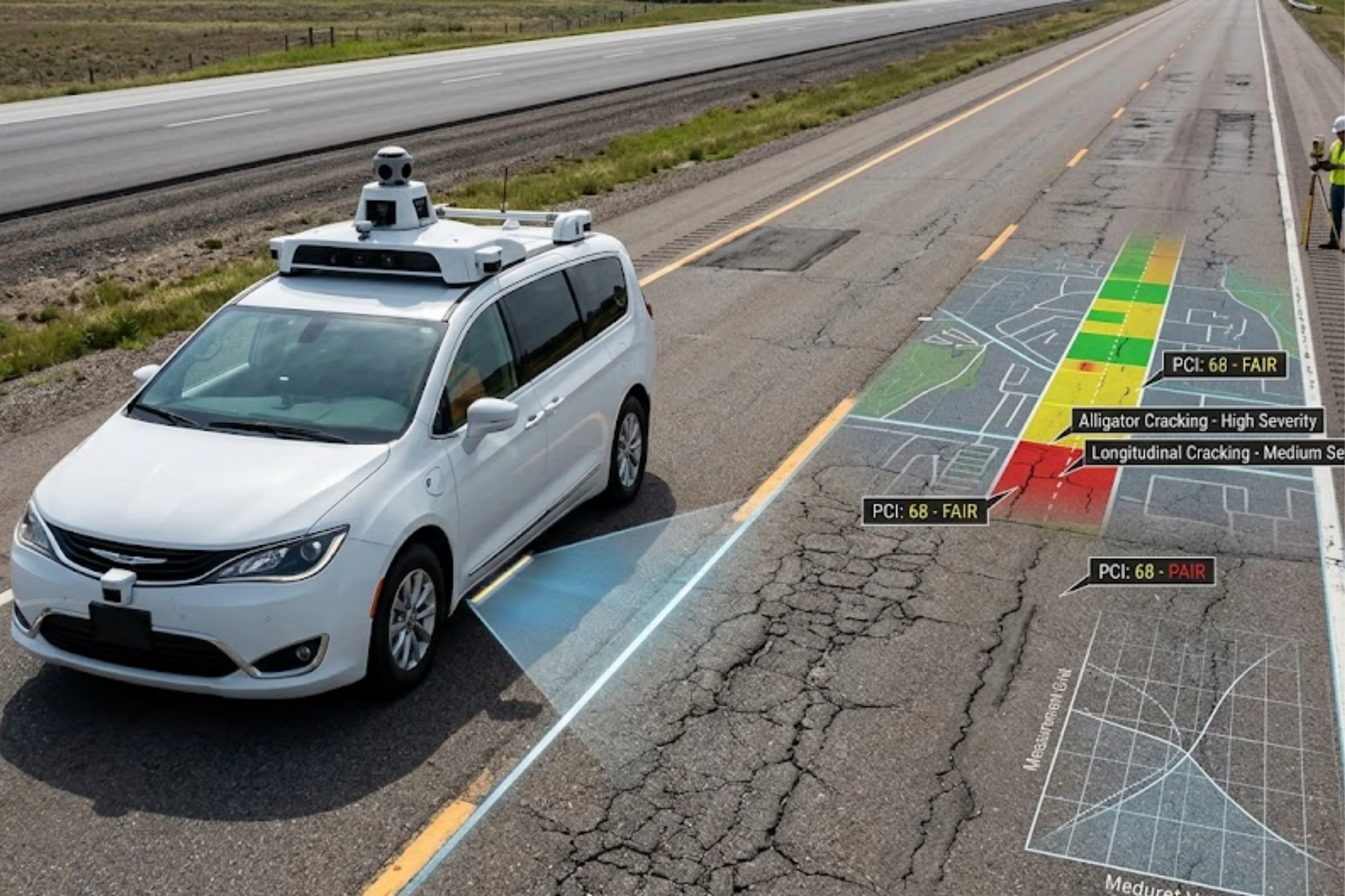
AI road condition monitoring is not a single product. It is an integrated ecosystem of data collection, machine learning analysis, and decision-support tools that transforms how agencies understand their road networks in real time.
At the data-collection layer, agencies deploy a combination of:
These feeds are ingested by machine learning platforms trained on millions of pavement samples to detect, classify, and severity-score defects including longitudinal cracking, transverse cracking, rutting, raveling, pothole formation, and subsidence. The systems don't just identify what is wrong they predict what will go wrong and when, based on weather patterns, traffic load data, soil composition, and historical degradation curves for that specific road segment.
The output is a dynamic, prioritized maintenance schedule. Instead of a crew chief deciding which block to patch based on last month's complaint log, a city engineer sees a color-coded network map showing exactly which 3% of roads account for 40% of imminent failure risk, ranked by intervention cost versus delay cost.
Let's walk through a concrete comparison to illustrate road inspection cost savings in practice.
Without AI Reactive Model:A suburban arterial road develops subsurface moisture infiltration in November. It goes undetected through winter. By March, freeze-thaw cycles have expanded the weak zone. A pothole erupts in April. By the time it is reported, patched, and re-reported for full repair, the base layer has failed across a 200-foot section.
Full milling and overlay: $94,000. Plus liability claim from a cyclist injury: $22,000. Total exposure: $116,000.
With AI Predictive Model:The same road's moisture signature is flagged by an AI monitoring system in October during a routine data sweep from instrumented city vehicles. The system assigns it a high-urgency preventive intervention tag based on the approaching winter forecast and historical failure patterns on similar road profiles in that drainage zone. A crew applies crack sealing and a targeted surface treatment in November. Total cost: $8,400. The road scores a Pavement Condition Index (PCI) improvement of 18 points and is pushed back into the low-risk maintenance tier.
Savings: over $107,000 on a single road segment
Scale that across a network of 800 lane-miles the size of a typical mid-sized city and the aggregate road maintenance ROI becomes transformational. Agencies implementing AI-driven systems consistently report 20–40% reductions in total maintenance spend within the first three years.
The concept of AI predictive road maintenance originated in industrial manufacturing, where sensor data from machines enabled engineers to replace components before failure rather than after. The principles translate directly to road infrastructure, with one crucial difference: roads serve the public, and failure has safety, liability, and economic ripple effects that extend far beyond the asset itself.
Predictive maintenance in road management works across three time horizons:
Short-term (0–6 months): Identifying surfaces approaching failure thresholds that require immediate low-cost intervention. This is where the highest ROI lives.
Medium-term (6–36 months): Scheduling resurfacing and structural treatments in the optimal maintenance window, before degradation accelerates. Allows for budget planning and contractor procurement at favorable rates.
Long-term (3–10 years): Capital planning for reconstruction projects, enabling agencies to sequence major work around budget cycles, bond financing, and utility coordination dramatically reducing the cost of mobilization and disruption.
Modern AI road monitoring platforms integrate with GIS systems, budget management software, and public works scheduling tools to make these predictions actionable rather than theoretical. Decision-makers receive not just a list of problems, but a ranked, costed, and time-sensitive maintenance program they can execute with their existing teams.
Agencies that continue to defer AI adoption are not saving money they are deferring and compounding costs. Consider the secondary costs that never appear on a single repair invoice but steadily drain municipal budgets:
Vehicle damage liability: Pothole-related vehicle damage claims cost U.S. local governments hundreds of millions annually. AI-enabled prevention directly reduces this exposure.
Emergency contractor premiums: Reactive repairs mobilized on short notice cost 30–60% more than planned work, due to rush rates, overtime, and inability to batch similar jobs.
Traffic disruption costs: Extended lane closures for major repairs create measurable losses in commercial activity, fuel consumption, and emergency response times.
Staff inefficiency: Without data-driven prioritization, maintenance crews spend significant time responding to complaint-driven requests that are not the highest-need locations while genuinely critical segments go unaddressed.
Public trust erosion: Residents notice deteriorating roads. Survey data consistently links road quality to municipal approval ratings and business investment decisions.
One of the most persistent misconceptions about AI road condition monitoring is that it requires a complete technological overhaul from day one. In reality, most agencies begin with a phased approach:
Phase 1 — Baseline Assessment: Deploy mobile data collection (often via existing fleet vehicles with mounted sensors or smartphones) to generate an AI-scored baseline PCI for the entire network. This typically takes 4–8 weeks and costs a fraction of traditional manual survey programs.
Phase 2 — Prioritization Engine: Feed baseline data into an AI analysis platform that produces a tiered maintenance priority map with cost estimates. This becomes the foundation for the annual maintenance budget.
Phase 3 — Continuous Monitoring: Establish recurring data collection cycles (quarterly or seasonal) to track network changes, update predictions, and refine the maintenance schedule dynamically.
Phase 4 — Integration & Reporting: Connect the AI platform to existing asset management and financial systems to automate reporting, measure outcomes, and demonstrate ROI to elected officials and oversight bodies.
Agencies that have completed this journey report not only financial savings but operational improvements: better crew deployment, reduced emergency callouts, and more defensible budget requests backed by objective network data.
The $10,000 intervention and the $100,000 emergency repair are not two different problems. They are the same road, at two different points in time one where AI gave the agency a choice, and one where it no longer had one.
Predictive road maintenance powered by AI road condition monitoring does not eliminate the need for road repair. Roads will always require upkeep. What AI eliminates is the waste the unnecessary emergency spending, the premature reconstruction, the liability exposure, and the squandered window where a fraction of the cost could have preserved a road for another decade.
The agencies leading in infrastructure efficiency today are not the ones with the largest budgets. They are the ones that decided to stop reacting to failure and start preventing it. For every public works department still operating on clipboard inspections and reactive dispatch, the question is not whether AI will eventually become standard practice in road management. The question is how many six-figure repair bills it will take before they make the switch.
Book a demo with RoadVision AI to explore how AI-powered road inspection can help your city improve road quality, optimize maintenance budgets, and build smarter urban infrastructure.
Most agencies see a measurable return within 12 to 24 months of full deployment. Early wins come from identifying high-priority intervention opportunities that prevent expensive reactive repairs. Full network-level ROI where total maintenance spend begins declining typically becomes measurable by Year 2 or 3. Some agencies report recouping their full platform investment within the first 18 months based on a single avoided major reconstruction project.
Yes and in many ways, smaller agencies benefit most. They have fewer resources to absorb the cost of emergency repairs and less budget buffer for reactive spending. Shared-service models, state DOT programs, and SaaS-based AI platforms have made road condition monitoring accessible to agencies managing networks as small as 50 lane-miles. The per-mile cost of AI monitoring has dropped significantly as platforms have scaled, making the road inspection cost savings achievable even for agencies with constrained capital budgets.
AI systems ingest a variety of data types: imagery from cameras and drones processed through computer vision, accelerometer data from vehicles detecting roughness and vibration signatures, LiDAR point-cloud data capturing surface geometry, weather and climate data for degradation modeling, and traffic load data from counters and GPS. Collection methods range from dedicated survey vehicles to smartphone-equipped fleet vehicles (street sweepers, delivery trucks, transit buses) that passively gather data during normal operations.

The Autonomous Road Engineer
AI-powered road condition monitoring, asset management, & infrastructure intelligence helping agencies move from reactive maintenance to predictive road management.


.webp)
.webp)