
A pothole rarely looks like an emergency. It's just a dip in the road something you swerve around, complain about for five seconds, and forget by the next intersection. That casual dismissal is exactly the problem. Potholes are one of the most underestimated hazards on any road network, quietly causing crashes, damaging vehicles, and costing economies hundreds of billions of dollars every year, largely because they're treated as a nuisance instead of the safety and infrastructure risk they actually are.
This piece looks at what potholes really cost in money, in safety, and in the roads themselves and why waiting to fix them is almost always the most expensive option on the table.
Understanding why potholes are dangerous starts with understanding how ordinary they are to create. It doesn't take a disaster just water, traffic, and time.
The unsettling part is how fast this cycle moves once it starts. A hairline crack that looks cosmetic today can become a full pothole within a single rainy season.
Potholes cause tyre blowouts, sudden steering loss, and bent rims often at highway speed, where the margin for recovery is thin. For two-wheeled vehicles, the risk is far more severe: motorcyclists and cyclists hitting a pothole can lose control instantly, with far less protection than someone inside a car.
Even when a pothole doesn't directly cause a crash, it causes swerving and sudden, unpredictable lane changes to avoid a hole are a well-documented trigger for secondary collisions, especially in heavy traffic or poor visibility.
The damage isn't always immediate or obvious. Hitting a pothole can cause:
Much of this damage is cumulative a vehicle that repeatedly hits smaller potholes on a daily commute can develop steering and suspension problems that owners never trace back to the road itself. Vehicle repair costs tied to poor road conditions run into billions of dollars annually across affected regions, much of it paid out of pocket by drivers who never realized the road was the root cause.
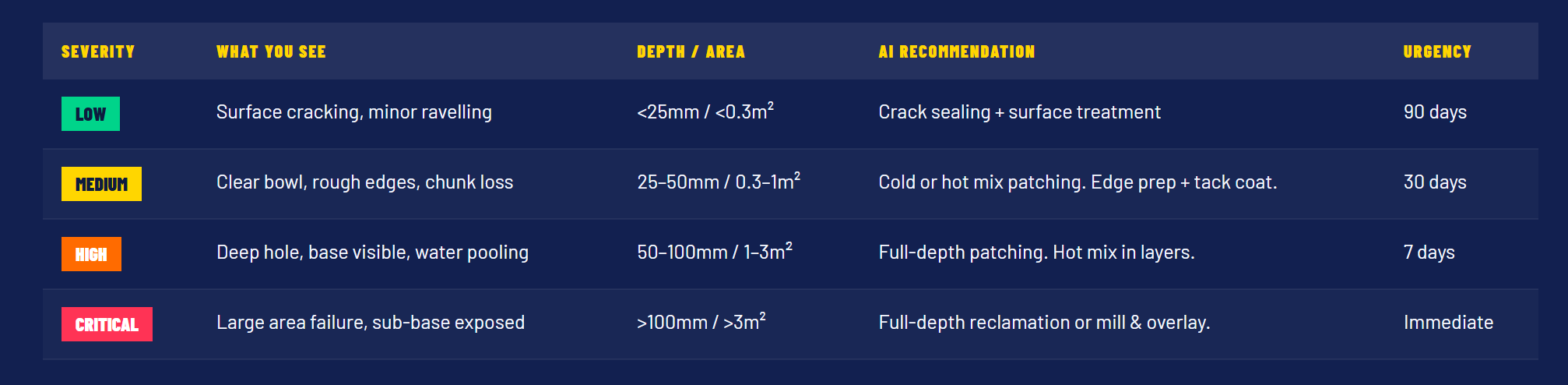
A pothole is not a static problem it's a growing one. Every month a crack or small pothole goes unrepaired, water and traffic continue expanding the damage beneath the surface, often invisibly. What could have been a simple crack seal today can require a full-depth patch next month, and complete reconstruction within a year or two.
Engineering estimates commonly put the cost multiplier for delayed repair at 3 to 5 times the original fix cost meaning deferred maintenance isn't saving money, it's borrowing against a much larger bill later.
Beyond the physical damage, chronically un repaired roads erode public confidence in local government and infrastructure agencies. Potholes are one of the most visible, most complained-about forms of infrastructure failure visible to every resident, every day, in a way that underground pipe corrosion or bridge fatigue simply isn't. A road network that looks neglected shapes public perception of an entire city's governance, whether or not that's a fair comparison.
A pothole rarely exists in isolation. It's often accompanied by surface cracking, faded lane markings, and drainage issues on the same stretch of road meaning the visible pothole is frequently a symptom of a broader section of pavement already in decline. Treating just the hole without assessing the surrounding pavement condition is a short-term fix on a longer-term problem.
Poor repair technique is one of the most common and most avoidable reasons potholes reappear. A durable fix requires:
Skipping any one of these steps especially compaction is why so many "repaired" potholes reopen within a single season, feeding a frustrating and expensive cycle of repeat repairs.
The honest answer is usually visibility, not neglect. Most road agencies rely on manual inspection or public complaints to find potholes and both methods are inherently reactive:
The result is a maintenance system that's often reacting to yesterday's damage instead of catching today's cracks before they become tomorrow's potholes.
This is exactly the gap AI-powered road monitoring is built to close. Instead of waiting for a complaint or a scheduled survey, AI systems can scan every stretch of a road network continuously and catch damage while it's still cheap to fix.
RoadVision AI's Collect–Process–Execute–Deliver pipeline turns any vehicle with a dashcam into a road survey tool. AI reviews every frame of footage, detecting and classifying potholes and other pavement defects with severity scoring, exact GPS location, and area measurement no road closures, no specialized survey fleet required.
The result is a live GIS dashboard showing real-time road condition across the network, an automatically generated maintenance plan with prioritized repair lists and cost estimates, and a before/after verification loop that confirms each repair actually holds. RoadVision AI has surveyed more than 3 million kilometers of road globally, detecting 65+ defect types across deployments in 17+ countries helping road agencies move from reacting to potholes after they're dangerous, to catching them while they're still cheap and easy to fix.
Don't wait for the next complaint to find out where your roads are failing. Get in touch with RoadVision AI to see how AI-powered defect detection can help your city catch potholes before they become a safety risk or a much bigger repair bill.
Potholes cause tyre blowouts, suspension damage, and sudden swerving that can trigger crashes risks that are especially severe for motorcyclists and cyclists. The visible hole is often just the surface sign of deeper pavement failure underneath.
Pothole-related vehicle damage tyres, rims, suspension, alignment collectively costs drivers billions of dollars annually across affected road networks, and much of it goes unclaimed because owners don't connect gradual wear to road conditions.
Water continues seeping into the crack, and every vehicle that drives over it adds stress that expands the damage. Freeze-thaw cycles accelerate this further. What starts as a small crack can become a full pothole within weeks under the wrong conditions.
Engineering estimates put the cost multiplier at roughly 3 to 5 times more expensive for delayed repair compared to catching and sealing the damage early — deferred maintenance almost always costs more in the long run.
RoadVision AI is an AI-powered road infrastructure monitoring and engineering platform helping road agencies and city governments worldwide detect, prioritize, and verify road maintenance work from potholes to pavement markings. Learn more at roadvision.ai.

The Autonomous Road Engineer
AI-powered road condition monitoring, asset management, & infrastructure intelligence helping agencies move from reactive maintenance to predictive road management.


.webp)
.webp)
.webp)