UK Highway Inspection: PAS 2020 Standard & AI Compliance
On this page
UK highway authorities operate under some of the most detailed inspection and maintenance frameworks in the world. Between statutory duties under the Highways Act, the "Well-managed Highway Infrastructure" code of practice, and a growing set of published standards (PAS) designed to formalise inspection methodology, councils and highway authorities face constant pressure to demonstrate that their road networks are inspected, assessed, and maintained to a defensible, auditable standard.
At the same time, AI-powered road inspection technology is becoming a practical tool for meeting these obligations more efficiently. Rather than relying solely on manual walked or driven inspections, an increasing number of UK authorities are exploring AI-assisted road surveymethods to support not replace their statutory inspection regimes. In this blog, we'll look at what UK highway inspection compliance typically involves, where AI fits into that picture, and what authorities should keep in mind when evaluating AI-assisted inspection tools against existing standards.
A note on standards: Published Available Specifications (PAS) and codes of practice are periodically reviewed and updated by bodies such as the British Standards Institution (BSI) and the UK Roads Liaison Group. If your authority is evaluating compliance against a specific PAS reference such as PAS 2020, always confirm the current clause requirements directly with BSI or your professional body, as this blog is intended as a general overview rather than a substitute for the official published standard.
The UK Highway Inspection Landscape
UK highway authorities county councils, unitary authorities, and Transport for London among them have a statutory duty under the Highways Act 1980 to maintain roads in a condition that is reasonably safe for road users. In practice, this duty is discharged through a structured inspection and maintenance regime, shaped by several key reference points:
Well-Managed Highway Infrastructure (Code of Practice): Published by the UK Roads Liaison Group, this is the primary national reference framework for highway asset management, inspection frequency, risk-based intervention levels, and record-keeping expectations across UK authorities.
Published Available Specifications (PAS): BSI-published specifications provide more detailed, standardised methodologies for specific aspects of highway inspection and asset management, supporting consistency across authorities and clarity for contractors and suppliers.
Network-Level Condition Surveys (e.g., SCANNER): Many authorities use standardised, machine-based surveys such as SCANNER (Surface Condition Assessment for the National Network of Roads) for higher-category roads, supplemented by Detailed Visual Inspection (DVI) and Coarse Visual Inspection (CVI) methods for local roads and footways.
Section 58 Defence: Under Section 58 of the Highways Act 1980, authorities can defend against liability claims if they can demonstrate that reasonable care was taken to maintain the highway making robust, documented inspection records not just good practice, but a critical legal safeguard.
Together, these frameworks create a demanding compliance environment: authorities must not only inspect roads at defined frequencies, but maintain clear, defensible records that can withstand legal scrutiny in the event of a claim.
Why Compliance Is Getting Harder to Manage Manually
Several pressures are converging to make traditional, manual inspection processes increasingly difficult to sustain:
Shrinking Budgets and Staff Capacity: Local authority funding pressures mean fewer inspectors are often responsible for larger or more complex networks, stretching manual inspection cycles thin.
Rising Claims and Litigation Risk: Pothole-related claims against UK councils remain a persistent and costly issue, placing a premium on inspection records that are consistent, timestamped, and defensible.
Increasing Public Scrutiny: Citizens increasingly report road defects directly via apps and online portals, creating an expectation of faster response times that manual inspection cycles struggle to match.
Aging Infrastructure: Much of the UK's road network was built decades ago and is showing accumulated wear, requiring more frequent and precise condition assessment to manage effectively within limited budgets.
Climate-Related Deterioration: Increasingly variable weather, including freeze-thaw cycles and heavier rainfall events, accelerates surface deterioration in ways that periodic manual inspection can struggle to keep pace with.
These pressures are pushing many highway authorities to look at how AI-assisted technology can support rather than replace their existing inspection frameworks.
Where AI Fits Into UK Highway Inspection Compliance
1. Supplementing, Not Replacing, Statutory Inspections
It's important to be clear: AI-based defect detection is generally positioned as a complement to statutory inspection regimes, not a wholesale replacement. Authorities remain bound by their code of practice and legal duties regardless of the technology used, and any AI-assisted approach should be designed to strengthen, not undermine, an authority's ability to demonstrate compliance.
2. Automated Defect Detection Between Formal Inspection Cycles
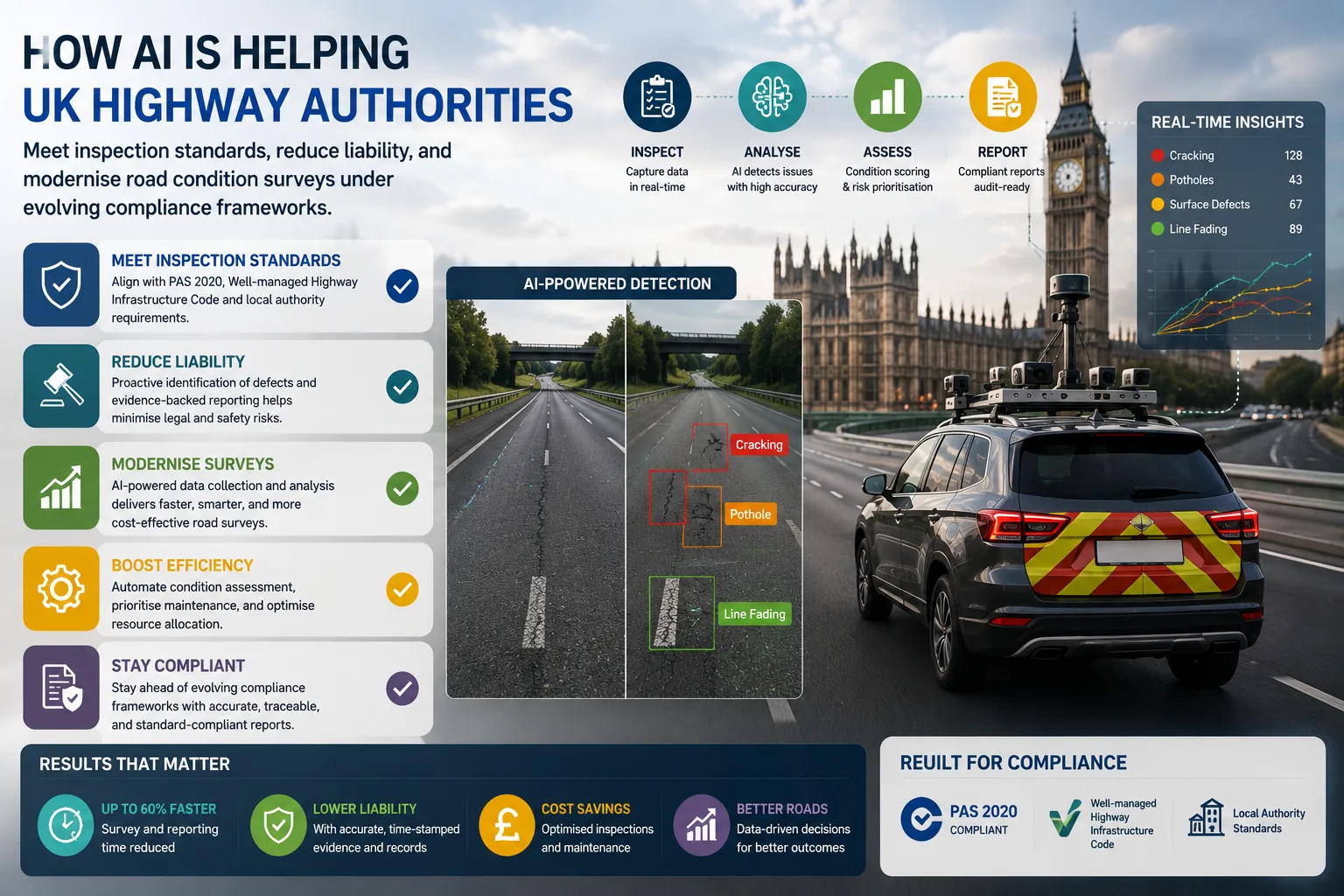
AI-powered systems using dashcams on council fleet vehicles, dedicated survey vehicles, or citizen-reported imagery—can identify potholes, cracking, and other surface defects between scheduled formal inspections. This provides an additional layer of monitoring that can help authorities catch and respond to rapidly forming hazards, such as those following a hard frost, well before the next scheduled inspection cycle.
3. Supporting Risk-Based Inspection Frequency
Modern codes of practice increasingly encourage a risk-based approach to inspection frequency, rather than fixed, one-size-fits-all schedules. AI-generated condition data and defect trend analysis can help authorities build a more evidence-based case for how they allocate inspection resources across different road hierarchy categories.
4. Strengthening Section 58 Defence Documentation
Because AI-based systems automatically timestamp and geotag detected defects, they can contribute to a more granular, auditable record of an authority's inspection and monitoring activity potentially strengthening the evidentiary basis for a Section 58 defence in the event of a claim, alongside the authority's formal inspection records.
5. Consistency Across Large or Distributed Networks
AI-based detection applies the same classification criteria consistently across an entire network, reducing the natural variability that can occur between different human inspectors, particularly across larger authorities managing extensive road hierarchies.
6. Faster Prioritisation and Response
By automatically classifying defect severity and location, AI systems can help authorities prioritise repair works more efficiently, supporting compliance with intervention timescales referenced in local highway maintenance policies.
Key Considerations When Evaluating AI Tools Against UK Standards
Authorities considering AI-assisted inspection technology should keep several compliance-specific factors in mind:
Alignment with Your Highway Infrastructure Asset Management Policy: Any new technology should be assessed against your authority's own documented policy and strategy, which should already reference the relevant code of practice and any applicable PAS.
Documented Methodology: Vendors should be able to clearly explain how their AI detection methodology relates to established visual inspection categories (such as DVI or CVI) so that outputs can be meaningfully compared or integrated with existing records.
Auditability: Ensure the system produces clear, timestamped, exportable records suitable for use in Section 58 defence documentation or Freedom of Information requests.
Legal and Insurance Sign-Off: Given the liability implications of highway inspection records, changes to inspection methodology involving AI should typically be reviewed with your authority's legal and insurance teams before formal adoption.
Integration with Existing Asset Management Systems: Confirm the AI platform can integrate with your authority's existing highway asset management software rather than creating a disconnected parallel record.
Ongoing Standard Alignment: Since codes of practice and PAS documents are periodically reviewed and updated, confirm how the vendor keeps their methodology aligned with the current published requirements.
Benefits of AI-Assisted Highway Inspection for UK Authorities
For Highway Authorities and Councils
Extended Coverage Between Formal Inspections: Additional monitoring helps catch rapidly developing hazards without waiting for the next scheduled cycle.
Stronger Documentation: Automated, geotagged defect records support more robust Section 58 defence documentation.
More Efficient Resource Allocation: Data-driven prioritisation helps direct limited maintenance budgets toward the highest-risk defects first.
Reduced Administrative Burden: Automating detection and initial classification reduces the manual workload associated with processing citizen reports and routine monitoring.
For Road Users and Residents
Faster Hazard Response: More frequent monitoring can shorten the time between a defect forming and being addressed.
Greater Transparency: Digital reporting tools give residents clearer visibility into how their reports are being handled.
For Elected Members and Public Accountability
Clearer Reporting: AI-generated condition data supports more transparent public reporting on road network health and maintenance spending.
Defensible Decision-Making: Data-driven prioritisation provides a clearer evidence base for maintenance budget decisions, supporting accountability to elected members and the public.
Challenges Authorities Should Plan For
Weather and Lighting Variability: The UK's frequently overcast and wet conditions require AI models trained and validated specifically on UK weather and road surface types to maintain reliable accuracy.
Integration with Legacy Highway Asset Management Systems: Many authorities operate long-established asset management software; integrating new AI data sources may require dedicated technical work.
Procurement and Framework Alignment: AI vendors should ideally be assessed through established local government procurement frameworks, ensuring appropriate due diligence and value-for-money scrutiny.
Staff Training and Change Management: Inspection teams and highway engineers will need training to interpret and act on AI-generated data alongside their existing statutory inspection responsibilities.
Data Protection Compliance: Any imagery collection involving public roads must be handled in line with UK GDPR requirements, particularly where footage may incidentally capture identifiable individuals or vehicles.
The Future of AI in UK Highway Compliance
As AI detection technology matures and more UK authorities pilot these systems, several trends are likely to shape how the technology intersects with formal compliance frameworks:
Closer Alignment Between AI Outputs and Established Visual Inspection Categories: Vendors are likely to continue refining their classification systems to map more directly onto DVI/CVI categories used in existing UK inspection practice.
Growing Use in Section 58 Defence Cases: As courts and insurers become more familiar with AI-generated inspection data, it may play an increasingly significant role in supporting or contesting liability claims.
Cross-Authority Data Sharing: Regional collaboration between authorities could support shared investment in AI inspection technology and more consistent data standards across boundaries.
Updated Guidance from National Bodies: As adoption grows, it's plausible that national reference frameworks will evolve to more explicitly address the role of AI-assisted monitoring alongside traditional inspection methods authorities should watch for updated guidance from the UK Roads Liaison Group and BSI over time.
Conclusion
UK highway authorities operate within one of the most structured and legally significant inspection compliance environments in the world, shaped by statutory duty, established codes of practice, and published standards. AI-assisted road inspection technology offers a genuine opportunity to strengthen this compliance environment extending monitoring coverage, improving documentation, and supporting more efficient, risk-based resource allocation but it works best as a complement to, not a replacement for, an authority's existing statutory inspection regime. Authorities evaluating AI tools should engage legal, insurance, and asset management teams early, confirm alignment with their documented highway infrastructure asset management policy, and always verify current standard requirements directly with BSI or the UK Roads Liaison Group before finalising any change to inspection methodology.
Frequently Asked Questions (FAQs)
1. Does AI-based inspection technology replace statutory highway inspections in the UK?
No. AI-assisted detection is generally used to supplement, not replace, an authority's statutory inspection duties under the Highways Act and its documented highway infrastructure asset management policy.
2. What is the "Well-managed Highway Infrastructure" code of practice?
It's the UK Roads Liaison Group's national reference framework for highway asset management, covering inspection frequency, risk-based intervention levels, and record-keeping expectations for UK highway authorities.
3. How does AI inspection data support a Section 58 defence?
Automated, timestamped, and geotagged defect detection records can contribute additional documented evidence of an authority's monitoring activity, potentially strengthening the evidentiary basis for a Section 58 defence alongside formal inspection records.
4. What is SCANNER survey technology?
SCANNER (Surface Condition Assessment for the National Network of Roads) is a standardised, machine-based network-level condition survey method commonly used on higher-category roads in the UK.
5. Should legal and insurance teams be involved in adopting AI inspection tools?
Yes, given the liability implications of highway inspection records, most authorities involve legal and insurance teams before formally changing or supplementing their inspection methodology with AI tools.




.webp)
.webp)
.webp)