
As traffic volumes continue to grow across Indian cities and national highways, conventional at-grade intersections often become major congestion points. To improve mobility, reduce delays, and enhance safety, transportation agencies increasingly rely on grade separators and elevated structures such as flyovers, interchanges, underpasses, and road overpasses.
To standardize their planning and design, the Indian Roads Congress introduced IRC SP 90-2010 – Manual for Grade Separators and Elevated Structures. The guideline provides engineers, planners, and highway authorities with a comprehensive framework for developing efficient, safe, and durable elevated transportation infrastructure.
Today, emerging technologies such as AI flyover overpass inspection India and elevated road infrastructure AI monitoring India are helping agencies ensure that these critical assets remain safe and compliant throughout their lifecycle.
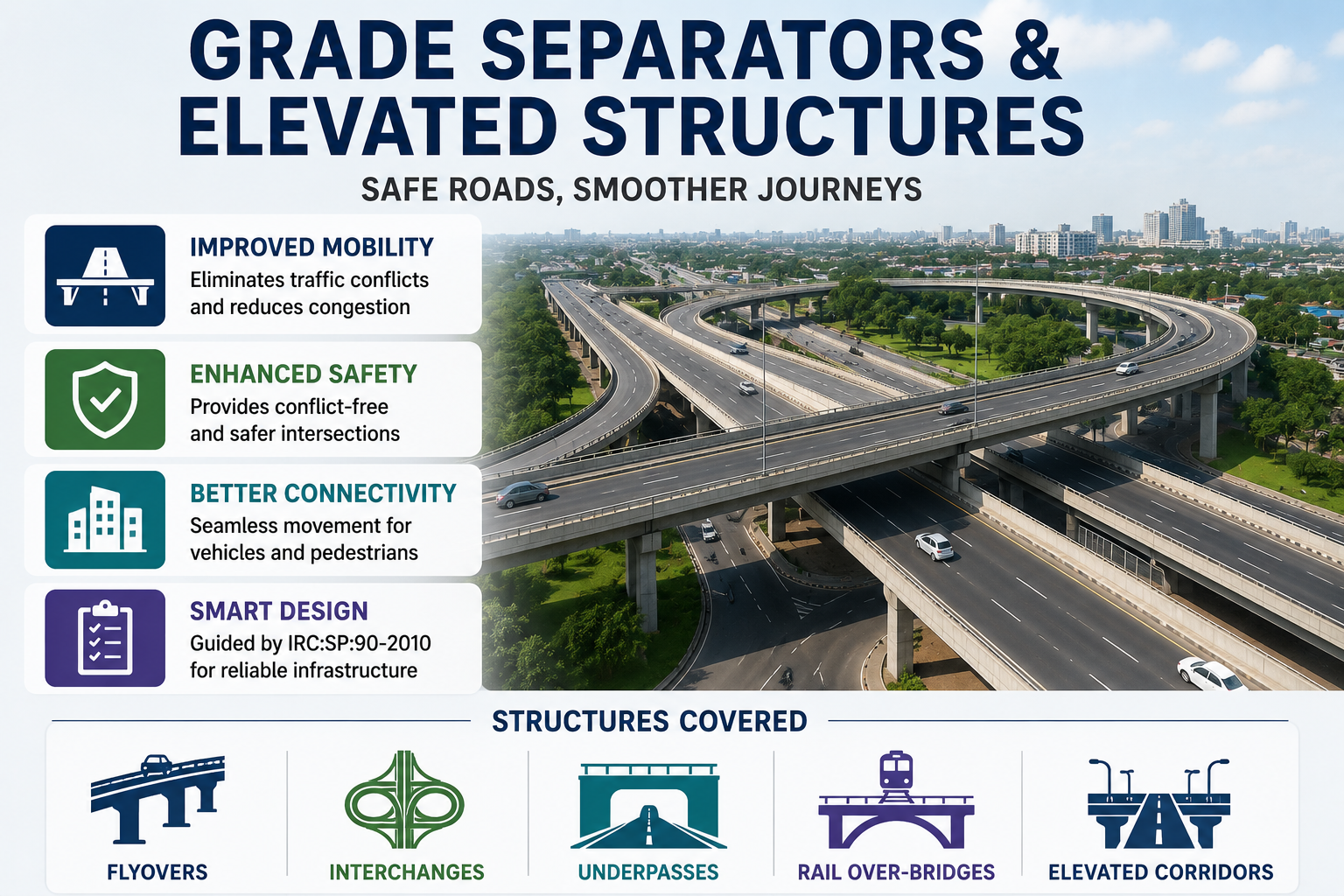
India's rapid urbanization and vehicle growth have placed immense pressure on road networks. Intersections frequently become bottlenecks that increase travel times, fuel consumption, and accident risks.
Grade separators eliminate these conflicts by separating traffic streams vertically. Instead of vehicles crossing at the same level, flyovers, underpasses, and interchanges allow uninterrupted movement, significantly improving traffic flow and safety.
For infrastructure owners managing large transportation networks, grade separator design compliance AI India solutions are increasingly being used to monitor performance and identify structural issues before they become critical.
IRC SP 90-2010 provides detailed recommendations covering the entire lifecycle of grade-separated infrastructure, from planning and design to construction and maintenance.
The manual applies to:
Its objective is to ensure consistent engineering practices while maximizing operational efficiency and structural reliability.
Successful elevated infrastructure projects begin with thorough planning and investigation.
IRC SP 90-2010 emphasizes the importance of collecting detailed information on:
The guideline also recommends coordination among government agencies, utility providers, and local authorities to minimize project delays and ensure smooth implementation.
Modern AI road design analysis platforms can support this planning process by evaluating traffic patterns, identifying congestion hotspots, and assisting with infrastructure prioritization.
The manual provides extensive guidance on geometric design and structural requirements for elevated infrastructure.
Safe and efficient movement is achieved through proper design of:
The IRC grade separator ramp design guidelines ensure that vehicles can safely navigate elevated structures while maintaining traffic flow.
IRC SP 90-2010 encourages the use of modern structural systems capable of handling increasing traffic loads and environmental stresses.
The guideline discusses:
Increasingly, agencies use AI flyover design analysis tools during planning and asset management to improve structural evaluation and lifecycle performance.
The success of any elevated infrastructure project depends heavily on construction quality.
IRC SP 90-2010 places significant emphasis on:
Strict quality control procedures are recommended throughout construction to ensure structural durability and compliance with design standards.
Proper construction planning minimizes traffic disruption while maintaining safety for workers and road users.
Safety protocols during construction are critical, particularly in urban environments where projects are often executed alongside active traffic corridors.
Many infrastructure agencies are now deploying AI road construction monitoring systems to track construction progress, verify quality, and improve site safety management.
While design and construction are important, long-term performance depends on regular inspection and maintenance.
IRC SP 90-2010 recommends periodic assessments of:
Traditionally, these inspections have been labor-intensive and costly. Today, technologies such as AI structural inspection elevated highway India and computer vision flyover defect detection India enable authorities to identify cracks, spalling, corrosion, and other defects much faster and more accurately.
As infrastructure networks expand, manual inspection methods struggle to keep pace.
Modern elevated road structure condition AI monitoring solutions help agencies:
Similarly, road overpass assessment AI dashcam systems allow large-scale network inspections using vehicle-mounted cameras and computer vision analytics.
These technologies are transforming how transportation agencies manage elevated infrastructure assets across India.
The importance of IRC SP 90-2010 extends beyond engineering standards.
The guideline supports:
Grade separators eliminate intersection conflicts and reduce congestion.
Conflict-free traffic movement lowers accident risks and improves operational safety.
Efficient transportation infrastructure reduces fuel consumption, emissions, and travel delays.
Standardized design and maintenance practices improve infrastructure longevity and lifecycle value.
Combined with AI flyover overpass inspection India technologies, agencies can further strengthen the reliability and performance of elevated transportation networks.
IRC SP 90-2010 serves as the foundation for planning, designing, constructing, and maintaining grade separators and elevated structures across India. By providing clear engineering standards for flyovers, underpasses, interchanges, and elevated highways, the guideline helps transportation agencies improve mobility, enhance safety, and support sustainable infrastructure growth.
As cities continue to expand, combining IRC-compliant infrastructure development with AI structural inspection elevated highway India, and computer vision flyover defect detection India technologies will enable smarter, safer, and more efficient transportation networks.
See how RoadVision AI helps agencies and consultants inspect flyovers, overpasses, and elevated highways using AI-powered condition assessment and automated infrastructure monitoring.
Book a Demo → Discover faster, safer, and more accurate infrastructure inspections.
IRC SP 90-2010 is the Indian Roads Congress manual that provides guidelines for the planning, design, construction, inspection, and maintenance of grade separators and elevated structures.
The guideline covers flyovers, interchanges, underpasses, elevated corridors, railway over-bridges, and other grade-separated transportation infrastructure.
AI-powered flyover inspection systems can automatically detect cracks, structural defects, drainage issues, and deterioration, enabling faster maintenance decisions and reducing inspection costs.
The Autonomous Road Engineer
AI-powered road condition monitoring, asset management, & infrastructure intelligence helping agencies move from reactive maintenance to predictive road management.


.webp)
.webp)
.webp)