
Road signs are one of the most critical elements of a safe and efficient transportation network. Whether guiding motorists through highways, indicating destinations, or warning of upcoming hazards, signs must be instantly readable at varying speeds and distances.
To ensure consistency across India's road network, the Indian Roads Congress (IRC) introduced IRC:30-1968 – Standard Letters and Numerals for Highway Signs, a code that establishes uniform standards for lettering, numeral dimensions, spacing, and sign legibility. These guidelines help road authorities, designers, and contractors create signage that improves navigation, enhances safety, and supports efficient traffic management.
As India's highways continue to expand under initiatives led by NHAI, MoRTH, and state road agencies, compliance with IRC 30 1968 highway sign letters numerals India standards remains essential for maintaining a clear and consistent road user experience.
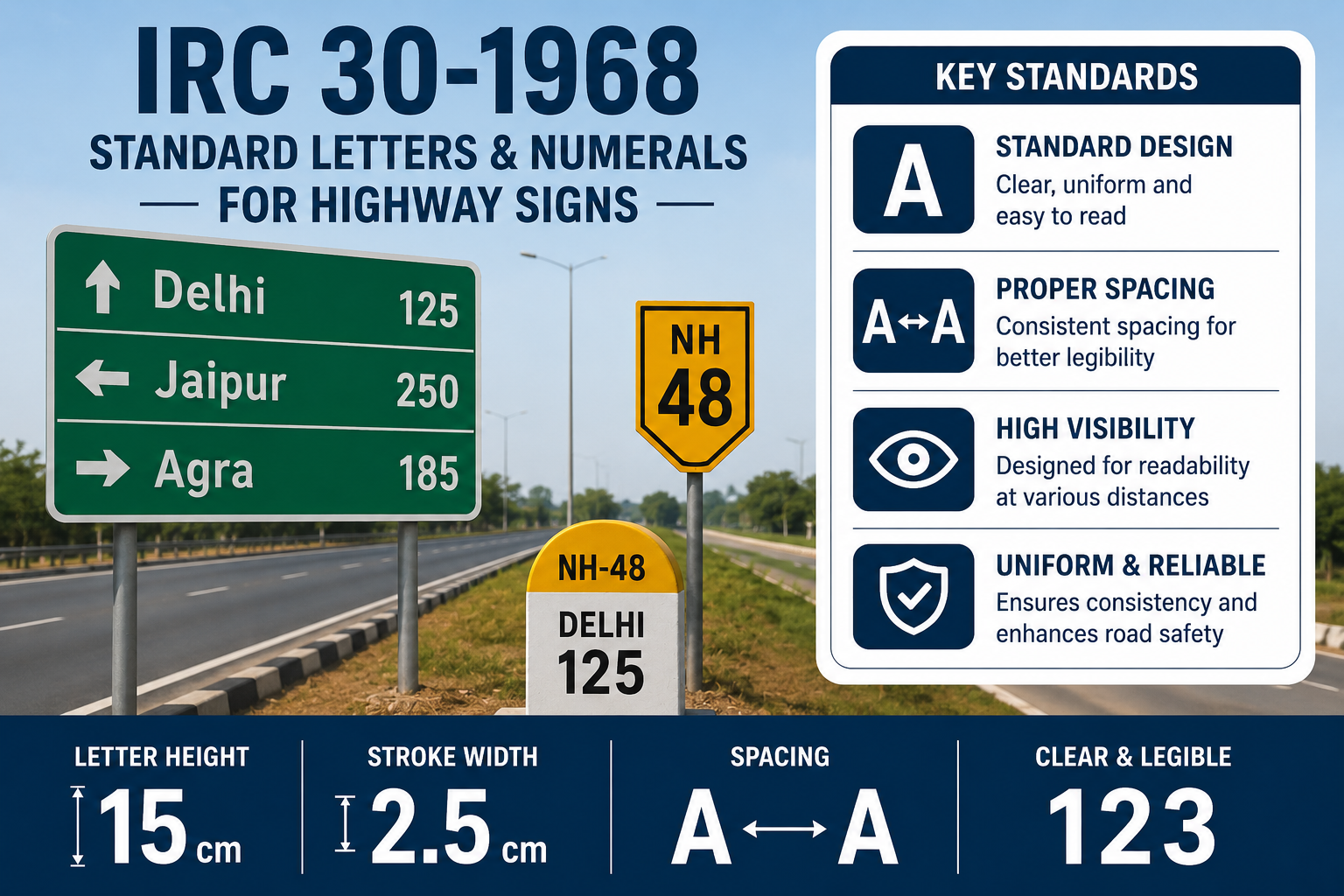
Road signs are often read within seconds while vehicles are moving at high speeds. Any inconsistency in lettering, spacing, or visibility can lead to confusion, delayed reactions, and increased accident risk.
Standardized sign design helps:
Modern AI traffic sign detection platforms also depend on consistent signage standards to accurately identify and assess road signs during automated inspections.
IRC:30-1968 provides detailed specifications for the design and use of letters and numerals on highway signs throughout India.
The code covers:
These standards apply to:
The objective is to create uniform signage that remains legible under different traffic, weather, and lighting conditions.
The code specifies standardized character shapes and dimensions to ensure maximum readability.
Key requirements include:
These standards ensure that signs can be interpreted quickly, particularly on high-speed roads and expressways.
Proper spacing is essential for sign legibility.
IRC:30-1968 provides:
Correct spacing prevents visual crowding and ensures information can be understood at a glance.
Today, AI road sign lettering compliance monitoring systems can automatically evaluate sign spacing and typography against IRC requirements.
Sign visibility directly impacts road safety.
The code emphasizes:
Modern IRC road sign visibility legibility standard assessments increasingly use computer vision technologies to evaluate whether signs remain readable under real-world conditions.
To maintain consistency, the code recommends:
High-quality manufacturing helps preserve sign clarity throughout its service life.
Many agencies now use highway sign AI survey tools to verify that installed signs match approved design standards.
One of the biggest benefits of IRC:30-1968 is nationwide consistency.
Standardized signage helps:
Uniformity becomes especially important as intelligent transportation systems and automated vehicle technologies rely increasingly on consistent road infrastructure.
The code serves as the foundation for highway signage throughout India, ensuring drivers encounter consistent information regardless of location.
Municipal agencies use the standards to maintain clarity and consistency across urban road systems.
Modern expressways require highly legible signage due to higher operating speeds and longer viewing distances.
Many agencies now deploy NHAI road sign inventory AI condition platforms to monitor signage assets and maintain compliance with IRC standards.
While IRC:30-1968 established the foundation for sign standardization decades ago, modern technologies are transforming how compliance is monitored.
Advanced automated highway signage audit AI India solutions can:
Using AI signage inspection computer vision India platforms, road authorities can evaluate thousands of signs rapidly and accurately without relying solely on manual inspections.
These systems support proactive maintenance and help agencies maintain compliance across extensive highway networks.
Organizations implementing IRC standards benefit from:
The integration of road asset sign quality assessment AI India technologies further strengthens these benefits by enabling continuous monitoring and data-driven maintenance planning.
As India's road infrastructure becomes increasingly digitized, highway signage is evolving from a static asset into a continuously monitored component of smart transportation systems.
Emerging technologies now support:
Combined with the proven standards established by IRC:30-1968, these innovations are helping create safer, smarter, and more efficient road networks.
IRC:30-1968 remains one of the foundational standards governing highway signage in India. By defining uniform requirements for letters, numerals, spacing, and legibility, the code ensures that road signs communicate clearly and consistently across the country's vast transportation network.
As road agencies embrace digital transformation, technologies such as AI traffic sign detection and automated highway signage audit AI India platforms are making it easier than ever to maintain compliance and improve sign quality at scale.
Combining established IRC standards with AI-powered inspection and monitoring solutions enables road authorities to enhance safety, improve navigation, and support the next generation of intelligent transportation infrastructure.
Ensure every road sign meets IRC standards. Book a demo to see how RoadVision AI automates highway sign inspections, compliance audits, and road asset management at scale.
IRC:30-1968 is the Indian Roads Congress standard that specifies the design, dimensions, spacing, and usage of letters and numerals on highway signs in India.
Standardization improves sign readability, reduces driver confusion, enhances safety, and ensures consistency across different roads and regions.
Modern AI signage inspection computer vision India systems can automatically detect, measure, and assess road signs for visibility, damage, and compliance with IRC standards.
The Autonomous Road Engineer
AI-powered road condition monitoring, asset management, & infrastructure intelligence helping agencies move from reactive maintenance to predictive road management.


.webp)
.webp)
.webp)