
The Toll Operate Transfer (TOT) model has fundamentally changed the economics and accountability of highway management. Under TOT concessions, private operators take on long-term operational rights to existing public highways committing to maintain defined service levels, meet performance benchmarks, and deliver road quality standards across the full concession period, often spanning 30 years or more.
This is a fundamentally different business from traditional road construction. TOT operators do not build roads they inherit them, manage them, and are contractually obligated to hand them back in a defined condition at the end of the concession term. Every kilometer of deteriorating pavement, every faded road marking, every damaged sign, and every drainage failure represents both a compliance liability and a direct threat to the financial model underpinning the concession.
The stakes are enormous. In India, where the National Highways Authority of India (NHAI) has aggressively pursued the TOT model since 2018, concession bundles have been awarded for hundreds of kilometers of national highway at a time, with operators committing to annuity payments worth thousands of crores of rupees. Similar models operate across Southeast Asia, Latin America, Europe, and the Middle East.
Yet despite the scale of financial and operational commitment involved, many TOT operators still rely on inspection regimes and data management tools that were designed for an earlier era of highway management periodic manual surveys, spreadsheet-based condition tracking, and AI reactive maintenance workflows that leave operators perpetually behind the deterioration curve.
A fit-for-purpose monitoring platform changes this equation entirely. This blog explores exactly what TOT road management system need from such a platform and why getting it right is not merely a matter of operational convenience, but a core requirement for financial viability across the full concession lifecycle.
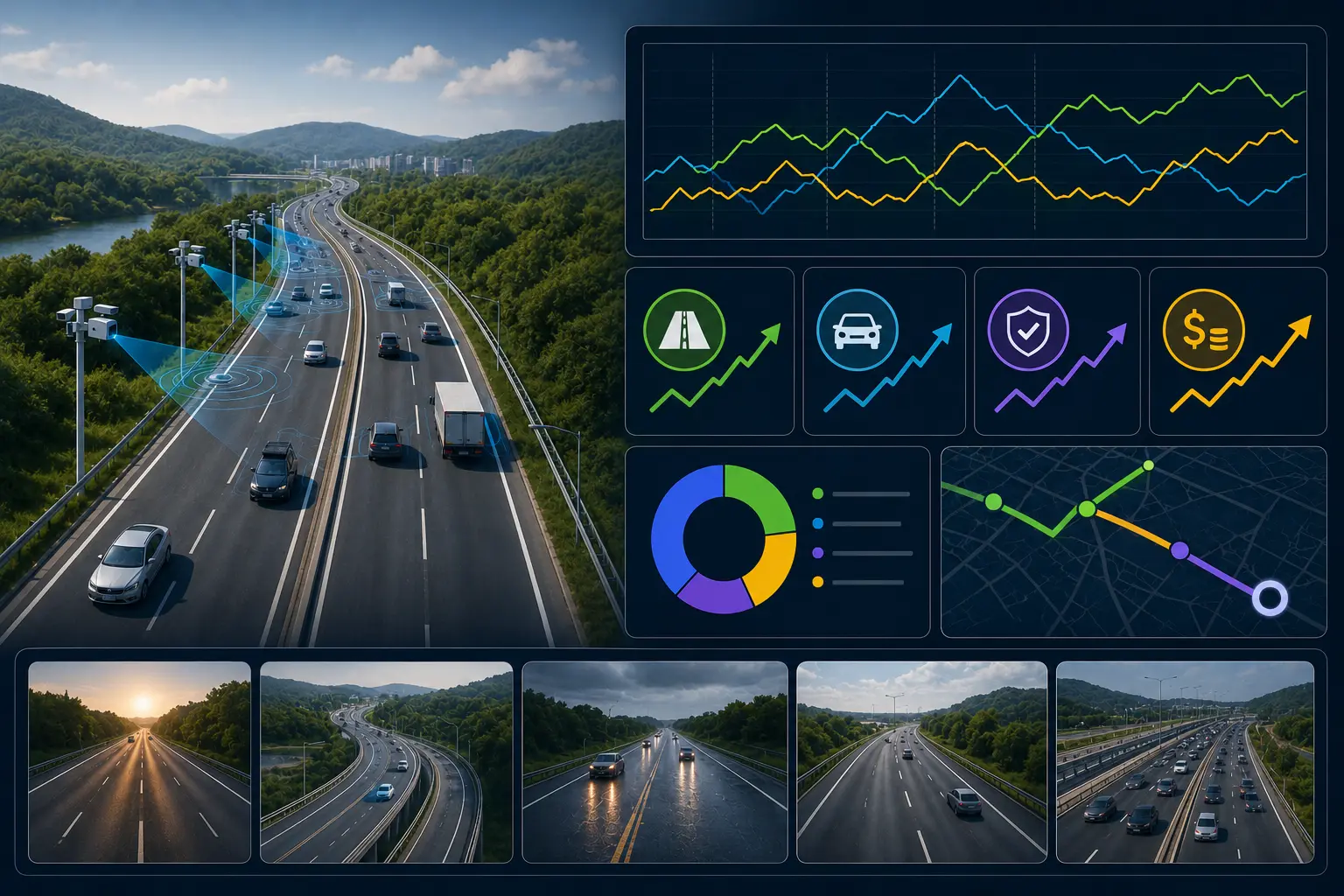
Before defining platform requirements, it is important to understand what makes the TOT operator's situation distinct from other road stakeholders.
A TOT operator simultaneously holds three roles that are often in tension with each other:
As a revenue generator, the operator collects toll fees and must maximize traffic throughput and minimize operational disruptions that deter users or trigger compensation claims.
As an asset custodian, the operator is contractually obligated to maintain road condition within defined parameters throughout the concession period, with financial penalties for non-compliance and asset handback standards that determine whether the operator recovers its terminal value.
As a risk manager, the operator has committed to a fixed long-term financial model based on projected maintenance costs, traffic volumes, and asset condition trajectories at the time of bid. Unexpected deterioration, undisclosed pre-existing damage, or maintenance cost escalation directly erodes the concession's financial returns.
A monitoring platform must serve all three roles simultaneously. It is not merely a maintenance management tool it is a financial risk management instrument, a compliance documentation system, and an operational command center rolled into one.
The moment a TOT operator takes possession of a highway bundle is critically important. Any pre-existing defects, undocumented deterioration, or assets in poor condition that were not disclosed during the bidding process become the operator's liability the moment the concession commences.
A monitoring platform must support rapid, comprehensive baseline documentation at handover capturing the condition of every road segment, structure, sign, marking, and drainage asset across the entire concession network. This baseline serves as the legal and operational reference point for all future condition assessments, maintenance planning, and end-of-concession handback negotiations.
Modern platforms use AI-powered dashcam surveys, drone inspections, and structured data collection to create a georeferenced digital asset inventory at handover that can be legally certified and referenced throughout the concession period. Operators who enter a concession without a robust, defensible baseline are exposed to disputes over liability for pre-existing damage disputes that can cost crores to resolve.
TOT concession agreements typically define Maintenance Quality Standards (MQS) or similar performance metrics that specify maximum allowable crack density, roughness indices, pothole counts, and other surface condition parameters. Breaching these standards triggers financial penalties, independent audits, and reputational damage with the concessioning authority.
The challenge is that road condition is not static it deteriorates continuously, and in climate-sensitive regions like northern and central India, deterioration accelerates dramatically during monsoon seasons and following extreme heat events that soften asphalt binders.
A monitoring platform must support high-frequency condition surveys ideally monthly or quarterly covering the full concession network. The only economically viable way to achieve this frequency across hundreds of kilometers is through AI-powered dashcam systems that deploy on routine maintenance vehicles, eliminating the need to schedule and fund dedicated inspection runs.
The platform must aggregate survey data into segment-level condition scores that map directly to concession agreement performance parameters, giving the operations team a clear, always-current picture of where the network stands relative to MQS thresholds.
TOT operators lock in their maintenance cost assumptions at bid stage. If actual maintenance requirements exceed bid assumptions because condition deteriorates faster than modeled, or because certain segments require more frequent intervention the financial model deteriorates with them.
Predictive maintenance capability is therefore not a luxury feature for TOT operators: it is a financial necessity. The platform must use AI-driven deterioration modeling to forecast future AI pavement condition trajectories for every road segment based on current condition data, historical deterioration rates, traffic load, climate factors, and pavement age.
These forecasts should directly feed a multi-year maintenance budget model, enabling the operator's finance and engineering teams to project capital expenditure requirements across the full concession period, identify budget years where maintenance demand will spike, and make proactive intervention decisions that extend asset life and defer expensive rehabilitation.
Operators who can accurately forecast their 5-year and 10-year maintenance liability have a significant advantage over those reacting to conditions as they arise both in financial performance and in concession negotiations with the authority.
TOT concession agreements require operators to submit regular condition reports to the concessioning authority typically NHAI in India, or equivalent bodies in other markets. These reports must demonstrate that the road network meets defined performance standards and that maintenance obligations are being fulfilled.
The monitoring platform must automate the generation of compliance reports in formats specified by the concession agreement, with data traceability back to survey evidence that can withstand independent audit. Every reported condition score must be backed by GPS-tagged survey imagery, timestamped detection records, and quality-assured processing logs.
When an independent engineer or concessioning authority auditor questions a reported condition score, the operator must be able to produce the underlying evidence immediately and compellingly. Platforms that generate reports without auditable data trails expose operators to disputes they cannot defend.
Beyond standard periodic reporting, the platform should support incident documentation recording emergency events, sudden deterioration events, and weather-related damage in a format that supports force majeure claims or requests for maintenance obligation waivers where concession agreements permit.
Most TOT concessions appoint an Independent Engineer (IE) — a technical representative of the concessioning authority who monitors the operator's compliance and has authority to challenge reported condition data or trigger additional inspections.
A monitoring platform must include a structured interface for IE access — allowing the independent engineer to view condition data, review survey evidence, and export reports without requiring the operator to manually produce bespoke documentation for every IE request. Transparency with the IE builds trust, reduces audit friction, and positions the operator favorably in the relationship with the authority.
Some platforms support concurrent IE survey capabilities — where the authority's own inspection team can upload their independent survey data to the same platform for side-by-side comparison with the operator's data. This collaborative approach to condition monitoring reduces adversarial disputes and builds a shared evidence base for concession management decisions.
Large TOT operators may manage multiple concession bundles simultaneously each comprising dozens of highway segments across different states, traffic profiles, and pavement condition histories.
The monitoring platform must support portfolio-level management, providing executives and senior engineers with a consolidated view across all concessions simultaneously. Network-level dashboards should display condition heat maps, compliance status, maintenance budget utilization, and upcoming survey schedules for the entire portfolio while allowing drill-down to individual corridor and segment level for detailed operational management.
Portfolio visibility enables operators to optimize resources across concessions identifying opportunities to deploy maintenance crews across adjacent concession areas, balance equipment utilization, and prioritize investment in segments approaching MQS threshold breaches ahead of those with comfortable condition margins.
Highway operations involve incidents accidents, flooding, road surface failures, bridge closures, and other emergency events that require rapid response, documentation, and reporting to the authority. The monitoring platform must support incident management workflows that capture the event location, severity, immediate response actions, and resolution timeline in a structured, reportable format.
Incident documentation serves multiple purposes: it demonstrates responsive operations to the concession authority, provides evidence for insurance claims, supports force majeure applications where relevant, and feeds the platform's condition database with data points on sudden deterioration events that can inform predictive modeling.
Integration with traffic management systems and variable message signage enables the platform to serve as a coordination hub during major incidents linking road condition data, traffic impact assessment, and maintenance response tracking in a single operational view.
TOT operators are responsible not just for the road surface but for the full inventory of highway assets: bridges, culverts, retaining walls, signage, markings, drainage systems, toll plazas, rest areas, and roadside furniture. The monitoring platform must maintain a comprehensive, georeferenced asset register that tracks the condition, maintenance history, and expected remaining life of every asset category.
This asset register is particularly critical for structural assets bridges and culverts where condition deterioration carries safety implications and where major rehabilitation or replacement represents the largest capital expenditure items in the maintenance budget. AI-powered visual inspection tools that detect concrete cracking, spalling, and joint deterioration from imagery feeds enable more frequent structural condition assessments than traditional manual inspections alone can support.
At concession end, the asset register and its full history of condition records forms the basis for handback negotiations. Operators who can demonstrate sustained, documented maintenance of all assets throughout the concession period are better positioned to achieve favorable handback assessments and avoid penalty clawbacks.
A monitoring platform that operates in isolation from the operator's financial systems delivers only part of its potential value. The most sophisticated platforms integrate condition data with financial models to provide return-on-concession analytics tracking actual maintenance expenditure against bid assumptions, projecting concession NPV under different maintenance scenarios, and flagging early warning signals when cost trajectories threaten financial viability.
For the concession's investment committee and lenders, condition and maintenance data integrated with financial performance reporting provides the assurance that assets are being managed in a way that protects the concession's value and debt service capacity. This financial integration elevates the AI road monitoring platform from an engineering tool to a boardroom-relevant risk management instrument.
The platform must not only serve engineers at their desks it must be usable by field maintenance crews on the highway. Mobile applications that allow maintenance teams to receive work orders, capture before-and-after photographic evidence of completed repairs, log materials used and crew hours, and update the asset register in real time are essential for closing the loop between condition monitoring and maintenance execution.
Field data captured by mobile crews feeds back into the platform's condition database, enabling the AI models to learn from maintenance outcomes and improve future deterioration predictions. The combination of AI road monitoring and field-captured maintenance records creates a continuously improving data ecosystem that becomes more valuable over the life of the concession.
Beyond the core requirements above, the features that distinguish genuinely excellent TOT monitoring platforms from adequate ones include:
Concession-specific configuration — the ability to define custom performance thresholds, reporting formats, and KPI structures that match the exact terms of each concession agreement, rather than requiring operators to translate platform outputs into concession compliance formats manually.
Data sovereignty and security — highway condition data is commercially sensitive and in some cases nationally sensitive. Platforms must offer robust data governance, localized data storage where required by regulation, and role-based access controls that ensure sensitive operational data is not accessible to unauthorized parties.
Vendor-neutral data portability — operators should not be locked into a single vendor's ecosystem. Platform data should be exportable in standard formats, and the platform should support integration with third-party systems including government databases, financial software, and alternative survey tools.
Scalability from corridor to national network — the platform must perform as effectively managing a single 100-kilometer concession as managing a national portfolio of 3,000 kilometers, without requiring architectural changes or performance compromises at scale.
Operators who deploy inadequate monitoring platforms pay the price in multiple ways. Compliance failures due to poor condition visibility lead to financial penalties from the authority. Reactive maintenance triggered by late-stage defect detection costs three to five times more than early preventative intervention. Disputed handback assessments at concession end expose operators to retroactive liability for asset conditions that a robust monitoring record could have defended against.
Perhaps most significantly, operators who cannot demonstrate rigorous condition monitoring to their lenders and investors face higher financing costs lenders price concession risk higher when they cannot see reliable evidence that asset condition is being tracked and managed proactively.
The monitoring platform is not an overhead item in the TOT operator's cost structure. It is a risk management investment that pays for itself many times over through penalties avoided, maintenance costs reduced, and financing terms improved.
The TOT model places extraordinary operational and financial demands on road concession operators. Unlike construction-based models where performance is measured at project completion, TOT operators must demonstrate sustained performance across decades managing assets they did not build, in conditions they may not have fully anticipated at bid stage, under regulatory scrutiny that intensifies with every performance report submitted.
In this environment, a monitoring platform is not a nice-to-have addition to the operations toolkit. It is the operational foundation on which the entire concession business model stands. Without reliable, continuous, AI-powered condition monitoring, operators are flying blind across a decades-long financial commitment exposed to compliance penalties they did not see coming, maintenance costs they could not forecast, and handback disputes they cannot defend.
The right platform one that delivers continuous condition intelligence, predictive maintenance capability, compliance-ready reporting, portfolio management, and financial integration transforms the TOT operator's ability to manage risk, control costs, and protect returns across the full concession lifecycle.
For operators evaluating platforms today, the question is not whether the investment is justified. It is how quickly the right platform can be deployed before the next compliance cycle, the next monsoon season, or the next independent engineer audit arrives at the gate.
The Toll Operate Transfer (TOT) model involves a private operator taking over operational rights to an existing, already-built highway from the government authority in exchange for an upfront concession fee or annuity payments. Unlike BOT (Build Operate Transfer), the TOT operator does not construct the road they inherit it and manage it. This means the operator's core challenge is maintenance management and asset condition preservation rather than construction execution.
MQS are performance benchmarks defined in the concession agreement that specify the minimum acceptable condition of road assets monitoring system throughout the concession period. They typically include parameters such as maximum allowable pothole count per kilometer, maximum International Roughness Index (IRI) values, minimum retroreflectivity standards for road markings, and structural condition requirements for bridges. Breaching MQS triggers financial penalties, mandatory remediation timelines, and potential independent audits.
Best practice recommendations and many concession agreements require quarterly condition surveys as a minimum, with monthly surveys recommended for high-traffic national highways or segments in climate-sensitive regions where rapid deterioration is likely. With AI-powered dashcam systems deployed on routine maintenance vehicles, monthly network-wide surveys are operationally and economically achievable.
Absolutely. A monitoring platform that has maintained a continuous, auditable record of asset conditions, maintenance activities, and compliance performance throughout the concession period provides the operator's strongest possible defense in handback negotiations. It enables the operator to demonstrate sustained compliance, challenge claims of deterioration that occurred prior to the concession, and support financial reconciliation of any handback penalty calculations.
The Autonomous Road Engineer
AI-powered road condition monitoring, asset management, & infrastructure intelligence helping agencies move from reactive maintenance to predictive road management.


.webp)
.webp)
.webp)