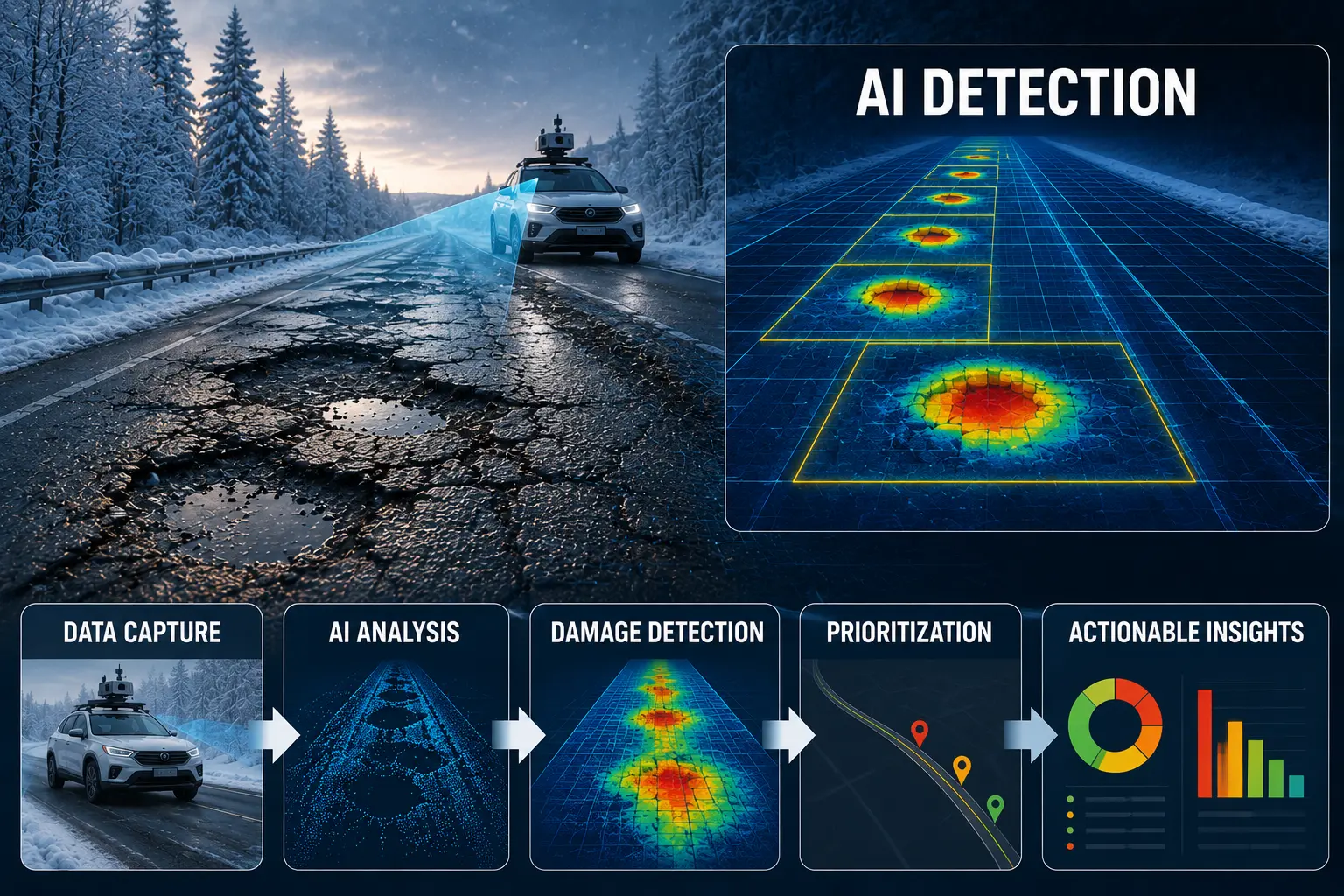
Every winter, roads across the globe take a brutal beating. Temperatures fluctuate above and below freezing, water seeps into the tiniest cracks, and the relentless cycle of freezing and thawing silently destroys pavement from within. The result? Billions of dollars in road damage, dangerous driving conditions, and overwhelmed municipal budgets. In the United States alone, poor road conditions cost drivers approximately $130 billion annually in vehicle repairs, fuel waste, and accidents.
But a technological revolution is quietly reshaping how governments and infrastructure engineers fight back. Artificial intelligence is now at the forefront of detecting, predicting, and preventing freeze-thaw pavement failure transforming reactive road maintenance into a proactive, data-driven science.
This blog explores how AI is changing the road maintenance game, how freeze-thaw cycles damage pavement at the molecular level, and why early AI detection could save cities enormous sums while keeping drivers safe.
Before exploring AI solutions, it's essential to understand the enemy: the freeze-thaw cycle
When temperatures drop below 0°C (32°F), water that has infiltrated pavement cracks and pores expands as it freezes. Water expands by approximately 9% in volume when it freezes a seemingly small percentage that generates enormous pressure within the confined spaces of asphalt and concrete. This internal pressure forces existing cracks wider and creates new fractures.
When temperatures rise above freezing, the ice melts, leaving behind enlarged voids. The next freeze fills those larger voids with more water, expanding them further. Each cycle compounds the damage exponentially. In regions like the American Midwest, Canada, Scandinavia, and northern Europe, roads can experience dozens of these cycles in a single winter season.
Pavement failure progresses through recognizable stages:
Stage 1 — Micro-cracking: Hairline fractures form in the asphalt binder or concrete surface, often invisible to the naked eye.
Stage 2 — Surface cracking: Cracks widen and become visible. Water infiltration accelerates. This is the last practical window for low-cost intervention.
Stage 3 — Alligator cracking: Interconnected cracks create a pattern resembling alligator skin, indicating structural base failure beneath the surface.
Stage 4 — Pothole formation: The surface layer collapses into the weakened base, creating the potholes that damage vehicles and endanger road users.
Traditional road inspections often catch damage only at Stages 3 or 4 when repair costs have already multiplied several times over compared to early intervention.
Artificial intelligence brings something invaluable to road maintenance: the ability to detect damage at Stages 1 and 2, before costly structural failure sets in
One of the most powerful AI pavement inspection is computer vision machine learning models trained on vast datasets of road images to identify surface anomalies with extraordinary precision.
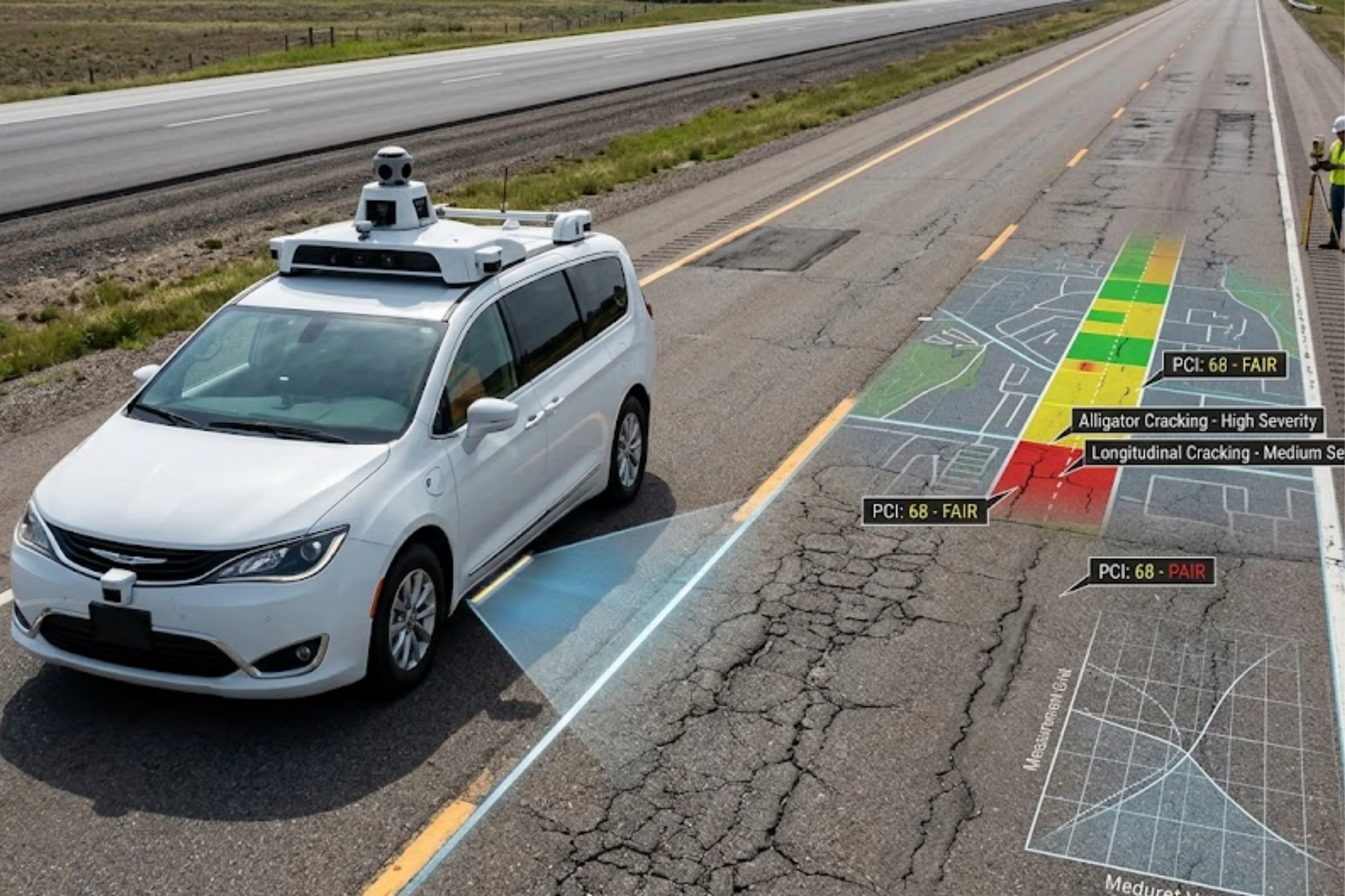
Modern AI systems can analyze images captured by smartphone cameras mounted in standard vehicles, specialized inspection vehicles equipped with high-resolution cameras, drone footage providing aerial pavement surveys, and satellite imagery for broad regional monitoring.
These models are trained on labeled datasets containing millions of pavement images, teaching them to recognize crack patterns, surface texture changes, and early indicators of freeze-thaw damage that human inspectors would typically miss. A well-trained convolutional neural network (CNN) can identify hairline cracks as narrow as 0.2 millimeters far beyond the detection threshold of routine human inspection.
LiDAR (Light Detection and Ranging) sensors mounted on inspection vehicles emit laser pulses that create detailed three-dimensional maps of road surfaces. AI algorithms process these point clouds to measure surface deformation, rutting depth, and elevation changes caused by freeze-thaw heaving.
This technology can detect frost heave where frozen soil beneath the road lifts the pavement before it causes visible surface cracking. By identifying heave patterns, engineers can predict which road sections are most vulnerable during upcoming winter cycles.
AI doesn't just detect existing damage it predicts future failure. Machine learning models can integrate pavement condition data, historical weather records, freeze-thaw cycle frequency, traffic load measurements, road age and construction materials, and soil composition beneath roadways.
By training on years of road performance data, these models identify patterns that precede failure months or even seasons in advance. A section of highway that experienced 40 freeze-thaw cycles last winter, carries heavy freight traffic, and shows Stage 1 micro-cracking might be flagged as high-priority for preventative treatment before the next winter season begins.
Ground-penetrating radar (GPR) sends electromagnetic pulses into pavement layers and measures the reflected signals to reveal subsurface conditions. On its own, GPR generates enormous volumes of complex data that human analysts struggle to interpret efficiently.
When combined with AI, GPR data becomes a powerful diagnostic tool. Machine learning algorithms can identify subsurface voids and delamination caused by freeze-thaw cycles, moisture infiltration pathways that will worsen with future freeze events, deterioration in pavement base layers invisible from the surface, and rebar corrosion in concrete road structures.
Some advanced infrastructure programs deploy embedded sensor networks directly within road surfaces. These sensors continuously monitor temperature gradients through pavement layers, internal moisture levels, structural strain and deformation, and traffic load distribution.
AI platforms aggregate this real-time data alongside weather forecasts, alerting maintenance teams when conditions are approaching critical thresholds. Rather than waiting for visible damage, crews can apply protective sealants or drainage improvements before freeze events cause irreversible harm.
Cities like Amsterdam, Helsinki, and Calgary have piloted AI-powered pavement management systems with impressive results. Calgary's smart road monitoring program, for example, uses AI-analyzed dashcam footage from city vehicles to continuously update pavement condition scores across thousands of road segments a task that previously required expensive manual inspections scheduled years apart.
Apps and platforms that collect road condition data from smartphone accelerometers detecting jolts and vibrations that indicate potholes or rough surfaces feed this information into AI models that generate city-wide road condition heat maps. This crowdsourced approach dramatically expands the geographic coverage of pavement monitoring at a fraction of traditional inspection costs.
Several state Departments of Transportation in the US have deployed AI-powered inspection vehicles that scan highway networks continuously throughout the year, tracking pavement condition changes across seasons and identifying freeze-thaw damage progression in real time.
The economics of AI-powered early detection are compelling. Preventative pavement treatments such as crack sealing and surface rejuvenation applied at Stage 1 or Stage 2 can cost as little as $2–$5 per square meter. Full pavement reconstruction at Stage 4, by contrast, typically costs $80–$200 per square meter or more.
This means that identifying and treating damage early through AI road monitoring can deliver a return on investment of 10:1 to 40:1 compared to traditional reactive maintenance approaches. For large municipalities maintaining thousands of kilometers of road, AI-driven savings can reach tens of millions of dollars annually.
Beyond direct repair savings, improved road conditions reduce vehicle damage costs for drivers, lower accident rates, decrease fuel consumption from rough surfaces, and minimize traffic disruption from emergency road closures.
AI road damage detection is not without its challenges. Training data quality is critical models trained on pavement images from warm climates may perform poorly when applied to northern road conditions with ice, snow cover, and different asphalt formulations.
Weather conditions can obscure camera-based systems: snow cover, heavy rain, and glare from ice all reduce image quality. GPR and LiDAR systems are less affected by surface conditions but come with higher equipment costs.
Data integration across different city systems, sensor networks, and inspection vehicles remains a technical challenge. Standardizing data formats and building unified AI platforms that city engineers can easily use is an ongoing area of development.
The trajectory of this technology points toward increasingly autonomous pavement management. Future systems are expected to integrate real-time freeze-thaw weather forecasting with pavement condition models to predict optimal maintenance windows, autonomous inspection drones capable of conducting nightly road surveys and reporting new damage by morning, AI-driven maintenance scheduling that automatically dispatches repair crews and orders materials, and digital twins virtual replicas of road networks that simulate the impact of coming winter seasons on current pavement conditions.
As AI models continue to improve and sensor costs fall, the technology is becoming accessible even to smaller municipalities that previously could not afford comprehensive road monitoring programs.
Winter road damage caused by freeze-thaw cycles is one of the most persistent and costly infrastructure challenges facing governments around the world. For too long, the standard response has been reactive: wait for visible damage, then spend disproportionately large sums on repairs that could have been prevented.
Artificial intelligence is fundamentally changing this equation. By detecting pavement damage at its earliest stages, predicting where failure will occur before winter strikes, and enabling data-driven maintenance prioritization, AI is helping cities and transportation agencies stretch limited budgets further while keeping roads safer for everyone.
The technology is not a distant future prospect it is being deployed today in cities across North America, Europe, and beyond. For infrastructure managers, engineers, and policymakers, investing in AI-powered road monitoring is no longer a luxury. In an era of ageing infrastructure and constrained budgets, it is becoming a necessity.
AI systems using high-resolution cameras and trained deep learning models can detect cracks as small as 0.2mm with accuracy rates exceeding 90% in controlled testing conditions. Human inspectors typically miss early-stage damage that AI systems flag consistently, especially micro-cracking that precedes visible surface deterioration.
Yes. Machine learning models that combine pavement condition data, historical weather records, traffic loads, and freeze-thaw cycle frequency can identify high-risk road segments months before visible pothole formation occurs. This predictive capability is one of the most valuable aspects of AI in road maintenance.
This depends on pavement quality, drainage, traffic load, and initial crack density. However, research shows that roads can develop Stage 2 visible cracking after as few as 10–20 severe freeze-thaw cycles in a single season when moisture infiltration is present, particularly in older pavement with existing micro-fractures.

The Autonomous Road Engineer
AI-powered road condition monitoring, asset management, & infrastructure intelligence helping agencies move from reactive maintenance to predictive road management.


.webp)
.webp)