
Every year, tens of thousands of road crashes occur at locations that engineers and planners had already identified as problematic — but never acted on fast enough. The Road Safety Audit (RSA) process exists precisely to catch these dangers before they claim lives. Yet in most jurisdictions, RSAs are slow, expensive, intermittent, and dependent on the availability of trained human auditors who can only be in one place at a time.
The traditional RSA model a team of qualified engineers conducting staged inspections at defined project milestones or in response to crash cluster reports was designed for a world without real-time data. That world no longer exists. Today, AI road condition monitoring systems can continuously assess road networks, flag safety-critical defects, model crash risk, and generate audit-quality reports in a fraction of the time and cost of conventional methods.
This is not a distant promise. Agencies across North America, Europe, and Australia are already integrating AI into their RSA pipelines, dramatically expanding their ability to audit more roads, more often, with more objective and actionable outputs. The result is a fundamental shift in how road safety is understood, budgeted, and delivered and the financial case is as compelling as the safety one.
%20(1).webp)
A Road Safety Audit is a formal, independent examination of a road project or existing road network to identify safety hazards and recommend corrective measures before those hazards cause crashes or fatalities. RSAs are conducted at multiple stages: during design, pre-opening, and post-opening and separately as operational safety reviews on existing roads.
The benefits of a rigorous RSA program are well-documented. Studies consistently show that RSAs reduce injury crashes by 20–60% at treated locations, and that every dollar invested in safety audit programs generates between $20 and $60 in avoided crash costs. On paper, this makes RSAs one of the highest-return activities in all of transportation engineering.
In practice, however, the traditional RSA process faces serious structural limitations:
Coverage gaps: Manual RSAs are resource-intensive. Even well-funded agencies can only audit a small fraction of their network in any given year. The roads not audited remain invisible from a systematic safety perspective.
Timing lag: An RSA triggered by a crash cluster report arrives after people have already been injured. The process is reactive by design when it should be predictive by capability.
Subjectivity and inconsistency: RSA findings depend heavily on the experience and judgment of individual auditors. Two teams assessing the same corridor may produce substantially different recommendations making it difficult to prioritize investments consistently across a network.
High cost per audit: A full formal RSA on an existing road can cost $15,000 to $50,000 or more, depending on corridor length and complexity. At that price point, comprehensive network coverage is simply not achievable through manual methods alone.
These are the gaps that AI was built to close.
AI road condition monitoring platforms are transforming the RSA from a periodic, resource-constrained exercise into a continuous, network-wide safety intelligence system. Here is how AI is automating each core component of the traditional audit process.
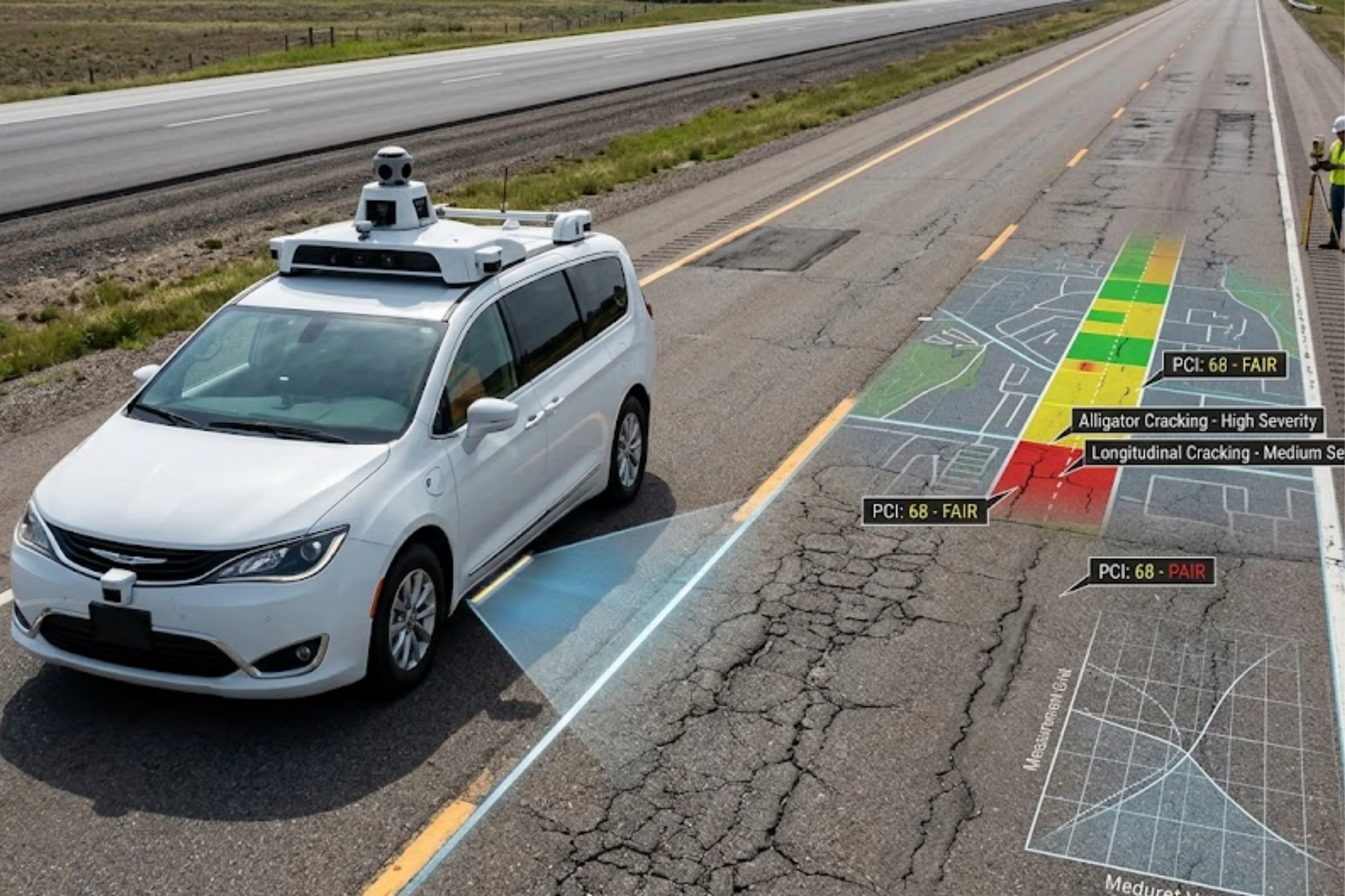
The first stage of any RSA is data gathering understanding the physical condition and geometric characteristics of the road being assessed. Traditionally, this meant sending survey crews on-site to collect measurements, photographs, and condition observations. AI replaces and augments this with:
What previously required weeks of manual survey work can now be completed in hours and at a fraction of the road inspection cost savings that auditors are increasingly citing as the primary financial justification for AI adoption.
Once data is collected, AI platforms apply trained machine learning models to classify every observable condition across the road network. Unlike human inspectors who may overlook subtle early-stage defects or apply inconsistent severity ratings, AI models apply the same classification criteria uniformly across every meter of road assessed.
Key safety features automatically detected and rated include:
Each finding is geotagged, timestamped, severity-scored, and linked to relevant safety standards producing audit-ready documentation automatically.
This is where AI moves the RSA from a descriptive process to a genuinely predictive maintenance tool. Rather than simply cataloguing what is wrong, AI platforms correlate physical road condition data with crash history, traffic volumes, speed data, weather patterns, and road geometry to build predictive risk models for every segment of the network.
These models answer the question that traditional RSAs struggle to address efficiently: not just "what is the current condition of this road?" but "where is the next serious crash most likely to occur, and what intervention will prevent it?"
Predictive risk scoring allows agencies to:
A formal Road Side Asset Survey report is a structured document that must meet defined standards, reference applicable design guidelines, and provide prioritized recommendations with cost estimates. Historically, producing this document required significant auditor time often representing 30–40% of the total audit cost.
Modern AI platforms auto-generate draft RSA reports that include:
Human auditors review and validate these outputs rather than producing them from scratch dramatically compressing the time and cost of the formal audit stage while maintaining professional accountability.
The road inspection cost savings delivered by AI-automated RSA programs are measurable across every phase of the audit lifecycle.
Survey and data collection: AI-equipped vehicles collect condition data at network scale for $500–$1,500 per lane-mile, compared to $3,000–$8,000 per lane-mile for traditional manual survey programs. For a network of 500 lane-miles, this represents a potential saving of $1.25 million to $3.25 million per survey cycle.
Audit frequency: Because AI monitoring is continuous rather than periodic, agencies can maintain near-real-time awareness of network safety status without scheduling discrete audit events. This eliminates the cost of mobilizing audit teams while increasing the effective frequency of safety assessment by an order of magnitude.
Intervention timing: By identifying safety-critical defects at early stages, AI-driven RSA programs enable low-cost preventive treatments that avoid the far higher cost of reactive repair following a crash. A retroreflective marking renewal at $4,000 that prevents a nighttime lane-departure crash avoids not just a human tragedy but an average crash cost including property damage, emergency response, medical treatment, and liability estimated by the FHWA at $70,000 to $1.5 million depending on injury severity.
Report production: Automated draft reporting reduces auditor time on documentation by 50–70%, allowing the same professional resource to review and validate more audits per year effectively multiplying RSA program output without proportional budget increases.
The aggregate road maintenance ROI of a well-implemented AI RSA program consistently exceeds 10:1 when modeled over a five-year horizon, and agencies that have published program evaluations report safety benefit-cost ratios of 15:1 to 40:1 when crash reduction outcomes are monetized.
A common concern raised by transportation professionals when AI RSA tools are introduced is that automation threatens the role of the qualified road safety auditor. The evidence points in the opposite direction.
AI tools handle the data-intensive, repetitive, and logistically demanding components of the audit process collection, classification, scoring, and initial report drafting at a scale and consistency that human teams cannot match. But the professional judgment required to interpret findings in context, recommend solutions that account for local constraints, communicate risk to non-technical stakeholders, and take responsibility for audit sign-off remains firmly human.
What changes is the nature of the auditor's work. Instead of spending the majority of time on data collection and documentation, AI-empowered auditors spend their professional hours on higher-value activities: interpreting complex risk scenarios, evaluating treatment options, engaging with communities, and validating AI outputs against local knowledge. The result is more audits, better audits, and a more professionally satisfying role for the people who conduct them.
Agencies looking to integrate AI into their Road Safety Audit programs typically follow a structured adoption pathway:
Step 1 — Network Baseline: Commission an AI-assisted baseline condition and safety assessment across the full network. This establishes the data foundation for ongoing monitoring and prioritization.
Step 2 — Risk Stratification: Use AI predictive modeling to identify the highest-risk 10–15% of the network. Focus initial formal RSA resources human auditors on these segments for maximum impact per dollar.
Step 3 — Continuous Monitoring Integration: Establish recurring AI data collection cycles aligned with seasonal inspection needs and budget planning windows. Set automated alerts for segments crossing defined safety thresholds.
Step 4 — Program Evaluation: Track safety outcomes (crash frequency and severity trends) against treated and untreated segments to validate the ROI of the AI RSA program. Use this data to build the business case for program expansion.
The Road Safety Audit was always the right idea. Examine roads systematically, identify hazards objectively, act before crashes happen. The traditional model was never wrong in principle it was simply limited by the tools available to execute it at scale.
AI road condition monitoring removes those limitations. It makes continuous, network-wide safety assessment financially viable. It makes predictive maintenance of safety-critical features operationally practical. And it makes the case for road safety investment unambiguously clear — in data, in cost projections, and in lives.
Agencies that integrate AI into their RSA programs are not just saving money on road inspection costs. They are building a fundamentally more defensible, more equitable, and more effective road safety system one where the next dangerous curve, faded marking, or failing guardrail is identified and addressed before it becomes a statistic.
The audit is no longer just a milestone event. With AI, it is a continuous act of responsibility.
Every year, tens of thousands of road crashes occur at locations that engineers and planners had already identified as problematic but never acted on fast enough. The Road Safety Audit (RSA) process exists precisely to catch these dangers before they claim lives. Yet in most jurisdictions, RSAs are slow, expensive, intermittent, and dependent on the availability of trained human auditors who can only be in one place at a time.
The traditional RSA model a team of qualified engineers conducting staged inspections at defined project milestones or in response to crash cluster reports was designed for a world without real-time data. That world no longer exists. Today, AI road condition monitoring systems can continuously assess road networks, flag safety-critical defects, model crash risk, and generate audit-quality reports in a fraction of the time and cost of conventional methods.
This is not a distant promise. Agencies across North America, Europe, and Australia are already integrating AI into their RSA pipelines, dramatically expanding their ability to audit more roads, more often, with more objective and actionable outputs. The result is a fundamental shift in how road safety is understood, budgeted, and delivered and the financial case is as compelling as the safety one.
A Road Safety Audit is a formal, independent examination of a road project or existing road network to identify safety hazards and recommend corrective measures before those hazards cause crashes or fatalities. RSAs are conducted at multiple stages: during design, pre-opening, and post-opening and separately as operational safety reviews on existing roads.
The benefits of a rigorous RSA program are well-documented. Studies consistently show that RSAs reduce injury crashes by 20–60% at treated locations, and that every dollar invested in safety audit programs generates between $20 and $60 in avoided crash costs. On paper, this makes RSAs one of the highest-return activities in all of transportation engineering.
In practice, however, the traditional RSA process faces serious structural limitations:
Coverage gaps: Manual RSAs are resource-intensive. Even well-funded agencies can only audit a small fraction of their network in any given year. The roads not audited remain invisible from a systematic safety perspective.
Timing lag: An RSA triggered by a crash cluster report arrives after people have already been injured. The process is reactive by design when it should be predictive by capability.
Subjectivity and inconsistency: RSA findings depend heavily on the experience and judgment of individual auditors. Two teams assessing the same corridor may produce substantially different recommendations making it difficult to prioritize investments consistently across a network.
High cost per audit: A full formal RSA on an existing road can cost $15,000 to $50,000 or more, depending on corridor length and complexity. At that price point, comprehensive network coverage is simply not achievable through manual methods alone.
These are the gaps that AI was built to close.
AI road condition monitoring platforms are transforming the RSA from a periodic, resource-constrained exercise into a continuous, network-wide safety intelligence system. Here is how AI is automating each core component of the traditional audit process.
The first stage of any RSA is data gathering understanding the physical condition and geometric characteristics of the road being assessed. Traditionally, this meant sending survey crews on-site to collect measurements, photographs, and condition observations. AI replaces and augments this with:
What previously required weeks of manual survey work can now be completed in hours and at a fraction of the AI road inspection cost savings that auditors are increasingly citing as the primary financial justification for AI adoption.
Once data is collected, AI platforms apply trained machine learning models to classify every observable condition across the road network. Unlike human inspectors who may overlook subtle early-stage defects or apply inconsistent severity ratings, AI models apply the same classification criteria uniformly across every meter of road assessed.
Key safety features automatically detected and rated include:
Each finding is geotagged, timestamped, severity-scored, and linked to relevant safety standards producing audit-ready documentation automatically.
This is where AI moves the RSA from a descriptive process to a genuinely predictive road maintenance tool. Rather than simply cataloguing what is wrong, AI platforms correlate physical road condition data with crash history, traffic volumes, speed data, weather patterns, and road geometry to build predictive risk models for every segment of the network.
These models answer the question that traditional RSAs struggle to address efficiently: not just "what is the current condition of this road?" but "where is the next serious crash most likely to occur, and what intervention will prevent it?"
Predictive risk scoring allows agencies to:
A formal RSA report is a structured document that must meet defined standards, reference applicable design guidelines, and provide prioritized recommendations with cost estimates. Historically, producing this document required significant auditor time often representing 30–40% of the total audit cost.
Modern AI platforms auto-generate draft Road Survey Asset reports that include:
Human auditors review and validate these outputs rather than producing them from scratch dramatically compressing the time and cost of the formal audit stage while maintaining professional accountability.
The road inspection cost savings delivered by AI-automated RSA programs are measurable across every phase of the audit lifecycle.
Survey and data collection: AI-equipped vehicles collect condition data at network scale for $500–$1,500 per lane-mile, compared to $3,000–$8,000 per lane-mile for traditional manual survey programs. For a network of 500 lane-miles, this represents a potential saving of $1.25 million to $3.25 million per survey cycle.
Audit frequency: Because AI monitoring is continuous rather than periodic, agencies can maintain near-real-time awareness of network safety status without scheduling discrete audit events. This eliminates the cost of mobilizing audit teams while increasing the effective frequency of safety assessment by an order of magnitude.
Intervention timing: By identifying safety-critical defects at early stages, AI-driven RSA programs enable low-cost preventive treatments that avoid the far higher cost of reactive repair following a crash. A retroreflective marking renewal at $4,000 that prevents a nighttime lane-departure crash avoids not just a human tragedy but an average crash cost including property damage, emergency response, medical treatment, and liability estimated by the FHWA at $70,000 to $1.5 million depending on injury severity.
Report production: Automated draft reporting reduces auditor time on documentation by 50–70%, allowing the same professional resource to review and validate more audits per year effectively multiplying RSA program output without proportional budget increases.
The aggregate road maintenance ROI of a well-implemented AI RSA program consistently exceeds 10:1 when modeled over a five-year horizon, and agencies that have published program evaluations report safety benefit-cost ratios of 15:1 to 40:1 when crash reduction outcomes are monetized.
A common concern raised by transportation professionals when AI RSA tools are introduced is that automation threatens the role of the qualified road safety auditor. The evidence points in the opposite direction.
AI tools handle the data-intensive, repetitive, and logistically demanding components of the audit process collection, classification, scoring, and initial report drafting at a scale and consistency that human teams cannot match. But the professional judgment required to interpret findings in context, recommend solutions that account for local constraints, communicate risk to non-technical stakeholders, and take responsibility for audit sign-off remains firmly human.
What changes is the nature of the auditor's work. Instead of spending the majority of time on data collection and documentation, AI-empowered auditors spend their professional hours on higher-value activities: interpreting complex risk scenarios, evaluating treatment options, engaging with communities, and validating AI outputs against local knowledge. The result is more audits, better audits, and a more professionally satisfying role for the people who conduct them.
Agencies looking to integrate AI into their Road Safety Audit programs typically follow a structured adoption pathway:
Step 1 — Network Baseline: Commission an AI-assisted baseline condition and safety assessment across the full network. This establishes the data foundation for ongoing monitoring and prioritization.
Step 2 — Risk Stratification: Use AI predictive modeling to identify the highest-risk 10–15% of the network. Focus initial formal RSA resources human auditors — on these segments for maximum impact per dollar.
Step 3 — Continuous Monitoring Integration: Establish recurring AI data collection cycles aligned with seasonal inspection needs and budget planning windows. Set automated alerts for segments crossing defined safety thresholds.
Step 4 — Program Evaluation: Track safety outcomes (crash frequency and severity trends) against treated and untreated segments to validate the ROI of the AI RSA program. Use this data to build the business case for program expansion.
The Road Safety Audit was always the right idea. Examine roads systematically, identify hazards objectively, act before crashes happen. The traditional model was never wrong in principle it was simply limited by the tools available to execute it at scale.
AI road condition monitoring removes those limitations. It makes continuous, network-wide safety assessment financially viable. It makes predictive maintenance of safety-critical features operationally practical. And it makes the case for road safety investment unambiguously clear in data, in cost projections, and in lives.
Agencies that integrate AI into their RSA programs are not just saving money on road inspection costs. They are building a fundamentally more defensible, more equitable, and more effective road safety system one where the next dangerous curve, faded marking, or failing guardrail is identified and addressed before it becomes a statistic.
The audit is no longer just a milestone event. With AI, it is a continuous act of responsibility.
Book a demo with RoadVision AI to explore how AI-powered road inspection can help your city improve road quality, optimize maintenance budgets, and build smarter urban infrastructure.
AI-assisted RSAs deliver value across all road types from high-speed rural highways to urban arterials and residential collectors. However, the highest immediate return is typically found on high-volume corridors, roads with poor crash histories, and networks that have not received a formal safety review in more than five years. AI is particularly valuable for agencies managing large networks with limited audit staff, as it enables meaningful safety coverage across the full network rather than just selected high-priority segments.
Most modern AI road condition monitoring platforms are designed with open APIs and standard data formats (GeoJSON, IRI, PCI indices) that integrate with widely used asset management systems including IBM Maximo, Cityworks, Hansen, and custom GIS environments. Integration allows agencies to sync AI-generated condition scores, defect inventories, and maintenance recommendations directly into their existing work order and budget planning workflows eliminating duplicate data entry and ensuring that RSA findings translate into scheduled action items.
Leading AI road condition monitoring platforms have demonstrated detection accuracy rates of 90–97% for major surface defect categories (cracks, potholes, rutting) when validated against ground-truth manual surveys. For safety features like lane markings and signage, computer vision systems can assess retroreflectivity and visibility conditions that are difficult for human inspectors to evaluate reliably without specialized equipment. Importantly, AI systems apply consistent standards across 100% of the network, eliminating the inter-rater variability that can reduce the reliability of manual inspection programs.
The Autonomous Road Engineer
AI-powered road condition monitoring, asset management, & infrastructure intelligence helping agencies move from reactive maintenance to predictive road management.


.webp)
.webp)